Key Highlights
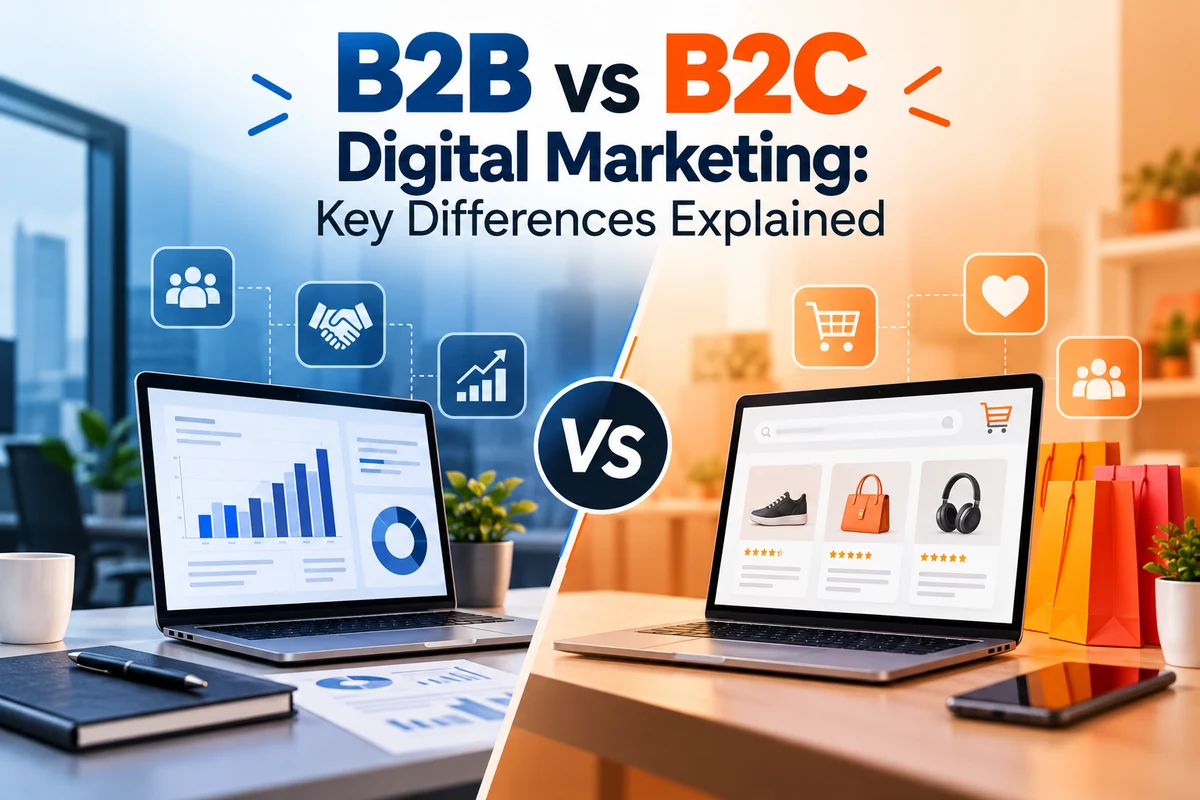
- B2B vs B2C marketing differs in audience, buying behaviour, sales cycles and conversion goals.
- B2B purchases often involve several decision-makers and longer research periods.
- B2C purchases are often faster, but trust, reviews, convenience and price still influence decisions.
- B2B vs B2C digital marketing differences affect SEO, content, social media, email and paid campaigns.
- Search intent should guide channel selection instead of fixed B2B or B2C rules.
- Businesses serving both audiences need separate customer journeys and messaging.
- The right strategy should focus on business outcomes, not traffic alone.
What Is B2B vs B2C Digital Marketing?
B2B stands for business-to-business. It covers businesses that sell products or services to other organisations. Examples include SaaS companies, IT providers, manufacturers, consultants, logistics firms and business service providers.
B2C stands for business-to-consumers. It refers to businesses that sell directly to individual customers. Ecommerce stores, fashion brands, beauty companies, travel businesses and food delivery services are common examples.
The difference seems simple. But it changes how marketing should work.
A B2B buyer may spend weeks researching a solution. They may compare vendors, speak to colleagues, request a product demo, and wait for internal approval. A B2C customer may discover a product, check reviews, and make a purchase within minutes.
LinkedIn explains that B2B buying processes are generally longer and involve multiple steps, while B2C marketing often focuses on encouraging faster purchasing decisions.
Still, marketers should avoid one common mistake. B2B buyers are not purely rational, and B2C buyers are not always driven by emotion.
A B2B buyer is also a person. They care about trust, reputation, ease of use, and reducing risk. The difference is that their purchase also needs to make sense for the business.
That is why B2B vs B2C marketing should be understood through customer behavior, not just business labels.
B2B vs B2C Digital Marketing: What Are the Key Differences?
The main B2B vs B2C digital marketing differences can be seen across the buying process.
| Factor | B2B | B2C |
| Target audience | Businesses and professionals | Individual consumers |
| Decision-makers | Often several people | Usually, one person or household |
| Buying cycle | Usually longer | Often shorter |
| Main concerns | Value, risk, efficiency and ROI | Price, convenience, need and preference |
| Content | Guides, case studies, reports and demos | Videos, reviews, guides and social content |
| Main conversion | Enquiry, lead, demo or consultation | Purchase, signup or download |
| Relationship | Often long-term | Transactional or repeat-based |
| Retention | Renewals, contracts and account growth | Repeat purchases and loyalty |
| Key metrics | Leads, pipeline, CAC and revenue | Conversion rate, AOV, CAC and repeat sales |
These are useful general differences, but they are not strict rules.
For example, a low-cost B2B software product may have a very short buying process. On the other hand, a customer buying a car may spend weeks comparing options.
The better question is: How does the customer make the decision?
That answer should shape the marketing strategy.
Buyer intent is different
A B2B customer often starts with a business problem.
They may search for ways to reduce costs, improve productivity, manage data or solve an operational issue.
A B2C customer may begin with a need, preference or product discovery.
They may search for the best running shoes, compare smartphones or look for a skincare product.
The search terms may be different, but both audiences need useful answers.
How Do B2B and B2C Marketing Strategies Differ?
The channels used by B2B and B2C brands can overlap. The strategy behind those channels is what changes.
1. SEO and search
B2B vs B2C SEO begins with search intent.
A B2B company may target searches around business problems, services, industries and solutions. For example, an organisation may search for “inventory management software” before it ever looks for a particular vendor.
The content needs to educate the buyer and build enough trust to encourage an enquiry.
B2C searches are often closer to products, categories and purchases. A consumer may search for a product, compare alternatives or look for reviews before buying.
This makes B2B vs B2C SEO different in keyword planning, content and conversion goals.
Google Search Central states that SEO helps search engines understand website content and helps users decide whether a site is relevant to their search. It also makes clear that there are no shortcuts that guarantee a first-place ranking.
2. Content marketing
B2B content often needs to support research and evaluation.
Useful formats include:
- Industry guides
- Case studies
- Whitepapers
- Research reports
- Product comparisons
- Webinars
- Product demonstrations
- Expert articles
B2C content often needs to help customers understand and compare products quickly.
Common formats include:
- Product guides
- Reviews
- Short videos
- Buying guides
- FAQs
- Social media content
- User-generated content
The purpose is not to make content longer. It is to make it useful for the decision the customer is trying to make.
3. Social media
B2B brands may use LinkedIn to reach professionals and decision-makers. They can also use webinars, industry communities and thought leadership content.
B2C brands often rely more on consumer-focused social platforms, creators, product videos and promotions.
However, there is no fixed rule.
A B2B brand can perform well on YouTube or Instagram. A B2C company may find LinkedIn useful if its customers are active there.
The right channel depends on where the audience spends time and what they expect from that channel.
4. Email marketing
B2B email marketing often focuses on nurturing.
Someone may download a guide today but not be ready to contact sales. Follow-up emails can provide useful information, case studies and product details before presenting a sales offer.
B2C email can focus more on product launches, discounts, recommendations, abandoned carts and repeat purchases.
In both cases, relevance matters more than frequency.
How Does the B2B vs B2C Customer Journey Differ?
The B2B vs B2C customer journey is another major area of difference.
A typical B2B journey may look like:
Problem → Research → Shortlist → Evaluation → Demo → Internal discussion → Approval → Purchase → Onboarding → Retention
A B2C journey may look like:
Need → Discovery → Comparison → Purchase → Delivery → Review → Repeat purchase
B2B journeys often involve several people.
Imagine a company looking for new cybersecurity software.
An employee may first research providers. The IT team may assess technical features. Finance may review pricing. Procurement may compare contracts. Senior management may approve the final purchase.
The marketing team therefore needs content that answers different questions for different people.
A consumer journey can be shorter, but that does not make it simple.
A shopper may discover a product on social media, visit the website, read reviews, compare prices and leave without buying. A slow website or complicated checkout can be enough to lose the sale.
Match content to each stage
| Stage | B2B approach | B2C approach |
| Awareness | Blogs, guides, research | Social posts, videos, blogs |
| Consideration | Case studies, comparisons, webinars | Reviews, comparisons, buying guides |
| Decision | Demos, consultations, ROI content | Product pages, offers, testimonials |
| Retention | Support, onboarding, account content | Loyalty, recommendations, email |
This is why understanding the B2B vs B2C customer journey should come before selecting content formats.
Which Digital Marketing Strategy Is Right for Your Business?
There is no universal formula for B2B vs B2C marketing.
The right approach starts with the customer.
Identify who makes the decision
Is the buyer an individual, a business owner, a procurement team or a group of department heads?
Knowing this helps determine the message, content and conversion path.
Understand what they search for
Look beyond high-volume keywords.
Find the questions customers ask before they are ready to buy. These searches often reveal their problems, concerns and intent.
This is especially important when planning B2B vs B2C SEO because the same product category can attract very different searches.
Define the real conversion
For B2B, a conversion may be a qualified enquiry, consultation, demo or sales opportunity.
For B2C, it may be a purchase, signup, app download or subscription.
Traffic is useful, but it is not the final goal.
Measure what matters
B2B teams may track:
- Qualified leads
- Cost per lead
- Lead-to-opportunity rate
- Pipeline value
- Customer acquisition cost
- Revenue
- Customer lifetime value
B2C teams may track:
- Conversion rate
- Cost per acquisition
- Average order value
- Cart abandonment
- Repeat purchases
- Customer lifetime value
- Return on ad spend
Businesses that serve both audiences need to be even more careful.
Consider a manufacturer that sells products in bulk to distributors while also selling individual products through an ecommerce website.
The products may be similar. The customers are not.
The distributor may need pricing information, supply details and sales support. The individual customer may care more about product features, reviews, delivery and price.
Using one message for both audiences can weaken the entire campaign.
Instead, create separate journeys while keeping the overall brand consistent.
Choosing the Right Approach for Your Business
The key lesson from B2B vs B2C digital marketing differences is that there is no single strategy that works for every business. B2B marketing often needs more support across research, evaluation and approval, while B2C marketing may need faster discovery, comparison and purchase. Yet both depend on useful content, search visibility, trust, a strong website and a clear customer journey.
At Savit Interactive, we believe marketing should begin with the customer and business goal, not with a fixed list of channels. As a digital marketing company in India, we work across SEO, content, paid media, social media and web design, creating strategies around audience behaviour and measurable business needs. Our experience also covers B2B and ecommerce businesses, where different audiences require different journeys and conversion paths.
Our suggestion is simple: map your customer journey before choosing your marketing channels. Understand what your audience searches for, what stops them from converting and what information they need at every stage. For businesses serving both audiences, build separate paths instead of forcing everyone into one strategy.
When the strategy follows the buyer, B2B vs B2C marketing becomes less about choosing between two formulas and more about creating the right digital experience for the people you want to reach.
FAQs
1. What is the difference between B2B and B2C digital marketing?
B2B digital marketing targets businesses, while B2C digital marketing targets individual consumers. B2B purchases often involve several decisionmakers and longer evaluation periods. B2C purchases are generally faster, although high-value consumer purchases can also involve extensive research.
2. Which digital marketing channels work best for B2B and B2C businesses?
There is no single best channel. B2B businesses may use SEO, LinkedIn, email, webinars and paid search. B2C businesses may use SEO, social media, email, paid search, video and influencer campaigns. The best mix depends on where the audience searches and makes decisions.
3. How is SEO different for B2B and B2C businesses?
B2B vs B2C SEO mainly differs in search intent and conversion goals. B2B SEO often targets business problems, industry searches and solution-focused queries. B2C SEO often focuses on products, categories, comparisons and purchase-related searches.
4. Is B2B marketing more difficult than B2C marketing?
Not necessarily. B2B marketing can involve longer buying cycles and multiple stakeholders. B2C marketing can involve larger audiences, intense competition and the need to make decisions quickly. Both require a clear understanding of the customer.
5. Can a business use both B2B and B2C marketing strategies?
Yes. Some businesses serve both organisations and individual customers. In such cases, separate messaging, content, customer journeys and conversion goals can make the marketing more relevant and effective.