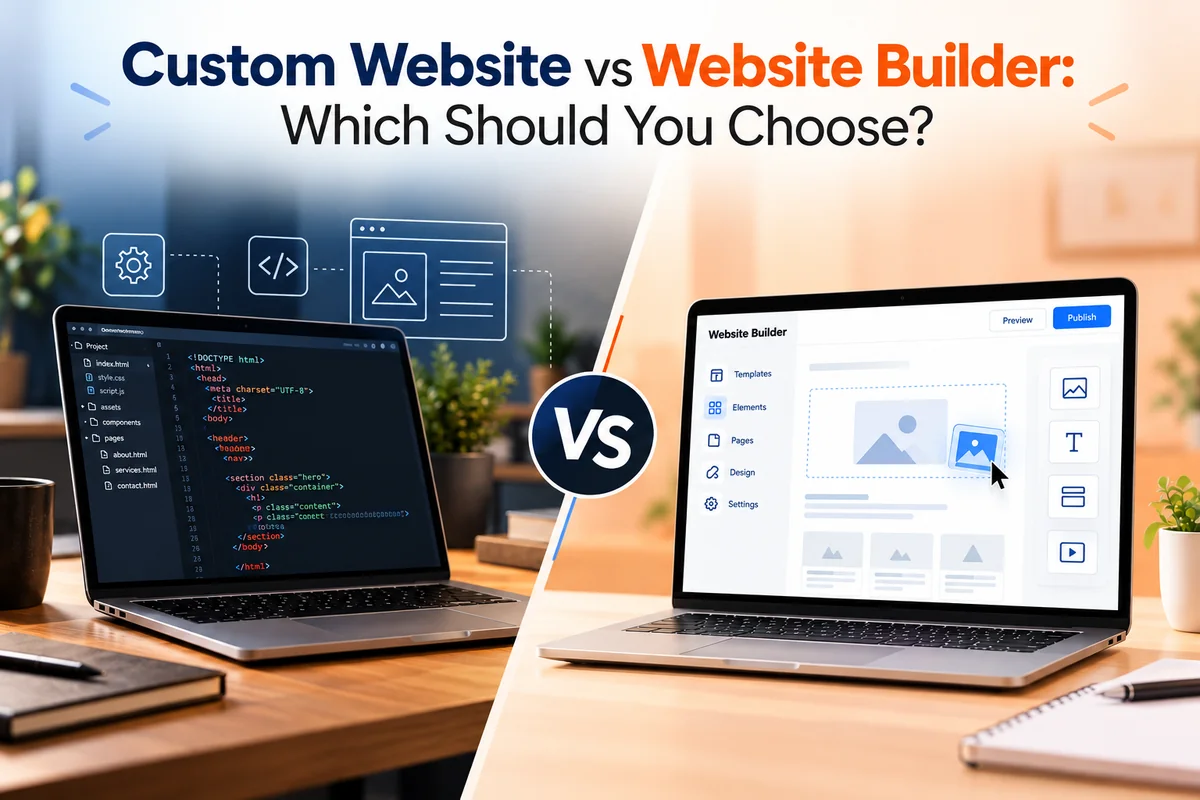
Choosing how to build your website is not only about cost. Your decision can affect design, SEO, performance, maintenance, scalability and how easily your business can grow online.
Key Highlights
- A website builder is usually faster, simpler and less expensive to launch.
- A custom website offers more control over design, functionality and integrations.
- Neither option automatically guarantees better SEO.
- Long-term costs, maintenance and platform restrictions should be considered.
- Small businesses may not need a fully custom website from day one.
- Growing businesses may eventually need more flexibility than a builder can provide.
- A hybrid approach can work when businesses need a balance between speed and customisation.
Custom Website vs Website Builder: What Is the Difference?
Before choosing between the two, it helps to understand what each option actually means.
A website builder is a platform that lets you create a website using pre-designed templates, visual editors and built-in features. You can usually add pages, images, forms, blogs and other sections without writing code.
This makes a website builder useful for people who want to launch a website without depending heavily on developers.
A custom website is developed specifically for a business. The design, page structure, features and integrations can be created around its requirements.
The difference is mainly about control.
With a builder, you work within the features and limits of a platform. With custom development, you have greater control over how the website looks and works.
However, custom does not always mean better.
A five-page local business website may not need expensive custom development. On the other hand, a business with complex product searches, customer accounts, booking systems or CRM integrations may quickly outgrow a standard platform.
It is also useful to separate a custom website from a custom web application. A website mainly provides information and helps visitors take action. A web application can include dashboards, user accounts, databases, complex workflows and other advanced functions.
The right choice starts with understanding what your business actually needs.
Website Builder vs Custom Website: How Do They Compare?
The biggest differences become clearer when you compare both options across the areas that affect a business after launch.
| Factor | Website Builder | Custom Website |
| Initial cost | Usually lower | Usually higher |
| Launch time | Faster | Longer |
| Design flexibility | Limited to platform capabilities | High |
| Technical knowledge | Low to moderate | Higher |
| Maintenance | Usually simpler | Requires more planning |
| SEO control | Depends on platform | Greater technical control |
| Integrations | Built-in or app-based | Can be developed as required |
| Scalability | Depends on platform | More flexible |
| Performance control | Platform-dependent | Greater control |
| Ownership | May depend on platform | Usually greater control |
| Content updates | Easy for non-technical teams | Depends on CMS and setup |
Cost is only one part of the decision
A builder may cost less at the beginning. You may pay a monthly subscription and use existing templates and features.
A custom website usually requires a larger initial investment because designers and developers create the website around your requirements.
But look beyond the first invoice.
Consider hosting, plugins, premium apps, maintenance, redesigns, developer support and feature upgrades. A low-cost platform can become more expensive if you need many paid add-ons.
At the same time, a custom website can also become expensive if the project is poorly planned or requires frequent development work.
The better question is not, “Which one is cheaper?”
It is, “Which option gives my business the right value over the next few years?”
What about SEO?
This is where many comparisons become misleading.
A custom website does not automatically rank better on Google.
Google’s SEO Starter Guide explains that SEO helps search engines crawl, understand and index your content. It does not say that websites built with custom code automatically receive better rankings.
A website builder for business can work well for SEO if it gives you control over important elements such as page titles, URLs, indexing, internal links, structured data and content.
Custom development can provide more technical control, but that control only helps when it is used properly.
So, when comparing both options, ask whether the platform can support your SEO optimization rather than assuming that custom code will solve everything.
Performance matters too
Website speed affects how people experience a site. Google Search Central recommends that websites be secure, fast, accessible and usable across devices.
A builder may include features that make development easier but can also limit how much technical control you have.
Custom development gives developers more control over code, assets, scripts and infrastructure. But poor custom development can still create a slow website.
The goal should always be a fast, stable and easy-to-use website, regardless of the development method.
When Should You Choose a Website Builder?
A website builder for business can be a sensible choice when your requirements are straightforward.
For example, consider a local service provider that needs:
- A home page
- About page
- Services
- Contact form
- Testimonials
- Blog
- Location details
There may be little reason to build every element from scratch.
A builder can help such a business launch quickly and manage everyday updates without waiting for a developer.
It can also be useful for:
- Freelancers
- Consultants
- Small local businesses
- Personal brands
- Portfolio websites
- Early-stage businesses
- Simple service websites
- Small online stores
A builder may be right if you:
Need to launch quickly
Templates and drag-and-drop tools can reduce development time.
Have a limited budget
You can start with essential pages and invest more as the business grows.
Want to manage the website yourself
Content, images and basic page changes can often be handled without coding.
Do not need complex functionality
If your website mainly informs visitors and generates enquiries, a builder may provide everything you need.
But do not choose one only because it is cheap.
Check its SEO controls, export options, integrations, design flexibility, hosting terms and future upgrade costs before committing.
When Is a Custom Website the Better Choice?
A custom website becomes more useful when your website is closely connected to how your business operates.
For example, an ecommerce company may need a complex product experience that does not fit standard templates. A B2B company may need CRM and ERP integrations. A booking business may require a customised booking flow.
These requirements can make a Custom Website vs Website Builder decision much easier.
Custom development may be worth considering when you need:
Unique user experiences
If your customer journey is different from a standard website, custom development can build the experience around that journey.
Advanced integrations
A business may need its website to connect with CRMs, ERPs, payment systems, inventory tools or other software.
Greater scalability
If you expect your website to add new features, markets, products or user types, flexibility becomes more important.
More control over performance
Custom development can give your technical team greater control over code, scripts, hosting and infrastructure.
How to Choose the Right Website Approach for Your Business
There is no universal answer to the Custom Website vs Website Builder question.
Start with your business goals.
Ask yourself:
- How complex does my website need to be?
- How quickly do I need to launch?
- Who will manage the website after launch?
- Do I need custom integrations?
- How important are SEO and organic traffic?
- Will the website need major new features later?
- How much control do I need over design?
- What is my realistic three-year budget?
- Can I move the website if I leave the platform?
- What happens when my business grows?
You can also use a simple rule.
- Choose a website builder if: your requirements are standard, speed matters and your team wants to manage the website easily.
- Choose custom development if: your website needs unique functionality, advanced integrations or greater long-term control.
- Consider a hybrid approach if: you need the simplicity of a platform but also require custom features in selected areas.
Watch for signs that you have outgrown your builder
You may need a different solution when:
- You keep adding paid apps to fill feature gaps.
- Your desired design cannot be created within the platform.
- Your website needs complex integrations.
- Performance problems are becoming difficult to solve.
- Your team needs custom workflows.
- Your website has become central to sales or operations.
- You are repeatedly rebuilding pages to work around platform restrictions.
This does not mean you need to move immediately. A migration also takes planning. But these signs are worth reviewing before investing more money into a platform that may no longer fit.
Think beyond the launch
A website is not finished when it goes live.
It needs content updates, security checks, performance improvements, SEO work and regular testing. Your choice of development approach should make those tasks manageable.
That means your website should be easy to navigate, useful, secure, fast and built around what visitors need.
Making the Right Website Investment
The best choice depends on your business, not on whether one technology is considered more advanced. A website builder for business can be a smart starting point when your needs are simple and you want speed and easy management. A custom website makes more sense when your business needs greater control, unique functionality and room to scale.
At Savit Interactive, we believe we should first understand what a business needs before recommending how its website should be built. We look at the brand, audience, user journey, SEO needs and long-term goals instead of pushing every business towards the same solution. If you are comparing options with a website design company in India, our suggestion is to focus on the website’s long-term role in your business, not just its launch cost. A good website should be easy for your customers to use today and flexible enough to support your growth tomorrow.
FAQs
1. Is a custom website better than a website builder?
Not always. A website builder can be better for simple websites that need to launch quickly. Custom development is more suitable when you need unique functionality, advanced integrations or greater control.
2. Is it cheaper to use a website builder or build a custom website?
A builder usually has a lower upfront cost. A custom website generally costs more initially, but the long-term cost depends on maintenance, features, hosting, integrations and future changes.
3. Which is better for SEO, a custom website or website builder?
Neither automatically wins. A website builder for business can support strong SEO when it provides the right technical controls. Custom development provides more control, but good implementation is what matters.
4. When should a business switch from a website builder to a custom website?
Consider switching when your platform limits important features, integrations, design, performance or future growth. Repeatedly working around platform restrictions is often a sign that your needs have changed.
5. Can I start with a website builder and move to a custom website later?
Yes. Many businesses start with a builder and move to a more flexible solution as their requirements grow. The move should be planned carefully so that important content, URLs, SEO signals and customer data are not unnecessarily lost.