Corporate Website Design Built for Credibility, Compliance, and Growth
Your corporate website is examined by buyers, procurement, legal, and IT before anyone speaks to you. Our corporate website design work covers the whole project, from architecture and secure build to CRM integration and protected migration, so the site earns trust at every level and turns serious interest into enquiries.

Fixed timelines and structured review stages, written into the contract
-
Builds prepared for IT, accessibility and data privacy review
-
CRM and ERP integration handled inside the build
-
Full ownership plus post-launch support
 Get a Free Corporate Website Consultation

Get Your Free Shopify SEO Proposal
Share your Shopify store for a detailed blueprint & strategy →
 WHAT WE DO
Corporate Website Services
Built to Win Business
A corporate website carries more weight than a standard business site. Our corporate website design and development services cover architecture, design, security, integration, migration and handover as one project.
-
 Corporate Website Design and Development
-
 Corporate B2B Website Design
-
 Information Architecture
-
 CMS Setup and Content Governance
-
 Security, Privacy and Compliance-Ready Builds
-
 CRM, ERP and Marketing Stack Integration
-
 Multi-Language, Multi-Location and Multi-Entity Sites
-
 Corporate Website Redesign and Migration
-
 Accessibility and Inclusive Design

Corporate Website Design and Development
Complete corporate website development services for organisations that need their site to carry authority in front of a serious audience. We shape structure, design and messaging around your positioning, then build to standards that hold up when your IT and legal colleagues look closely.
-
 Brand-Led Design.
Design, tone and page flow built around how you want the organisation understood by the people you are trying to persuade. Premium without decoration, so the site reads as confident rather than busy.
-
Conversion-Planned.
Enquiry paths and calls to action placed at each stage of the visitor journey, not only on Contact Us. Whatever page a serious buyer lands on, the next step is obvious.
-
Scalable Structure.
Architecture planned for the divisions, services and regions you will add over the next three years, not only what exists at launch. Growth does not force a rebuild.
-
Fast by Design.
Clean code, controlled asset usage and Core Web Vitals attention from the first sprint. Speed is engineered in, not patched on late.

Corporate B2B Website Design
Purpose-built work from a B2B website design company that understands how enterprise sales actually happen. Gartner puts the share of the B2B purchase journey buyers spend with suppliers at 17%, which means your website is doing most of the persuasion while your sales team waits to be contacted.
-
Every Decision Maker.
Technical evaluators, finance approvers and business sponsors each want different things from the page. We plan pages for all of them rather than writing to one and hoping.
-
Proof Architecture.
Case studies, certifications, client logos and technical documentation placed exactly where doubt tends to arise. Credibility is findable at the moment it is needed, not filed under About Us.
-
Specification Depth.
Product and service pages carrying the detail an engineer wants without losing a generalist reader. Two audiences served by one page.
-
Qualified Leads.
Enquiry forms designed to tell your sales team who is worth calling first. Fewer enquiries, considerably better ones.

Information Architecture
Most corporate websites fail on structure long before they fail on design. When you work with a corporate web design agency that has organised sites for multi-division businesses for 20 years, architecture is where the real value is created.
-
Content Audit.
Every existing page reviewed and classified as keep, rewrite or retire, with recommendations you can act on. You see the full picture before major decisions are made.
-
Clear Navigation.
Divisions, subsidiaries, product lines and service verticals mapped so visitors reach the right page quickly. Complexity lives in the structure, not in the visitor's head.
-
Search-Ready Hierarchy.
URL structure, heading levels and internal linking planned for people and crawlers together, because search visibility is an architecture decision before it is anything else.
-
Signed Off Early.
Structure is approved before design work begins. Late structural change is the most expensive change there is, and we do not build it in.
CMS Setup and Content Governance
A corporate website is only as strong as your team's ability to keep it current. We configure the CMS so several departments can publish safely and independently without interfering with each other.
-
Role-Based Access.
Each team edits what it owns and nothing else. Marketing, HR and investor relations work in parallel without collision or accidental changes.
-
Approval Workflows.
Draft, review and publish stages configured to match how your organisation already signs things off. Nothing goes live without the approvals it needs.
-
Editor-Safe Templates.
Page templates built so a non-technical editor can add content without breaking layouts. Your team is not held hostage by a developer for routine updates.
-
Training and Documentation.
Hands-on sessions plus written guidance for the people who will actually use the CMS. We would rather you were self-sufficient than reliant on us for small changes.

Security, Privacy and Compliance-Ready Builds
Corporate projects get reviewed by people who were not in the design meetings, and the questions they ask are technical. We build so that review is straightforward instead of adversarial.
-
Hardened Build.
Protected admin access, secure form handling, SSL, controlled release processes and locked-down backend areas. Standard practice on every corporate build we deliver.
-
Privacy Mechanics.
Under India's Digital Personal Data Protection Act and the DPDP Rules, organisations handling personal data carry obligations around consent, notice, retention and breach readiness. We build the website mechanics that support those obligations, working to the brief your legal team sets. Determining what the law requires of your organisation is a matter for your counsel.
-
Review-Ready.
Documentation, access controls and hosting decisions prepared so your IT team can assess the build without a long back-and-forth. Assessment, not interrogation.
-
Ongoing Upkeep.
Patching, monitoring and backup routines available after launch, so the security position holds well past go-live rather than degrading quietly.

CRM, ERP and Marketing Stack Integration
An enquiry sitting in an inbox is a lost enquiry. We connect the website into the systems your teams already work in, so every submission arrives where somebody will act on it, with the context sales needs.
-
CRM Connected.
Enquiries routed into your CRM with source, campaign and page attribution attached. Sales knows exactly where the lead came from, and marketing can measure what actually worked.
-
Internal Systems.
Secure API connections where the website needs to read from or write to your ERP, PIM or other internal systems. No manual exports, no double entry.
-
Stack Configured.
Analytics, tag management, Search Console and marketing automation set up correctly at launch. Not left to be bolted on in month three when someone remembers.
-
Smart Routing.
Rules that send each enquiry to the right team by region, division or service line. Response times improve immediately, because nothing waits for a human to forward it.

Multi-Language, Multi-Location and Multi-Entity Sites
Group structures, regional operations and language requirements need planning at architecture stage. Retrofitting them is expensive and it usually shows on the finished site. As a corporate web design company in India working with group businesses, we plan the full picture from the outset.
-
Group Structures.
Parent, subsidiaries and divisions organised with clear relationships and consistent branding, without turning the site into a maze the visitor has to solve.
-
Language Versions.
Correct hreflang handling so each language version reaches the right audience and gets indexed properly. Built right the first time, not corrected after.
-
Location Pages.
Regional offices, plants, showrooms and service territories presented with the local detail that matters. Connected into one coherent site rather than sitting in silos.
-
Central Governance, Local Control.
Regional teams manage their own content inside a framework that protects brand and structure at group level. Autonomy without drift.

Accessibility and Inclusive Design
Accessibility has moved from optional consideration to procurement requirement, particularly for listed companies, regulated sectors and organisations working with government. We build with WCAG guidelines as the reference standard from day one.
-
Designed In.
Colour contrast, text sizing, focus states and touch targets checked against recognised guidelines during design, rather than corrected after build when it is expensive.
-
Keyboard and Screen Reader.
Navigation, forms and interactive elements built to work without a mouse and to be read correctly by assistive technology. Real accessibility, not a checkbox.
-
Accessible Structure.
Proper heading hierarchy, descriptive link text, alt text and clearly labelled forms. Good accessibility practice also improves search readability, which is a useful side effect.
-
Documented.
Pre-launch accessibility checks with findings documented, so your team has a record when procurement or an internal audit asks for one.

Corporate Website Redesign and Migration
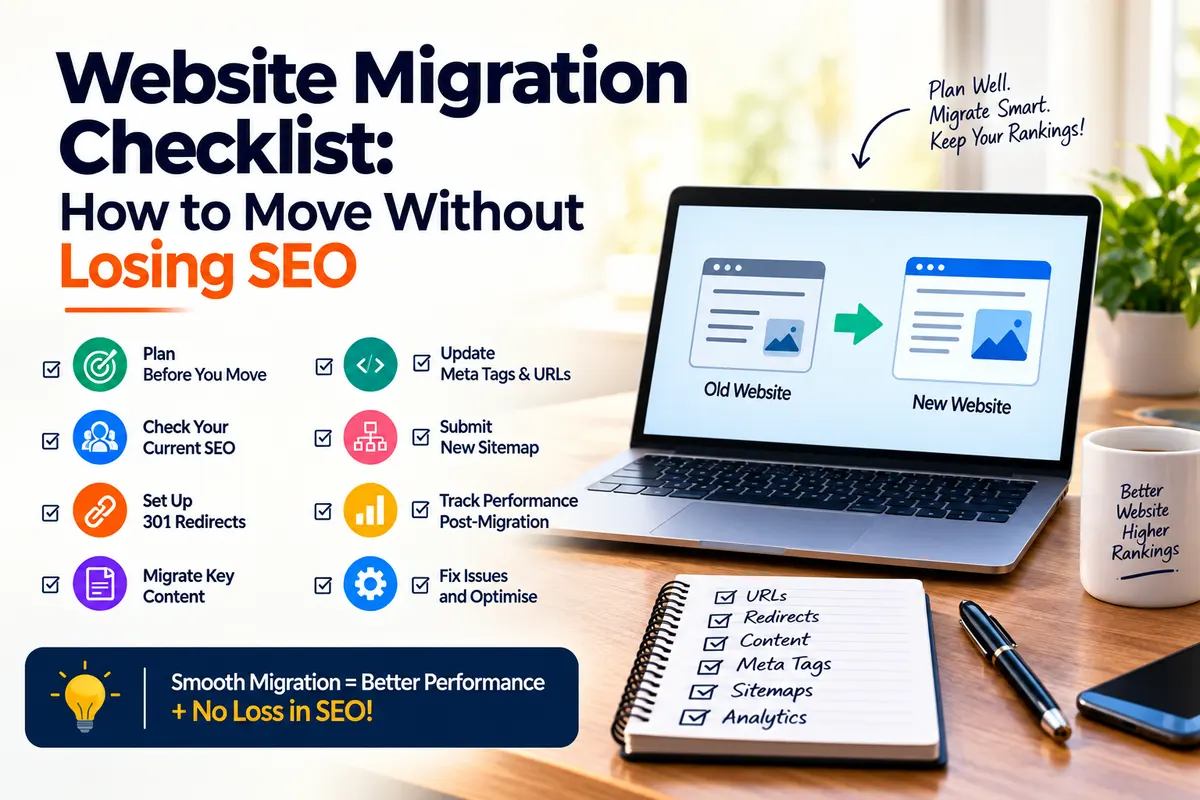
An established corporate website carries search visibility built over years. Protecting it through a rebuild is the most important technical job on the project, and our in-house search team owns it end to end.
-
Pre-Migration Audit.
Every URL, ranking page, backlink and internal link mapped before anything changes. You know exactly what is at stake before the first line of new code is written.
-
Redirects, Individually Mapped.
Every changed URL receives a planned redirect, reviewed before launch and verified after. No catch-all rules pointing your entire history at the homepage.
-
Phased or Single Cutover.
Larger sites migrate in stages to reduce risk, mid-sized sites move in one controlled cutover. We recommend what your traffic and content justify rather than defaulting to one approach.
-
Watched After Launch.
Rankings, indexation, crawl errors and traffic tracked closely through the weeks after launch. Anything unexpected is caught early rather than discovered in month three.
WHY IT MATTERS
What Makes a Corporate Website Perform
Most of a corporate decision is made before anyone contacts you. Buyers research quietly, build a shortlist and agree requirements internally, which gives your website the whole of that stretch to work in your favour. Clear structure, findable proof, fast pages and an obvious enquiry path are what turn that opportunity into pipeline. Those fundamentals are where we concentrate, because they are the highest-return work on any corporate site.
17%
Most of the Journey Happens Before Sales
Buyers spend just 17% of the B2B purchase journey interacting with suppliers.
81%
Preference Forms Early
81% of buyers have a preferred vendor before speaking to a supplier.
6 to 10
You’re Selling to a Committee
A typical B2B buying group involves 6 to 10 decision-makers.
10.2
Buyers Move Across Channels
B2B buyers use an average of 10.2 channels during the purchase journey.
Problem We Solve
Four Gaps That Hold
Corporate Websites Back, and How We Close Them
These are the four issues we see repeatedly on corporate websites, and the fixes that follow. None of them require starting over, and each one makes a measurable difference to how the site performs for the business.
1
The Site Presents the Company but Never Qualifies the Buyer
Problem: The website explains what the organisation does thoroughly, then leaves a serious buyer with nowhere obvious to go. Information is plentiful, decision support is thin, and enquiries come mainly from people who were already going to call.
How We Fix It: We build decision support into the structure: comparison content, case studies placed where they answer a live doubt, specification detail for technical evaluators, and enquiry paths on every relevant page. The site starts doing sales work rather than only presenting information.
2
Internal Review Cycles Stall the Project
Problem: Corporate projects involve many stakeholders with different priorities. Without a defined process, feedback arrives from several directions at once, decisions get reopened, and the timeline slips while scope grows.
How We Fix It: We map stakeholders and approval routes in week one, identify a single decision owner, then work through structured review gates with one consolidated feedback round each. Architecture is signed off before design, and design before development, so late changes stay rare and the launch date holds.
3
The Redesign Loses the Search Visibility You Built Over Years
Problem: A rebuild changes structure, URLs and content. Without careful planning, redirects get missed and ranking pages disappear, and organic traffic drops in the weeks after launch, exactly when the new site should be proving itself.
How We Fix It: Our search team audits the existing site before anything changes, maps every URL and ranking page, plans redirects individually and monitors closely afterwards. Corporate website design and development and technical SEO sit inside one team here, which is why migration is a planned step rather than a hopeful one.
4
Your Team Cannot Update the Site Without Raising a Ticket
Problem: The CMS is handed over without roles, workflows or training. Within a year the site has ossified, content is out of date, and every small change becomes a request to an external developer at their pace, not yours.
How We Fix It: We configure role-based permissions, approval workflows and editor-safe templates, then train the people who will use them. You own the site, the access and the files, and you can run it without us.
Industries We Design For
Corporate Websites Built for Your Sector
Every sector evaluates differently. We shape each corporate website around how buying decisions get made in your market, drawing on 20 years across a wide range of industries.

Manufacturing and Industrial
Capability catalogues, plant detail, certifications and the specification depth engineering buyers expect.
Businesses We Serve
- Manufacturers
- Industrial equipment suppliers
- Engineering firms
- OEM and component suppliers

Financial and Professional Services
Leadership credibility, service depth, regulatory content handling and secure enquiry routes.
Businesses We Serve
- Financial services firms
- Consulting practices
- Legal and audit firms
- Insurance and advisory

Healthcare and Pharmaceutical
Research, product, facility and compliance content structured for professional and public audiences alike.
Businesses We Serve
- Hospital groups
- Pharmaceutical companies
- Medical device manufacturers
- Diagnostic chains

Technology and SaaS
Product architecture, integration documentation, security detail and proof built for technical evaluators.
Businesses We Serve
- SaaS companies
- IT services firms
- Technology product businesses
- Enterprise software providers

Infrastructure and Real Estate
Project portfolios, capability credentials, location detail and investor-facing content with the authority these decisions need.
Businesses We Serve
- Infrastructure companies
- Real estate developers
- Construction groups
- Property investment firms

Education
Programme structure, admissions journeys, faculty credibility and multi-campus organisation.
Businesses We Serve
- Universities and institutes
- School groups
- Ed-tech companies
- Training organisations
Logistics and Supply Chain
Network clarity, coverage detail, capability proof and enquiry routes that suit enterprise and mid-market buyers.
Businesses We Serve
- Logistics providers
- Freight and shipping
- Warehousing businesses
- Supply chain services
Small Business Website Design
Practical, high-quality websites built for businesses that need a stronger online presence, easier management, and a clearer path to local enquiries and customer trust.
Businesses We Serve
- Services
- Retail
- Professional practices
HOW WE WORK
A Corporate Website Design Process That Keeps Your Project Moving
01
Business Goals, Stakeholder Mapping and Requirements
We start with what the website has to achieve commercially, then map every stakeholder whose approval the project needs and gather requirements from each of them, including IT, legal and brand. Getting these on the table in week one is what stops them arriving as objections in week ten.
02
Content Audit and Information Architecture
We audit the existing site page by page, then design the new sitemap, navigation logic, URL structure and page hierarchy. All of it is agreed and signed off before any design work begins.
03
Technical and Security Requirements Review
We work through hosting, access control, form handling, integrations, privacy mechanics and accessibility with your technical and legal colleagues. This is where a corporate project either prepares properly for its review or quietly stores up trouble for later.
04
Wireframes and Structured Review
Page-level wireframes establish content order, hierarchy and conversion paths before any visual design begins. Reviewing structure separately from aesthetics is what keeps feedback focused and revision rounds short.
05
Visual Design and Brand Alignment
Key templates are designed in Figma, aligned to your brand and positioning, and shared for collaborative review and comment. Your team can see, mark up and approve directly, and the files are handed over for future work.
06
Development and Integration
Front-end and back-end build, CMS configuration, template creation, and integration with your CRM, ERP and marketing stack. Performance and clean code are handled during build rather than pushed to a final optimisation pass.
07
SEO, Migration and Redirect Planning
Technical SEO setup including schema, sitemap, canonicals and heading structure, plus the individually mapped redirect for every URL that changes. Our search team owns this stage, which is why migration risk stays controlled rather than accepted.
08
Testing, Accessibility and Pre-Launch Review
Cross-browser and cross-device testing, form and integration verification, accessibility checks, performance testing and a final pass against the stage 03 requirements. Everything documented for your internal sign-off.
09
Launch, Handover, Training and Support
Controlled launch with post-launch monitoring of rankings, indexation and performance. You receive ownership, admin access, project files, CMS training and 12 months of post-launch support included with every project.
TECHNOLOGY WE BUILD ON
The Technology We Build On
We recommend the stack that fits your content, team and growth plans. No platform suits every corporate website, and we would rather say so than sell what we prefer to build.
CMS Platforms
WordPress, Drupal, Webflow and custom content management.
When we use it:
On every corporate build. The choice follows your content model and your team's capability.
Frontend
React, Next.js and standards-based HTML, CSS and JavaScript builds.
When we use it:
Where interactivity or speed needs more than a traditional template delivers.
Backend
PHP, Node.js, Laravel and custom backend development.
When we use it:
Whenever the site must talk to another system or handle logic beyond page delivery.
Integration Layer
Secure API connections to CRM, ERP, marketing automation and analytics tools.
When we use it:
Where enquiries, data or content move between the website and internal systems.
Hosting and Infrastructure
Managed hosting, CDN, SSL, staging environments and backup routines.
When we use it:
Specified at stage 03 so your IT team approves the environment before build.
Design Tools
All design produced and shared in Figma.
When we use it:
On every project. Files are handed over, so future updates never start from scratch.
Why Savit
20 Years. 5,000+ Projects.
One Team.
Choosing a corporate website design company usually means choosing between two partial answers: a design agency that cannot handle integrations or a security review, or an IT firm that handles both and delivers something nobody wants to look at. We cover the whole project.
| What You Are Comparing | Savit | Design-Led Agency | IT Services Firm |
|---|---|---|---|
| Project start | Goals and stakeholders, week one | Creative brief | Technical requirements |
| Architecture | Audited and signed off before design | Designed page by page | Inherited from the old site |
| IT and security review | Requirements set at stage 03, documented | Subcontracted or client-handled | A core strength |
| Privacy mechanics | Built to your legal team's brief | Rarely in scope | Capable, usually a separate workstream |
| Design quality | Brand-led, reviewed in Figma | Their core strength | Often the weakest deliverable |
| CRM and ERP | Built in-house with lead routing | Outsourced | A core strength |
| Migration and SEO | Owned by our in-house search team | Often out of scope | Treated as redirects, not SEO |
| CMS governance | Permissions, workflows and training | Basic orientation | Admin access, limited editorial planning |
| Post-launch | 12 months included | Short warranty | Priced as a separate contract |
| What you own | Site, access and project files | Varies by agreement | Site, codebase and documentation |
See Our Thinking Before You Commit
Share your brief and a few reference sites. We will design a homepage mockup within 24 hours, free and with no obligation.
Pricing
Corporate Website Pricing, Made Clear
Corporate pricing follows scope, not page count. What moves the figure is structure complexity, integrations, language and location needs, content volume, and the depth of technical review your organisation requires. Every quote is fixed and scope-led, with 12 months of support included and no additions later.
Proven Results
Websites We Built.
Business They Delivered.
Corporate projects with measurable outcomes, drawn from Analytics and Search Console.
Boheco
Challenges
- Strong competition is dominating organic traffic and top keyword rankings.
- Limited flexibility due to compliance restrictions and approval dependencies.
SEO Approach
- Executed technical and on-page optimization, including metadata, schema, and indexing improvements.
- Optimized content with high-intent keyword targeting and search intent alignment.
- Strengthened internal linking and site structure to improve rankings and organic performance.
~2.41X Growth
(8.2K → 19.8K)Organic Sessions
~1.73X Growth
(8.6K → 14.9K)Clicks
~1.65X Growth
(55 → 91)Keyword Rankings
Clients Reviews
What Corporate Clients Say
Marketing, communications and IT teams who have run website projects with us.


Amar Equipment Pvt. Ltd.
“Savit Interactive has been managing SEO for Amar Equipment Pvt Ltd for the past year, and we’ve seen good progress in keyword rankings and organic enquiries. After limited success with PPC earlier, we also engaged them for Google Ads, and within a couple of months, we started seeing positive results. Special thanks to Akshay Kabre for managing the Google Ads account efficiently. The team is professional, responsive, and easy to work with.”
National academy
We've had a great association with Savit. We have see better visibility, higher quality leads and efficient campaigns. Great experience working with Akshay for PPC and Sonam for SEO. Would definitely recommend.

Ankita Gupta
We have been working with Savit Interactive for our Google Ads campaigns, and the experience has been good overall. Our point of contact, Palak, is very approachable, responsive, and easy to coordinate with. The team is supportive and professional, always ready to assist with our queries. There is still some scope for improvement in their campaign strategies and optimization approaches, but overall, it has been a positive experience working with them.
Kashish Chaudhari
We’ve been working with Savit Interactive for our Website, SEO, and PPC management, and their services have been truly impressive. The team is professional, responsive, and always available whenever needed. A special mention to Akshay for efficiently handling our PPC campaigns and ensuring great results. Their consistent support and expertise have significantly enhanced our online presence. Highly recommended!
Mihir Vaze
We are using their services for our website and are a good trusted company which gives good SEO results. I would highly recommend using them.
Dr.Santosh Jaiswar
As a healthcare professional in Mumbai, I understand the importance of having a strong online presence. I was searching for an SEO company in Mumbai that could provide tailored services for my medical practice, and Savit exceeded my expectations.
Corporate Website Design Questions, Answered
What corporate teams ask us most, covering cost, process, technical review, migration and working with us.


 Blogs /
Insights
Blogs /
Insights