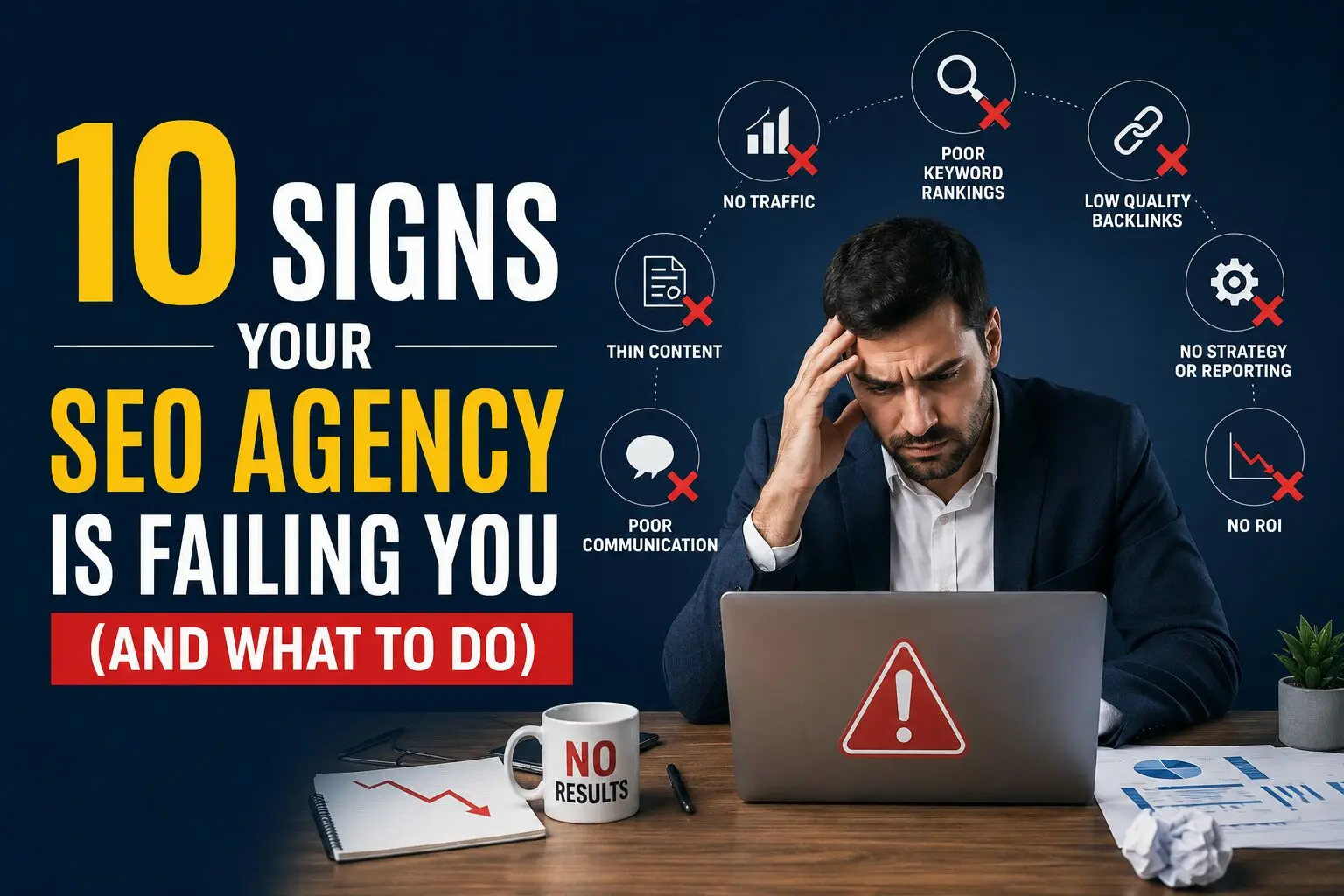
You signed the contract with optimism. The presentation was polished. The team seemed credible.
Months later, the invoices clear on schedule. The monthly report arrives in your inbox. But your rankings haven’t moved, organic enquiries are flat, and nobody from the agency has called to discuss either of those facts.
You’re not sure whether this is how SEO always feels, or whether something is genuinely wrong.
This guide helps you tell the difference.
When hiring an SEO agency, most business owners hand over the account precisely because they lack the in-house expertise to run it themselves. That’s a perfectly reasonable decision. The problem is that the same knowledge gap that drives you to seek outside help is the exact gap where a failing or dishonest agency conceals its shortcomings.
The scale of the problem is not trivial. Backlinko, in its SEO Services Report, found that 65% of businesses have worked with two or more SEO providers. Before committing to any new relationship, checking independent SEO agency reviews is sensible, but many businesses only encounter the red flags after the contract is already signed. The ten signs below are the patterns that appear most consistently before a business finally makes a switch.
What Are the Signs That Tell Whether an SEO Agency is Failing?
The warning signs are rarely dramatic. They don’t announce themselves. They appear gradually, as vague reports, evasive replies, and a slow erosion of the confidence you had at the start. If several of the following apply to your current engagement, the question isn’t whether something is wrong. It’s how quickly you act on it.
1. They guaranteed you a specific ranking on Google
No agency in the world can guarantee a specific position in Google’s search results, because no agency controls the algorithm. Google itself, in its published Search Central guidance, explicitly warns businesses to be cautious of any SEO provider that promises guaranteed rankings, stating directly that no one can promise a number one position on Google.
Guaranteed results often come paired with implausibly low SEO agency pricing, which compounds the risk. What typically follows a guarantee is one of two things: tactics that produce short-term ranking movement and long-term penalties, or a promise that quietly disappears from all future conversations. Either way, the business carries the consequences. If a first-page guarantee was the thing that persuaded you to sign, it is worth revisiting everything else promised in that same pitch.
2. Your Google accounts belong to the agency, not to you
Your Google Analytics 4, Search Console, and Google Business Profile should be registered in your business’s name. The agency should be granted partner-level access, not account ownership.
When an agency holds the primary accounts, they hold your data, your performance history, and your leverage if the relationship ends badly. This happens more than it should, particularly with smaller providers who set everything up on their own accounts for convenience at the outset. The practical consequence is significant: leaving the relationship without ownership of those accounts means losing months or years of performance history that any new provider would need. Your business’s digital assets belong to your business. That principle is not negotiable.
3. The monthly report is long, but answers nothing useful
A report that fills pages with submission counts, keyword position tables, and task completion logs, while containing nothing about traffic trends, lead volumes, or conversion data, is performing the appearance of transparency rather than delivering it.
A legitimate SEO agency service connects its monthly activity to business outcomes. How did organic traffic change? How many enquiries came through search? Which pages are driving qualified visits, and which are simply ranking for terms that bring no one relevant? If you cannot answer those questions after reading the report, it has been structured to look thorough rather than to inform. A simple test: ask your agency to include revenue and lead data alongside rankings in the next report. How that request is received tells you something important about how the account has been managed.
4. You don’t know where your backlinks are coming from
Backlinks remain a significant ranking signal, and they are also the area most frequently misrepresented in agency reporting. If your monthly updates mention link-building activity but offer only a selective sample of placements rather than a full, itemised list, that gap is rarely accidental.
Bulk link promises deserve immediate scrutiny. “300 backlinks per month” sounds like output, but Google’s Penguin updates made mass, low-quality link placements a liability many years ago. One editorial link from a relevant, authoritative publication carries considerably more weight than hundreds of directory submissions. If you haven’t recently reviewed your backlink profile through Search Console or a third-party tool, it’s worth doing. Some of what has been built in your name may surprise you.
5. The content on your site is thin, generic, or produced in bulk without real research
Re-spun articles were an SEO shortcut in 2015. Unedited, bulk-generated content is the 2026 version of the same problem. Google’s Helpful Content guidelines are now explicit on this point: content that lacks genuine expertise, specific insight, and measurable usefulness does not simply fail to rank. It pulls down the quality signals across your entire domain.
If the blogs appearing under your brand could belong to any business in any industry, if there are no original arguments, no industry-specific detail, no evident depth of knowledge, those pages are working against you. Producing quality content is slow and expensive. If your agency is publishing several posts a week at a notably low monthly cost, that mismatch in economics is worth examining closely.
6. Communication drops off when results are flat
A capable agency is most transparent when performance is difficult. Algorithm updates that affect your rankings, keyword targets that prove harder than anticipated, traffic fluctuations that need explaining: these are the moments that separate an engaged team from one that is hoping you won’t notice.
An agency that goes quiet after a flat month, or responds to direct questions with reassurances rather than data, is managing its own discomfort rather than your campaign. The pattern most commonly reported: a senior specialist wins the account, communicates well in the early weeks, and is then replaced by a junior who is rarely reachable. If this describes your experience, it is not a personality issue. It is a structural one, and it reflects how the account is valued.
7. A ranking drop or penalty happened and your agency didn’t flag it
If you discovered a significant traffic drop or an indexing problem in GA4 before your agency mentioned it, the account is not being actively monitored.
Professional account management includes alerts for the events most likely to cause real harm: manual actions in Search Console, significant organic traffic drops, Core Web Vitals failures, and crawl anomalies. These are not advanced interventions. They are standard practice for any competent SEO team managing a live account. Finding out three weeks after the fact that your site received a Google manual action, because you spotted the traffic cliff yourself, is precise and objective evidence of inattentiveness. It cannot be explained away as an oversight.
8. Every conversation ends with a new upsell
Good agencies recommend additional services when the data justifies it. There is a clear distinction, though, between a timely strategic suggestion backed by performance evidence and a recurring pitch for new packages while existing fundamentals remain broken.
If core rankings are flat, technical issues are outstanding, and content quality hasn’t improved, but every call somehow produces a proposal for social media management, a paid advertising trial, or a video content upgrade, the agency is growing its invoice rather than your campaign. A team that has your interests in mind addresses what is underperforming before recommending anything new to layer on top of it.
9. The strategy in 2026 looks the same as the strategy in 2020
Google AI Overviews now appear across a material proportion of search queries. Answer engines, large language models, and AI-powered discovery platforms represent a growing share of how people find information online. The content that gets cited in those surfaces, and the authority and E-E-A-T signals that influence that selection, looks different from the content that simply ranked for a keyword five years ago.
An agency running an unchanged playbook of keyword targeting and link volume, with no consideration of how to structure content for AI Overview visibility, no discussion of topical authority building, and no recognition of how search intent has shifted, is working in a landscape that has moved on without it. Ask your agency directly: how are you adapting our content strategy for AI-powered search? A vague or blank response to that question is its own answer.
10. They have suggested tactics you felt uncomfortable with
Trust that discomfort. If your agency has ever recommended purchasing links from a known network, generating reviews that are not genuine, using hidden text, cloaking, or deploying any tactic they described as “a shortcut the others don’t use,” these are not grey areas.
Black-hat practices can produce visible short-term ranking movement. They also carry the risk of a Google manual penalty or an algorithmic demotion that can take six months to a year to recover from, if full recovery is possible at all. The business does not simply lose rankings. It loses the enquiries and the revenue those rankings were generating. Any provider that proposes such methods, or hints that they have access to approaches that ethical agencies have ruled out, should not be given a second conversation.
What to Do When You Spot These Signs
Identifying the problem is step one. Acting on it without creating unnecessary disruption takes a deliberate sequence.
Step 1: Confront the agency directly, in writing, with specific questions
Start with specifics, not general dissatisfaction. Send a written request (email creates a verifiable record) covering the following:
- The complete backlink list for the past six months, including domain names and authority metrics
- Traffic and lead data to accompany the keyword position reports already being provided
- A clear month-by-month breakdown of the work actually completed on your account
- Written confirmation of who currently holds primary account ownership for each Google property
A capable SEO agency service responds to these questions with data, promptly and without defensiveness. Evasion, delays, or hostility at this stage is not a communication failure. It is a data point about the health of the engagement and how it has been managed. Document everything said in response. Put the exchange in writing.
Step 2: Commission an independent audit before making a decision
Acting on suspicion alone risks confusing a genuinely difficult market for a genuinely failing agency. Get an objective view from credible SEO experts with no stake in the outcome. A proper independent audit covers the technical condition of your site, the quality and relevance of links built in your name, the content quality signals across your domain, and whether any penalties or indexing problems have been missed.
When evaluating replacements, read SEO agency reviews on independent platforms: Google, Clutch, and DesignRush surface consistent patterns across multiple clients in a way that a curated portfolio cannot replicate. When hiring an SEO agency as a replacement, the standard of due diligence required is considerably higher than the first time, because the stakes of getting it wrong again are now clearer.
Step 3: If you exit, protect your business before you announce it
On the day you formally end the relationship, take these steps in order:
- Reset passwords and revoke agency access for Google Analytics, Search Console, and Google Business Profile
- Confirm that primary account ownership sits with your business across all platforms
- Revoke access to your CMS, hosting panel, and any domain email accounts the agency could reach
- Download and archive all historical performance reports, ranking data, and content exports
- Confirm ownership of all deliverables, creative assets, and domain registrations your business paid for
When comparing SEO agency pricing from potential replacements, evaluate on the basis of scope, transparency, and documented outcomes from past clients. The monthly fee is not the differentiator. What the fee buys in terms of process, communication, and accountability is.
A poorly managed SEO relationship is recoverable. Exiting it with your data intact, your accounts secured, and your next steps clear is a practical and entirely normal business decision.
What Good SEO Looks Like, and Where to Find It
As an SEO agency in Mumbai with over two decades of experience, Savit Interactive hears the same thing from most businesses that arrive after a difficult previous relationship: nobody explained what was being done, why it was being done, or how to measure whether it was working.
That is the gap our process is built to close.
Every client we work with retains full ownership of their Google Analytics, Search Console, and Business Profile from day one. Monthly reports include traffic figures, lead data, conversion tracking, and ranking movement, structured around what the business actually needs to understand, not what makes the agency look active. Our seven-step SEO process is shared with every client at the start of the engagement. The work is never opaque, the rationale is always available, and the team working on your account is the team you speak to.
We do not make guaranteed ranking promises because we will not make promises we cannot keep. Our SEO experts track how search is changing, including the AI-driven surfaces that increasingly shape how content is discovered and cited, and strategies are adapted accordingly. Clean practices, honest communication, and reporting tied to real business outcomes are not differentiators for us. They are the baseline.
If you are evaluating your options, whether you are based in Mumbai, operating across India, or looking to work with a reliable SEO agency in Mumbai from anywhere in the world, we would be glad to start with a straightforward conversation. Talk to our team and let us show you what a transparent, outcome-focused SEO engagement actually looks like.
Footnotes and References
- Backlinko, The SEO Services Report: Cited for the finding that 65% of businesses have worked with two or more SEO providers. The same report found that clients spending less than $500 per month were 75% more likely to report dissatisfaction than those investing more. Primary source: backlinko.com/seo-services-statistics
- Google Search Central, Hiring an SEO: Google’s own published guidance warns businesses explicitly against providers who promise specific ranking positions, stating that no one can guarantee a number one position on Google. Source: developers.google.com/search/docs/fundamentals/do-i-need-seo
- Red-flag patterns and structural cross-referencing sourced from: WebFX (9 Signs of a Bad SEO Agency, webfx.com); RankPa (19 Red Flags of a Bad SEO Agency, rankpa.com, February 2026); DubSEO (Is Your SEO Agency Failing You? 7 Warning Signs, dubseo.co.uk, March 2026); Search Scale AI (SEO Agency Red Flags: 12 Warning Signs, searchscaleai.com, April 2026); Minutehack (10 Signs You Can’t Trust Your SEO Agency, minutehack.com, 2015).
You signed the contract with optimism. The presentation was polished. The team seemed credible.
Months later, the invoices clear on schedule. The monthly report arrives in your inbox. But your rankings haven’t moved, organic enquiries are flat, and nobody from the agency has called to discuss either of those facts.
You’re not sure whether this is how SEO always feels, or whether something is genuinely wrong.
This guide helps you tell the difference.
When hiring an SEO agency, most business owners hand over the account precisely because they lack the in-house expertise to run it themselves. That’s a perfectly reasonable decision. The problem is that the same knowledge gap that drives you to seek outside help is the exact gap where a failing or dishonest agency conceals its shortcomings.
The scale of the problem is not trivial. Backlinko, in its SEO Services Report, found that 65% of businesses have worked with two or more SEO providers. Before committing to any new relationship, checking independent SEO agency reviews is sensible, but many businesses only encounter the red flags after the contract is already signed. The ten signs below are the patterns that appear most consistently before a business finally makes a switch.
What Are the Signs That Tell Whether an SEO Agency is Failing?
The warning signs are rarely dramatic. They don’t announce themselves. They appear gradually, as vague reports, evasive replies, and a slow erosion of the confidence you had at the start. If several of the following apply to your current engagement, the question isn’t whether something is wrong. It’s how quickly you act on it.
1. They guaranteed you a specific ranking on Google
Guaranteed results often come paired with implausibly low SEO agency pricing, which compounds the risk. What typically follows a guarantee is one of two things: tactics that produce short-term ranking movement and long-term penalties, or a promise that quietly disappears from all future conversations. Either way, the business carries the consequences. If a first-page guarantee was the thing that persuaded you to sign, it is worth revisiting everything else promised in that same pitch.
2. Your Google accounts belong to the agency, not to you
No agency in the world can guarantee a specific position in Google’s search results, because no agency controls the algorithm. Google itself, in its published Search Central guidance, explicitly warns businesses to be cautious of any SEO provider that promises guaranteed rankings, stating directly that no one can promise a number one position on Google.
Your Google Analytics 4, Search Console, and Google Business Profile should be registered in your business’s name. The agency should be granted partner-level access, not account ownership.
When an agency holds the primary accounts, they hold your data, your performance history, and your leverage if the relationship ends badly. This happens more than it should, particularly with smaller providers who set everything up on their own accounts for convenience at the outset. The practical consequence is significant: leaving the relationship without ownership of those accounts means losing months or years of performance history that any new provider would need. Your business’s digital assets belong to your business. That principle is not negotiable.
3. The monthly report is long, but answers nothing useful
A report that fills pages with submission counts, keyword position tables, and task completion logs, while containing nothing about traffic trends, lead volumes, or conversion data, is performing the appearance of transparency rather than delivering it.
A legitimate SEO agency service connects its monthly activity to business outcomes. How did organic traffic change? How many enquiries came through search? Which pages are driving qualified visits, and which are simply ranking for terms that bring no one relevant? If you cannot answer those questions after reading the report, it has been structured to look thorough rather than to inform. A simple test: ask your agency to include revenue and lead data alongside rankings in the next report. How that request is received tells you something important about how the account has been managed.
4. You don’t know where your backlinks are coming from
Backlinks remain a significant ranking signal, and they are also the area most frequently misrepresented in agency reporting. If your monthly updates mention link-building activity but offer only a selective sample of placements rather than a full, itemised list, that gap is rarely accidental.
Bulk link promises deserve immediate scrutiny. “300 backlinks per month” sounds like output, but Google’s Penguin updates made mass, low-quality link placements a liability many years ago. One editorial link from a relevant, authoritative publication carries considerably more weight than hundreds of directory submissions. If you haven’t recently reviewed your backlink profile through Search Console or a third-party tool, it’s worth doing. Some of what has been built in your name may surprise you.
5. The content on your site is thin, generic, or produced in bulk without real research
Re-spun articles were an SEO shortcut in 2015. Unedited, bulk-generated content is the 2026 version of the same problem. Google’s Helpful Content guidelines are now explicit on this point: content that lacks genuine expertise, specific insight, and measurable usefulness does not simply fail to rank. It pulls down the quality signals across your entire domain.
If the blogs appearing under your brand could belong to any business in any industry, if there are no original arguments, no industry-specific detail, no evident depth of knowledge, those pages are working against you. Producing quality content is slow and expensive. If your agency is publishing several posts a week at a notably low monthly cost, that mismatch in economics is worth examining closely.
6. Communication drops off when results are flat
A capable agency is most transparent when performance is difficult. Algorithm updates that affect your rankings, keyword targets that prove harder than anticipated, traffic fluctuations that need explaining: these are the moments that separate an engaged team from one that is hoping you won’t notice.
An agency that goes quiet after a flat month, or responds to direct questions with reassurances rather than data, is managing its own discomfort rather than your campaign. The pattern most commonly reported: a senior specialist wins the account, communicates well in the early weeks, and is then replaced by a junior who is rarely reachable. If this describes your experience, it is not a personality issue. It is a structural one, and it reflects how the account is valued.
7. A ranking drop or penalty happened and your agency didn’t flag it
If you discovered a significant traffic drop or an indexing problem in GA4 before your agency mentioned it, the account is not being actively monitored.
Professional account management includes alerts for the events most likely to cause real harm: manual actions in Search Console, significant organic traffic drops, Core Web Vitals failures, and crawl anomalies. These are not advanced interventions. They are standard practice for any competent SEO team managing a live account. Finding out three weeks after the fact that your site received a Google manual action, because you spotted the traffic cliff yourself, is precise and objective evidence of inattentiveness. It cannot be explained away as an oversight.
8. Every conversation ends with a new upsell
Good agencies recommend additional services when the data justifies it. There is a clear distinction, though, between a timely strategic suggestion backed by performance evidence and a recurring pitch for new packages while existing fundamentals remain broken.
If core rankings are flat, technical issues are outstanding, and content quality hasn’t improved, but every call somehow produces a proposal for social media management, a paid advertising trial, or a video content upgrade, the agency is growing its invoice rather than your campaign. A team that has your interests in mind addresses what is underperforming before recommending anything new to layer on top of it.
9. The strategy in 2026 looks the same as the strategy in 2020
Google AI Overviews now appear across a material proportion of search queries. Answer engines, large language models, and AI-powered discovery platforms represent a growing share of how people find information online. The content that gets cited in those surfaces, and the authority and E-E-A-T signals that influence that selection, looks different from the content that simply ranked for a keyword five years ago.
An agency running an unchanged playbook of keyword targeting and link volume, with no consideration of how to structure content for AI Overview visibility, no discussion of topical authority building, and no recognition of how search intent has shifted, is working in a landscape that has moved on without it. Ask your agency directly: how are you adapting our content strategy for AI-powered search? A vague or blank response to that question is its own answer.
10. They have suggested tactics you felt uncomfortable with
Trust that discomfort. If your agency has ever recommended purchasing links from a known network, generating reviews that are not genuine, using hidden text, cloaking, or deploying any tactic they described as “a shortcut the others don’t use,” these are not grey areas.
Black-hat practices can produce visible short-term ranking movement. They also carry the risk of a Google manual penalty or an algorithmic demotion that can take six months to a year to recover from, if full recovery is possible at all. The business does not simply lose rankings. It loses the enquiries and the revenue those rankings were generating. Any provider that proposes such methods, or hints that they have access to approaches that ethical agencies have ruled out, should not be given a second conversation.
What to Do When You Spot These Signs
Identifying the problem is step one. Acting on it without creating unnecessary disruption takes a deliberate sequence.
Step 1: Confront the agency directly, in writing, with specific questions
Start with specifics, not general dissatisfaction. Send a written request (email creates a verifiable record) covering the following:
- The complete backlink list for the past six months, including domain names and authority metrics
- Traffic and lead data to accompany the keyword position reports already being provided
- A clear month-by-month breakdown of the work actually completed on your account
- Written confirmation of who currently holds primary account ownership for each Google property
A capable SEO agency service responds to these questions with data, promptly and without defensiveness. Evasion, delays, or hostility at this stage is not a communication failure. It is a data point about the health of the engagement and how it has been managed. Document everything said in response. Put the exchange in writing.
Step 2: Commission an independent audit before making a decision
Acting on suspicion alone risks confusing a genuinely difficult market for a genuinely failing agency. Get an objective view from credible SEO experts with no stake in the outcome. A proper independent audit covers the technical condition of your site, the quality and relevance of links built in your name, the content quality signals across your domain, and whether any penalties or indexing problems have been missed.
When evaluating replacements, read SEO agency reviews on independent platforms: Google, Clutch, and DesignRush surface consistent patterns across multiple clients in a way that a curated portfolio cannot replicate. When hiring an SEO agency as a replacement, the standard of due diligence required is considerably higher than the first time, because the stakes of getting it wrong again are now clearer.
Step 3: If you exit, protect your business before you announce it
On the day you formally end the relationship, take these steps in order:
- Reset passwords and revoke agency access for Google Analytics, Search Console, and Google Business Profile
- Confirm that primary account ownership sits with your business across all platforms
- Revoke access to your CMS, hosting panel, and any domain email accounts the agency could reach
- Download and archive all historical performance reports, ranking data, and content exports
- Confirm ownership of all deliverables, creative assets, and domain registrations your business paid for
When comparing SEO agency pricing from potential replacements, evaluate on the basis of scope, transparency, and documented outcomes from past clients. The monthly fee is not the differentiator. What the fee buys in terms of process, communication, and accountability is.
A poorly managed SEO relationship is recoverable. Exiting it with your data intact, your accounts secured, and your next steps clear is a practical and entirely normal business decision.
What Good SEO Looks Like, and Where to Find It
As an SEO agency in Mumbai with over two decades of experience, Savit Interactive hears the same thing from most businesses that arrive after a difficult previous relationship: nobody explained what was being done, why it was being done, or how to measure whether it was working.
That is the gap our process is built to close.
Every client we work with retains full ownership of their Google Analytics, Search Console, and Business Profile from day one. Monthly reports include traffic figures, lead data, conversion tracking, and ranking movement, structured around what the business actually needs to understand, not what makes the agency look active. Our seven-step SEO process is shared with every client at the start of the engagement. The work is never opaque, the rationale is always available, and the team working on your account is the team you speak to.
We do not make guaranteed ranking promises because we will not make promises we cannot keep. Our SEO experts track how search is changing, including the AI-driven surfaces that increasingly shape how content is discovered and cited, and strategies are adapted accordingly. Clean practices, honest communication, and reporting tied to real business outcomes are not differentiators for us. They are the baseline.
If you are evaluating your options, whether you are based in Mumbai, operating across India, or looking to work with a reliable SEO agency in Mumbai from anywhere in the world, we would be glad to start with a straightforward conversation. Talk to our team and let us show you what a transparent, outcome-focused SEO engagement actually looks like.
Footnotes and References
- Backlinko, The SEO Services Report: Cited for the finding that 65% of businesses have worked with two or more SEO providers. The same report found that clients spending less than $500 per month were 75% more likely to report dissatisfaction than those investing more. Primary source: backlinko.com/seo-services-statistics
- Google Search Central, Hiring an SEO: Google’s own published guidance warns businesses explicitly against providers who promise specific ranking positions, stating that no one can guarantee a number one position on Google. Source: developers.google.com/search/docs/fundamentals/do-i-need-seo
- Red-flag patterns and structural cross-referencing sourced from: WebFX (9 Signs of a Bad SEO Agency, webfx.com); RankPa (19 Red Flags of a Bad SEO Agency, rankpa.com, February 2026); DubSEO (Is Your SEO Agency Failing You? 7 Warning Signs, dubseo.co.uk, March 2026); Search Scale AI (SEO Agency Red Flags: 12 Warning Signs, searchscaleai.com, April 2026); Minutehack (10 Signs You Can’t Trust Your SEO Agency, minutehack.com, 2015).