Two closely related strategies, often confused as one. This guide breaks down how remarketing and retargeting differ and how to use each to bring lost visitors back with intent.
In online marketing and advertising, some of the most widely used terms are also among the least consistently defined. Remarketing and retargeting are often treated as interchangeable, creating ambiguity about what each actually means and how they should be applied.
Here is the short version: remarketing vs retargeting describes two related but distinct strategies for bringing people back to your business after they leave without converting. They share a goal (re-engagement) but differ in who they target, how they reach them, and what stage of the customer journey they serve.
The longer version, the one that actually helps you spend your ad budget wisely, requires understanding how each works, where they overlap, and when to use one over the other (or both). That is what this guide covers.
And the stakes are real. Only about 2% of website visitors convert on their first visit. The other 98% leave, and without a strategy to bring them back, most never return. Retargeting and remarketing exist to close that gap. Businesses that use them well report conversion increases of up to 150% and return on ad spend averaging 4.2x compared to campaigns targeting cold audiences.
What Is Retargeting?
Retargeting is the practice of showing paid ads to people who have already interacted with your brand online but did not take the desired action. They visited your website, browsed a product page, watched a video, or clicked on a social post, then left. Retargeting follows them with relevant ads as they continue browsing other websites, scrolling social media, or watching YouTube.
How Does Retargeting Actually Work?
The mechanics are straightforward. When someone visits your website, a small piece of tracking code (a pixel or JavaScript snippet) records their behaviour. This data is shared with ad platforms like Google Ads or Meta Ads, which then serve your ads to that person as they move around the internet.
More advanced setups now use server-side connections (like Meta’s Conversions API or Google’s Enhanced Conversions) to compensate for the declining reliability of browser cookies.
What Types of Retargeting Exist?
| Type | What It Targets | Example |
| On-site retargeting | Users who visited your website or app | Someone who viewed a product page but did not add to cart |
| Off-site retargeting | Users who engaged with your content on other platforms | Someone who watched your YouTube ad or clicked your Instagram post |
| Search retargeting | Users based on search queries they made (even without visiting your site) | Someone who searched “running shoes Mumbai” on Google |
| Dynamic retargeting | Users shown the specific products they viewed | An ad showing the exact pair of shoes a visitor browsed on your site |
Where Do Retargeting Ads Appear?
Google retargeting ads (officially called Google Ads remarketing) appear across the Google Display Network, YouTube, Gmail, and Google Search (through remarketing lists for search ads). Retargeting ads on Facebook and Instagram appear in feeds, Stories, Reels, Messenger, and the Audience Network.
Why Is Retargeting So Effective?
The numbers explain it clearly:
- Retargeted visitors are 70% more likely to convert than first-time visitors (SQ Magazine, 2026)
- Retargeting ads achieve a click-through rate of 0.7% to 1.2%, which is higher than standard display ads (SQ Magazine)
- The average return on ad spend for retargeting campaigns reached 4.2x in 2025, up from 4.0x in 2024 (YeezyPay)
- Retargeting can reduce cart abandonment rates by at least 6.5% (DemandSage)
These results make sense. You are not introducing your brand to a stranger. You are reminding someone who already showed interest. The ad is a nudge, not an introduction.
What Is Remarketing?
Remarketing, in its traditional and more precise definition, refers to re-engaging people who are already known contacts: existing customers, email subscribers, past buyers, or CRM leads. Instead of reaching anonymous visitors with ads, remarketing uses first-party data you already own to deliver personalised messages through direct channels.
How Is Remarketing Different from Retargeting?
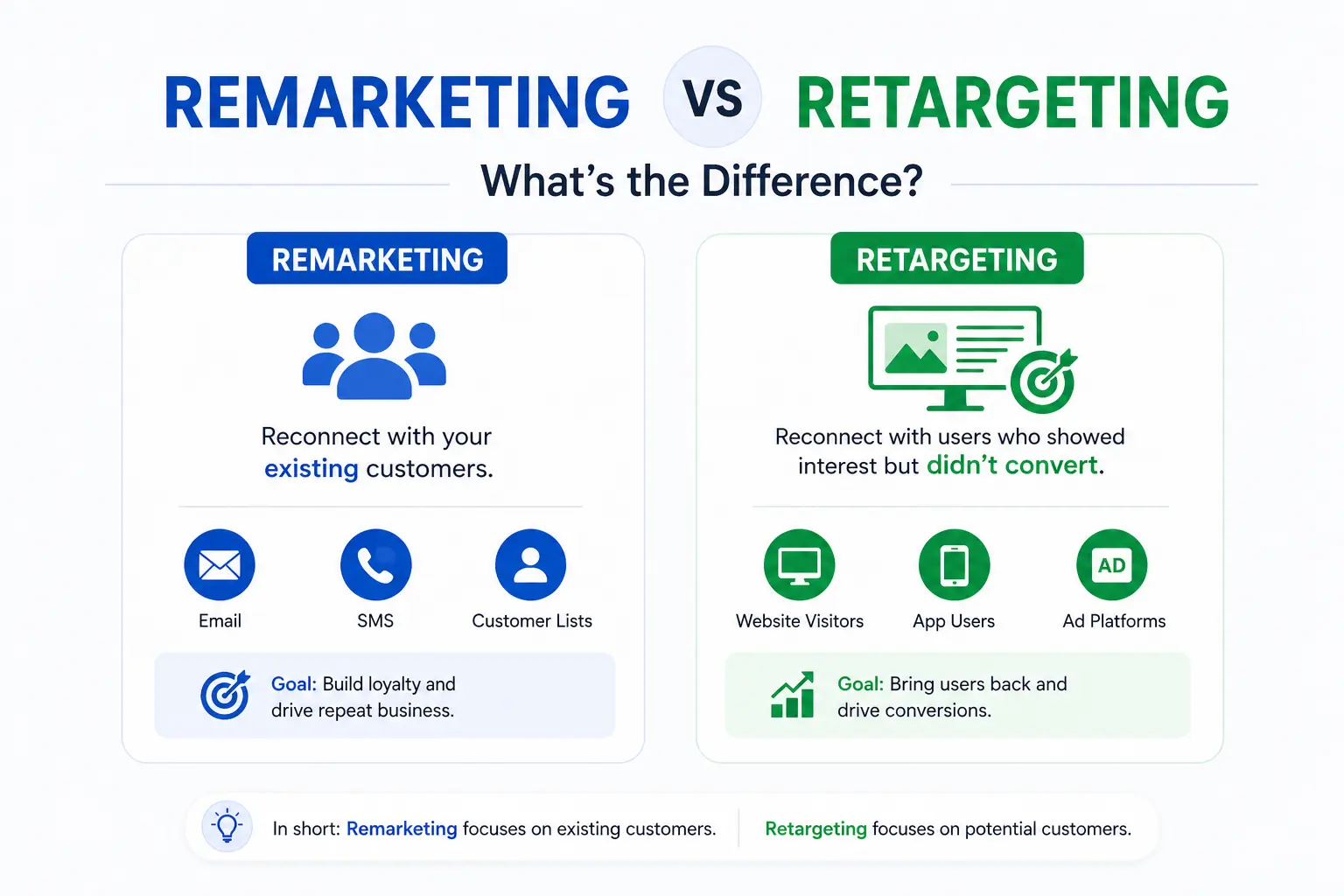
The core difference between remarketing and retargeting comes down to audience and channel:
- Retargeting reaches anonymous visitors through paid ads based on browsing behaviour.
- Remarketing reaches known contacts through direct communication (email, SMS, push notifications) and customer-list-based ad targeting.
A visitor who browses your site and later sees your display ad? That is retargeting. A past customer who receives an email with a personalised upsell offer? That is remarketing.
What Are the Common Forms of Remarketing?
Email remarketing is the most widely used form. Abandoned cart emails, win-back campaigns for inactive customers, upsell sequences, and loyalty programme messages all fall under this category. The performance is strong: 45% of abandoned cart emails are opened (BYYD, 2025), and 26% of users return to a website specifically because of remarketing (BYYD).
SMS and push remarketing delivers personalised messages to mobile devices: order reminders, flash sale alerts, or re-engagement prompts for app users who have gone quiet.
Customer list uploads to ad platforms represent where remarketing and retargeting overlap. Uploading an email list to Google (Customer Match) or Facebook (Custom Audiences) allows you to serve paid ads to known contacts. This is technically remarketing (using first-party data) executed through retargeting channels (paid ads).
Loyalty and retention programmes keep existing customers engaged through ongoing communication, rewards, and personalised offers based on purchase history.
Why Does Remarketing Matter for Long-Term Growth?
Remarketing targets people who already know and trust your brand. Acquisition costs are lower. Personalisation runs deeper because you have real data: purchase history, browsing preferences, engagement patterns, and communication history.
A MarTech case study from 2025 found that a publisher using remarketing emails to re-engage subscribers who had clicked on previous newsletter content tripled its paid membership revenue. Layering urgency-based follow-ups at the end of the campaign brought returns close to 4x compared to occasional promotional emails.
The strength of remarketing is compounding. Every interaction adds data. Every repeat purchase deepens the relationship. Over time, remarketing becomes more effective, not less.
Remarketing vs Retargeting: The Full Comparison
Now that both terms are defined, here is how they compare across every dimension that matters for planning.
| Dimension | Retargeting | Remarketing |
| Who you reach | Anonymous visitors, app users, social engagers | Known contacts: email subscribers, past buyers, CRM leads |
| Data source | Tracking pixels, cookies, platform-native signals | First-party CRM data, email lists, purchase history |
| Primary channels | Paid ads: Google Display, Facebook, Instagram, YouTube, programmatic | Email, SMS, push notifications + customer list ad targeting |
| Funnel stage | Mid-funnel (consideration) and lower-funnel (conversion) | Lower-funnel (conversion) and post-purchase (retention, loyalty) |
| Main goal | Convert prospects who showed interest but did not buy | Retain existing customers, drive repeat purchases, build loyalty |
| Personalisation | Moderate (based on pages viewed, products browsed) | High (based on purchase history, preferences, known identity) |
| Cost structure | CPC or CPM (ongoing ad spend) | Lower variable cost (email/SMS tools) + optional ad spend for list targeting |
| Typical campaigns | Cart abandonment ads, dynamic product ads, brand reminder ads | Loyalty emails, upsell/cross-sell sequences, win-back campaigns |
| Risk if overdone | Ad fatigue, negative brand association | Spam perception, unsubscribes |
Where Do They Overlap?
The overlap happens at a specific point: when you upload customer data to an ad platform.
Uploading an email list to Google Ads (Customer Match) or Facebook (Custom Audiences) to serve ads to past customers is remarketing by data source but retargeting by delivery channel. This is exactly why the industry confuses the two terms. Google Ads calls all of its re-engagement features “remarketing,” including pixel-based ad targeting that the rest of the industry would call retargeting.
The terminology is messy. The strategic distinction is not. Knowing whether you are trying to recover an anonymous visitor (retargeting) or re-engage a known customer (remarketing) determines which channel, message, and offer will work best.
How Does Google Remarketing vs Facebook Retargeting Compare?
This is the platform-specific question most marketers actually need answered. Both Google and Facebook offer powerful re-engagement tools, but they work differently and suit different situations.
Google Ads Remarketing: What Does It Include?
Google Ads remarketing is Google’s umbrella term for all ad-based re-engagement. It covers:
- Standard remarketing: Display ads served to past visitors across the Google Display Network (which reaches over 90% of internet users globally).
- Dynamic remarketing: Ads that automatically show the specific products or services a visitor viewed on your site.
- RLSA (Remarketing Lists for Search Ads): Adjusting your search ad bids and copy for users who have previously visited your website. When a past visitor searches for your product category again, you can bid more aggressively or show different ad copy.
- Video remarketing: Re-engaging users who watched your YouTube videos or interacted with your channel.
- Customer Match: Uploading email lists or phone numbers to target known contacts across Google Search, YouTube, Gmail, and Display.
Businesses using Google Ads remarketing lists report conversion rate improvements between 30% and 50% (SQ Magazine, 2026). RLSA in particular is valuable because it combines high search intent with the familiarity of a returning visitor.
Facebook/Meta Retargeting: What Does It Include?
Retargeting ads on Facebook and Instagram use:
- Meta Pixel and Conversions API: Tracking website behaviour and serving ads to those visitors in their Facebook and Instagram feeds.
- Custom Audiences: Uploading customer lists (emails, phone numbers) for targeted ad delivery. This is technically Facebook remarketing using Meta’s ad infrastructure.
- Engagement Audiences: Retargeting users who interacted with your Facebook or Instagram content (video viewers, page engagers, ad clickers, form openers).
- Dynamic Product Ads: Automatically showing users the specific products they viewed on your site, displayed as carousel or collection ads.
According to DemandSage (2026), 77% of marketers use retargeting on Facebook and Instagram to re-engage potential clients. Built With data shows 61% of the top websites worldwide use Facebook Custom Audiences, compared to 26% using Google Remarketing tags.
Side-by-Side Platform Comparison
| Feature | Google Ads Remarketing | Facebook/Meta Retargeting |
| Ad reach | Google Display Network (90%+ of internet), YouTube, Gmail, Google Search | Facebook, Instagram, Messenger, Audience Network |
| Best ad formats | Text/search ads (RLSA), display banners, YouTube video, Shopping | Feed images, carousels, video, Stories, Reels, Collection |
| Search intent recapture | Strong (RLSA lets you bid on returning searchers) | Not applicable (social platform, not search) |
| Visual/product retargeting | Dynamic remarketing (product-specific display ads) | Dynamic product ads (catalogue-driven, highly visual) |
| List-based targeting | Customer Match (email/phone uploads) | Custom Audiences (email/phone uploads) |
| Tracking setup | Google Ads tag + Enhanced Conversions | Meta Pixel + Conversions API |
| Strongest use case | Recapturing high-intent search visitors, broad display reach | Visual product retargeting, social engagement, younger demographics |
Which Platform Should You Choose?
The honest answer: the Google remarketing vs Facebook retargeting decision should not be either/or for most businesses.
Google’s strength is search intent. When a past visitor returns to Google and searches for your product category, RLSA lets you capture that moment with a tailored ad. No other platform offers this combination of intent and remarketing.
Facebook’s strength is visual, attention-grabbing re-engagement. Product carousels in a user’s Instagram feed or a video ad in Facebook Stories can remind someone of what they browsed in a way that a display banner on a news site cannot match.
Combining search retargeting with display remarketing can increase conversions by up to 60% (SQ Magazine, 2026). The platforms complement each other rather than competing.
When Should You Use Retargeting vs Remarketing?
Scenarios That Call for Retargeting
| Scenario | Why Retargeting Works Here |
| Cart abandonment recovery | The visitor showed strong purchase intent. A dynamic ad showing the exact products they left behind is a direct, relevant reminder. |
| Product page viewers who did not buy | They researched but did not commit. A follow-up ad keeps your product in consideration. |
| Blog or content readers | They engaged with your brand but are not yet in the funnel. Brand awareness ads keep you visible. |
| Video viewers | They invested time watching your content. A follow-up ad moves them toward action. |
| Search intent recapture (RLSA) | A past visitor searching again for your category is a high-value moment. Bid aggressively. |
Scenarios That Call for Remarketing
| Scenario | Why Remarketing Works Here |
| Win-back campaigns for lapsed customers | They bought before. A personalised email or offer can reactivate the relationship. |
| Upsell and cross-sell after purchase | Purchase data lets you suggest complementary products at the right time. |
| Loyalty programme engagement | Ongoing communication with known customers builds retention and lifetime value. |
| Subscription renewal reminders | Direct, timely communication through email or SMS prevents churn. |
| Abandoned cart email sequences | For known contacts (logged-in users, email subscribers), email often converts better than ads. |
When Should You Use Both Together?
The strongest results come from combining both into one connected system. Here is how that plays out for an e-commerce business:
Step 1: A visitor browses running shoes on your website but leaves without buying.
Step 2: Retargeting ads on Facebook show them the exact shoes they viewed as they scroll Instagram that evening.
Step 3: They click back, sign up for a 10% discount, and add the shoes to their cart, but do not check out.
Step 4: A remarketing email fires one hour later: “Your shoes are waiting. Complete your order and save 10%.”
Step 5: They complete the purchase.
Step 6: Two weeks later, a remarketing email suggests matching socks and a running belt based on their purchase.
Step 7: They buy again. They are now a repeat customer.
Retargeting brought them back. Remarketing converted them and kept them. Neither alone would have delivered the same result.
According to SQ Magazine (2026), combining retargeting with email remarketing lowers cost per acquisition by up to 22% compared to using either channel alone.
What Does Good Performance Look Like?
2026 Benchmarks for Retargeting and Remarketing
| Metric | Retargeting (Paid Ads) | Remarketing (Email) |
| Click-through rate | 0.7% to 1.2% (10x standard display) | 15-25% open rate (general); 40-45% for cart abandonment |
| Conversion rate | 70% higher than non-retargeted visitors; up to 150% increase overall | 10.7% for abandoned cart emails (Klaviyo) |
| Return on ad spend | 4.2x average (2025-2026) | Email marketing averages ₹3,000-3,500 return per ₹100 spent |
| Cost per click | $0.95-$1.25 (2025-2026, down from $1.30 in 2024) | N/A (cost per email send is minimal) |
| Cost per acquisition | ₹1,200-₹2,000 (vs ₹2,400+ for cold audiences) | Lower than paid; depends on list size and tool costs |
| Engagement uplift | Up to 400% higher ad engagement | 3-4x higher revenue from personalised remarketing vs generic outreach |
According to a 2025 RedSeer report on India’s digital advertising ecosystem, Indian e-commerce brands that implemented structured retargeting and remarketing programmes saw an average 35% reduction in customer acquisition costs within six months of deployment. The effect was most pronounced among mid-market D2C brands spending between ₹5-25 lakh per month on digital advertising.
Various analyses of Indian digital commerce found that 2/3 of Indian businesses with active paid media campaigns now use some form of retargeting or remarketing. The adoption is being driven by rising ad costs across Google and Meta, which makes re-engaging warm audiences more cost-effective than constantly acquiring cold traffic.
Common Mistakes That Waste Retargeting and Remarketing Budgets
What Goes Wrong Most Often?
No frequency capping. Showing the same ad to the same person twenty times in a week is not persistence. It is annoyance. Set impression limits per user per day and per week.
Retargeting everyone the same way. A visitor who spent 30 seconds on your homepage has very different intent from someone who added three items to their cart. Segment your audiences by depth of engagement and tailor the message accordingly.
Not excluding converted users. Serving purchase ads to someone who already bought is wasted budget and a poor customer experience. Always exclude recent converters from acquisition-focused retargeting campaigns.
Over-sending remarketing emails. Three emails in one day about the same abandoned cart crosses from helpful to spammy. Space your sequences sensibly and respect frequency limits.
Ignoring the privacy landscape. Third-party cookies are declining in effectiveness. Browser restrictions, ad blockers, and consent requirements are shrinking retargeting audiences. Invest in first-party data strategies (email collection, account creation, server-side tracking) now. According to SQ Magazine (2026), 72% of marketers are actively investing in first-party data collection to prepare for further cookie restrictions.
Poor attribution. Users move between devices and platforms. A customer might see a retargeting ad on their phone, then convert on their laptop. Without proper cross-device tracking and attribution modelling, you risk misallocating budget to the wrong channel.
How to Set Up Retargeting and Remarketing Campaigns
Setting Up Google Ads Remarketing
- Install the Google Ads tag (or Google Tag Manager) on your website.
- Create audience segments in Google Ads: all visitors, product page viewers, cart abandoners, past converters.
- Build campaigns targeting those segments across Display, Search (RLSA), YouTube, or Shopping.
- Set frequency caps (3-5 impressions per user per day is a common starting point).
- Exclude recently converted users from prospecting campaigns.
- For Customer Match: upload your email list and create campaigns targeting known contacts across Google properties.
- Use dynamic remarketing for e-commerce: connect your product feed so ads automatically show viewed items.
Setting Up Retargeting Ads on Facebook
- Install the Meta Pixel on your website and configure the Conversions API for server-side tracking.
- Create Custom Audiences based on website visitors (all visitors, specific page viewers, cart abandoners) and engagement audiences (video viewers, page engagers).
- Build campaigns using those audiences. Test different formats: carousel for product retargeting, video for brand re-engagement, Stories for time-sensitive offers.
- Set frequency caps and rotate creative regularly to avoid fatigue.
- For Facebook remarketing via Custom Audiences: upload your customer email list and build campaigns targeting past buyers with upsell or loyalty offers.
- Use dynamic product ads connected to your product catalogue for automated, personalised retargeting.
Setting Up Email Remarketing
- Abandoned cart flow: Email 1 at one hour (gentle reminder with cart contents). Email 2 at 24 hours (add social proof or benefit reinforcement). Email 3 at 48-72 hours (include an incentive if appropriate).
- Win-back flow: Segment inactive customers (no purchase in 60-90 days). Send a personalised re-engagement email. Follow up with a limited-time offer.
- Post-purchase flow: Thank-you email with order details. Follow up with complementary product suggestions 7-14 days later. Invite review or feedback 21 days post-purchase.
What Does the Future of Remarketing and Retargeting Look Like?
AI and Automation Are Changing How Both Work
Google’s Performance Max and Meta’s Advantage+ campaigns increasingly fold retargeting signals into broader, AI-driven campaign types. Instead of manually building remarketing audiences, the platforms use machine learning to decide who to show ads to and when.
This does not eliminate the need for strategy. It shifts the role of the marketer from audience building to signal feeding: making sure the platforms have the right data (conversion events, customer lists, product feeds) to optimise effectively.
First-Party Data Is Becoming the Foundation
As third-party cookies lose effectiveness, retargeting audiences built on cookies alone will continue shrinking. The businesses best positioned for 2026 and beyond are those investing in first-party data: email signups, account creation, loyalty programmes, and server-side tracking that does not depend on browser cookies.
CRM-based retargeting audiences (Customer Match on Google, Custom Audiences on Facebook) report up to 35% higher conversion rates than generic cookie-based audiences (SQ Magazine, 2026). The future of both remarketing and retargeting runs through the data you own.
Use Both, Use Them Differently, and Use Them Together
What Is the Actual Difference Between Remarketing and Retargeting?
Retargeting = paid ads served to anonymous visitors based on browsing behaviour. It recovers lost traffic and converts warm prospects who did not buy on their first visit.
Remarketing = direct re-engagement of known contacts through email, SMS, and CRM-based targeting. It retains existing customers, drives repeat purchases, and builds long-term loyalty.
The difference between remarketing and retargeting is about who you are reaching and how. But the best-performing strategies in 2026 do not treat them as separate tactics. They combine both into one connected system where retargeting brings people back and remarketing keeps them coming back.
The Principle That Ties It Together
Every business loses visitors. The vast majority will not return on their own. Retargeting and remarketing are the two mechanisms that close that gap, each at a different stage and through a different channel. Treating them as complementary rather than competing is what separates the businesses seeing 4x ROAS from those wondering why their ad budget is not delivering.
How We Approach Remarketing and Retargeting at Savit
At Savit, we do not apply a default playbook. We start by analysing how a business is currently performing across Google Ads and Facebook marketing, then build the re-engagement strategy based on what the data shows.
For some clients, the biggest opportunity is in Google Ads remarketing: recovering high-intent search visitors through RLSA, running dynamic remarketing for product catalogues, and using Customer Match to re-engage existing buyers across Search, YouTube, and Display. Our Google Ads management covers the full range, from campaign setup and audience building to bid optimisation and ongoing performance tracking.
For others, retargeting ads on Facebook and Instagram deliver the strongest returns. This is often the case for visual products, D2C brands, and businesses with active social audiences. Our Facebook advertising team builds dynamic retargeting campaigns that show the exact products users browsed, runs multi-format campaigns across feeds, Stories, Reels, and Messenger, and manages audience segmentation to keep frequency under control and relevance high.
In most cases, the answer involves both. We build integrated strategies where Google retargeting ads recapture search intent, Facebook remarketing through Custom Audiences re-engages known buyers with personalised offers, and email remarketing nurtures the relationship between ad touchpoints. The channel mix depends on the business, the audience, and the numbers.
As a Mumbai-based digital marketing agency with over two decades of hands-on experience managing paid campaigns across industries, we bring the strategic depth to know which approach fits and the daily execution discipline to make it work. Every campaign is monitored, tested, and optimised based on real performance data, not assumptions.
Whether you need to recover abandoned carts, re-engage lapsed customers, recapture search visitors, or build a full-funnel retargeting and remarketing system from scratch, we can help you get there.
Talk to Savit about your remarketing and retargeting strategy.