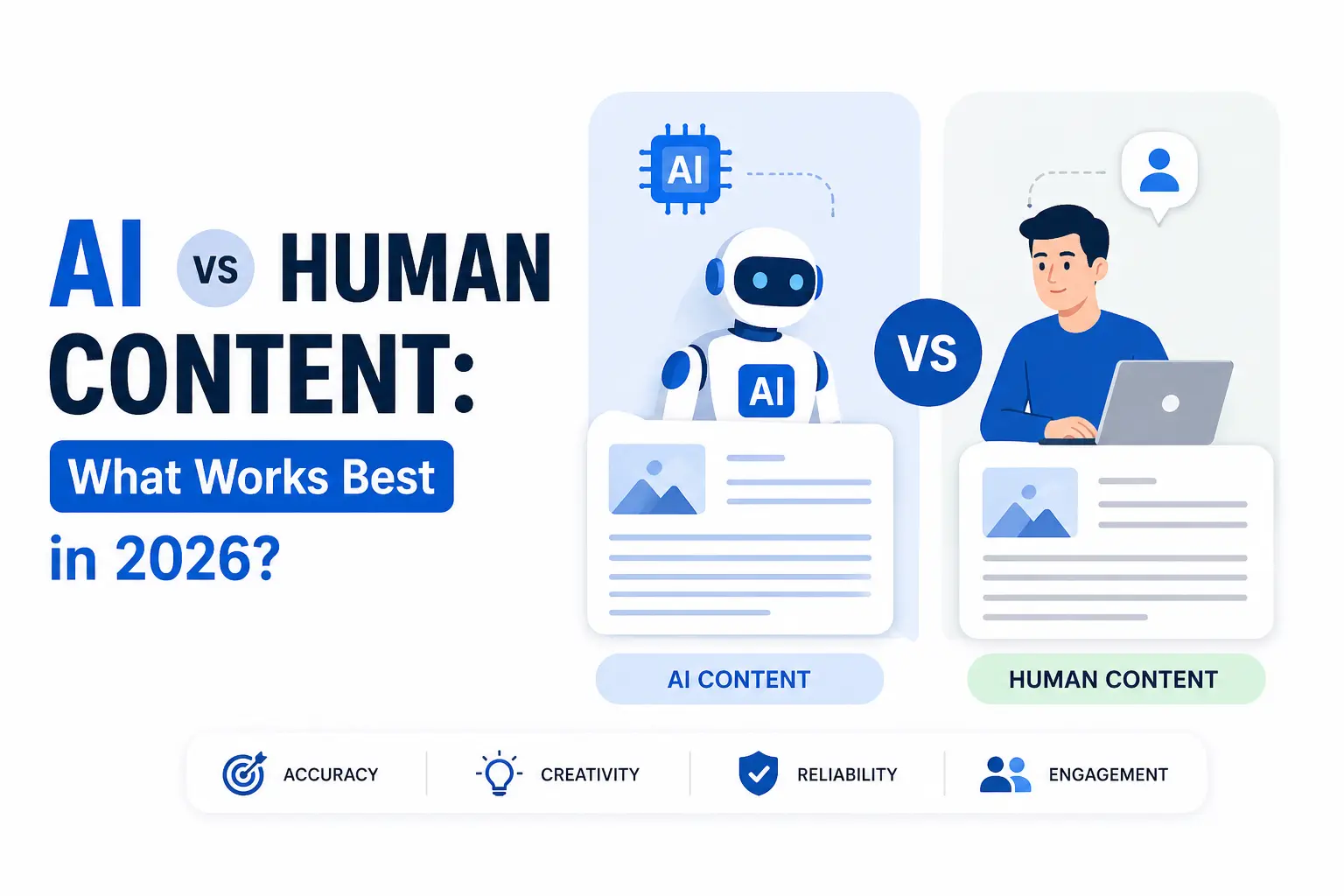
Human or AI content: which way to go? This guide breaks down when to use each, how to combine them, and what Google actually rewards in 2026.
Every marketing team in 2026 is having this conversation. AI tools can now produce a 2,000-word blog post in under three minutes. The output is grammatically clean, structurally sound, and often SEO-formatted right out of the box. So the obvious question follows: why pay human writers at all?
The obvious question also happens to be the wrong one.
The real question is not whether AI can write content. It clearly can. The real question is whether AI-generated content performs the same way human content does when it matters most: in search rankings, in reader trust, in conversions, and over time.
Recent data gives us a much clearer answer than the opinions flying around on LinkedIn. A Semrush study published in April 2026, analysing 42,000 blog posts across 20,000 keywords, found that human content occupies the #1 position on Google 80% of the time. Purely AI-generated content? Just 9%. That is an 8x gap at the very top of search results.
And yet, 72% of SEO professionals surveyed in the same study believe AI content performs as well as or better than human content. The perception and the data are telling two very different stories.
This guide unpacks what the data actually shows, where AI content writing genuinely helps, where human content remains irreplaceable, and how to build a content strategy that uses both without falling into the traps that have already burned thousands of sites.
What Are We Actually Comparing?
Before going further, some definitions worth getting right.
What Is AI Content Writing?
AI content writing refers to text generated by large language models (ChatGPT, Claude, Gemini, Jasper, and similar tools) trained on massive datasets. These tools can produce blog posts, product descriptions, ad copy, email sequences, meta descriptions, and more.
The output ranges from fully AI-generated (no human involvement at all) to AI-assisted (human-directed, AI-drafted, human-edited). That distinction matters enormously, because the performance gap between the two is where most of the interesting findings live.
What Is Human Content?
Human content is written by people who bring experience, expertise, editorial judgement, and brand understanding to the work. It reflects real-world knowledge, professional context, and the ability to connect with a specific audience in ways that feel authentic.
The line between the two is blurring. Most content produced today falls somewhere on a spectrum, and the data increasingly shows that where you land on that spectrum determines how your content performs.
What the Ranking Data Actually Shows
This is the section that businesses must pay attention to. The numbers matter, and they tell a more nuanced story than either “AI is fine” or “AI is doomed.”
The Semrush Study (April 2026)
Semrush analysed 42,000 blog pages extracted from 200,000 URLs tied to 20,000 keywords. Each page was classified using GPTZero as human-written, AI-generated, or mixed. The findings:
| Content Type | Presence at #1 | Trend Across Page 1 |
| Human-written | 80% of #1 positions | Dominant across all top 10 positions |
| AI-generated | 9% of #1 positions | Presence nearly doubles from position 1 to position 4 |
| Mixed (AI + human) | 11% of #1 positions | Distributed across mid-page positions |
The gap was widest at position 1 and narrowed as you moved down Page 1. AI content does appear on the first page. It just rarely holds the top spot.
The 16-Month Longitudinal Study
A separate analysis tracking 4,200 articles over 16 months found that purely AI-generated content ranked an average of 23% lower than human-authored content. For competitive, high-difficulty keywords, that gap widened to 41%.
More concerning: the gap grew over time. At the start of the study, AI content trailed by 14%. By the end, 31%. This suggests that Google’s algorithms increasingly reward signals that accumulate over time (backlinks, updates, engagement, authority) and that unedited AI content rarely earns.
The same study found AI-only articles were deindexed at over 3x the rate of human-written ones. Deindexation means complete removal from Google’s index, not just a ranking drop.
The Important Caveat
AI content can rank. The data does not say otherwise. When looking at any Page 1 placement (not just #1), AI and human content appeared almost equally often: roughly 57-58% of each type showed up somewhere in the top 10.
The takeaway is specific: AI content reaches Page 1 regularly, but human content dominates the highest positions. For businesses competing on valuable, commercial keywords, that distinction is the one that matters.
Does Google Actually Penalise AI Content?
This question comes up constantly, and the answer requires precision.
Google’s Official Position
Google has stated clearly: it evaluates content quality, not production method. There is no blanket penalty for AI-generated content. What Google penalises is low-quality, unhelpful, or manipulative content, regardless of how it was made.
Google’s helpful content guidelines and spam policies target content created primarily to manipulate rankings rather than serve users. If AI content meets the same quality bar as human content (helpful, accurate, well-sourced, demonstrating E-E-A-T), it can rank.
What Happens in Practice
The practical reality is more complicated than the official stance.
Google’s Helpful Content updates (2023-2025) and subsequent core updates have consistently hit sites that published large volumes of unedited AI content. Not because it was AI-generated, but because scaled AI output tends to be thin, repetitive, and lacking the experience and originality signals that quality raters and algorithms look for.
Sites that used AI responsibly (as a drafting tool with heavy human editing and enrichment) were largely unaffected. Sites that treated AI as a content factory and published hundreds of lightly edited pages saw volatility, ranking drops, and in some cases, deindexation.
The distinction Google draws is not AI vs human. It is helpful vs unhelpful. But the data consistently shows that unedited AI content is far more likely to fall on the wrong side of that line.
Why Human Content Still Outranks: The E-E-A-T Connection
The ranking advantage of human content is not random. It maps directly onto Google’s E-E-A-T framework (Experience, Expertise, Authoritativeness, Trustworthiness), which has become the dominant quality filter in 2026.
How Each E-E-A-T Signal Plays Out
| E-E-A-T Element | Human Content | AI Content |
| Experience | Can draw from real projects, client work, personal testing, lived outcomes | Has no experience. Cannot have done the work, served the client, or tested the product |
| Expertise | Can demonstrate credentials, professional background, years of practice | Can summarise expert knowledge but holds no credentials and cannot exercise judgement |
| Authoritativeness | Built through backlinks, mentions, PR, and recognition from credible sources | Rarely earns organic backlinks or citations from authoritative third parties |
| Trustworthiness | Visible author, transparent sourcing, verifiable claims, accountable byline | Often published without attribution, sourcing, or accountability |
One analysis found that 89% of AI-only articles lacked an identifiable expert author, compared to just 29% of human articles. AI content included original research in only 4% of cases, versus 38% for human content. Human articles featured expert quotes 52% of the time; AI articles, just 6%.
These are not minor differences. They are the specific signals Google’s quality systems are built to detect and reward.
The Engagement Signal Layer
Beyond E-E-A-T, human content tends to earn better behavioural signals: longer time on page, deeper scroll depth, lower bounce rates, and more social shares. These engagement patterns send positive quality signals back to Google, reinforcing rankings over time.
Content that reads like it was written by someone who understands the reader’s situation, speaks in a natural voice, and offers genuine insight holds attention. Content that reads like a competent summary of existing information does not hold attention the same way, even if the information is accurate.
Where AI Content Writing Genuinely Helps
The data does not say AI is useless. Far from it. AI content writing tools are powerful when applied to the right tasks with the right oversight.
What AI Does Well
Speed and volume. AI can produce drafts, outlines, and structured content in minutes. For businesses that need to cover many topics, languages, or product lines, this is a genuine operational advantage. A Semrush survey found 70% of teams cite faster production as AI’s top benefit.
Research acceleration. AI tools summarise sources, identify content gaps, cluster keywords, and generate initial frameworks faster than manual research. This is where AI for writing saves the most time without compromising quality, because the output is a starting point, not a finished product.
Structured and templated content. Product descriptions, FAQ pages, meta descriptions, data tables, and other formulaic content types are well-suited to AI generation with human review. The structure is predictable, the required creativity is low, and the volume is often high.
SEO formatting. AI consistently applies keyword placement, heading structures, and readability formatting. For teams producing blog writing AI drafts at scale, this ensures a consistent baseline before human editors refine the substance.
What AI Does Not Do Well
Original insight. AI recombines existing information. It does not generate new ideas, conduct interviews, run experiments, or draw from professional experience. Up to 30% of web content is already duplicative; AI without human direction adds to this problem rather than solving it.
Accuracy under pressure. AI hallucinates. It invents statistics, misattributes quotes, and generates plausible-sounding claims that are factually wrong. For any content where accuracy matters (and when does it not?), human fact-checking is mandatory.
Brand voice and emotional connection. AI produces competent prose. It does not produce prose that sounds like your brand, speaks to your specific audience’s frustrations, or builds the kind of trust that turns readers into customers. Surveys consistently show that around 90% of consumers value authenticity in brand content. Generic AI output does not deliver that.
YMYL content. Health, finance, legal, and safety topics involve real knowledge and verified credentials. Creating medical or financial advice using AI without consulting experts is not only dangerous from an SEO perspective but also unethical.
The Hybrid Model: What 87% of Teams Are Already Doing
The Semrush survey of 224 SEO professionals found that 87% keep humans heavily involved in content creation, and 64% use a specifically human-led, AI-assisted workflow. Only 5% rely on pure AI with no human oversight.
This is not a trend. It is the current standard practice among teams that take content performance seriously.
What a Human-Led, AI-Assisted Workflow Looks Like
The most effective approach treats AI as a production accelerator within a human-controlled quality system:
Stage 1: Strategy and brief (Human)
Define the topic, target keyword, search intent, audience, and the specific angle or experience the content needs to demonstrate. This is where content quality is won or lost, and it is entirely a human function.
Stage 2: Research and draft (AI-assisted)
Use AI for writing the initial draft, outline, or research summary. AI is fast here and saves meaningful time. But the draft is raw material, not a finished product.
Stage 3: Writing and enrichment (Human)
A human writer rewrites, restructures, and enriches the draft with original insight, case studies, expert perspective, brand voice, and the specific experience signals that E-E-A-T demands. This is where the content becomes genuinely valuable.
Stage 4: Fact-checking and E-E-A-T layer (Human)
Verify every claim, statistic, and source. Add author attribution, expert review where needed, and transparent sourcing. Remove AI-pattern language. Ensure the finished piece could not have been written by someone who has never done the work.
Stage 5: Optimisation and publication (Human + AI tools)
Final SEO checks, schema markup, internal linking, and formatting. AI tools can assist with technical optimisation; humans make the final editorial call.
Which Tasks Go Where?
| Task | Best Handled By | Why |
| Topic strategy and editorial planning | Human | Requires business context, audience understanding, and strategic judgement |
| Keyword research and clustering | AI-assisted | AI tools are faster and more comprehensive; humans validate intent |
| First drafts and outlines | AI | Saves time; provides a structured starting point |
| Writing and narrative development | Human | Requires voice, experience, and original perspective |
| Product descriptions at scale | AI with human review | Formulaic structure suits AI; human review ensures accuracy |
| Case studies and thought leadership | Human | Cannot be faked; requires real experience and data |
| Meta descriptions and title tags | AI-assisted | AI generates options; humans select and refine |
| YMYL content (health, finance, legal) | Human (expert-written or reviewed) | Accuracy and credentials are non-negotiable |
| Fact-checking and source verification | Human | AI hallucinates; verification requires judgement |
| Content updates and refreshes | Human | Requires editorial judgement about what has changed and why it matters |
How Does This Affect AI Search Visibility?
The AI vs human content question does not stop at traditional search rankings. AI Overviews, ChatGPT-powered search, and voice assistants are now intermediate layers between content and users.
AI Systems Cite What They Trust
According to Ahrefs data, 38% of URLs cited in Google’s AI Overviews also rank in the top 10 of traditional search results. Since human content dominates top rankings, it is more likely to be cited by AI systems.
Gartner projected that up to 25% of organic search traffic would shift to AI chatbots and voice assistants by 2026. That shift is now underway. Content that earns citations in these environments requires strong E-E-A-T signals, clear structure, and authoritative positioning. These are areas where human oversight continues to make a measurable difference.
What This Means for Content Strategy
Quality content for humans means quality content for AI search visibility at the same time. The same qualities needed for ranking well traditionally (experience, expertise, authority, and trust) are the very qualities that AI considers when it decides to cite information.
Content structured with clear headings, direct answers, schema markup, and transparent authorship performs well in both environments. Blog writing AI tools can help with the structural formatting. Humans need to supply the substance that makes the content worth citing.
How to Decide What Your Content Needs
A Decision Framework by Content Type
| Content Type | Recommended Approach | Why |
| Blog posts and thought leadership | Human-led, AI-assisted | Needs original insight, experience, and brand voice |
| Product descriptions (high volume) | AI-generated, human-reviewed | Formulaic; AI handles scale, humans ensure accuracy |
| Landing pages and conversion content | Human-written | Trust and persuasion require human understanding of the audience |
| FAQs and structured data pages | AI-drafted, human-edited | Structure suits AI; human review adds nuance and accuracy |
| YMYL content (health, finance, legal) | Human-written, expert-reviewed | Accuracy and credentials are mandatory |
| Social media and ad copy | AI-drafted, human-refined | Speed matters; human refinement ensures tone and relevance |
| Email campaigns | AI-assisted, human-finalised | AI helps with variants; humans ensure brand consistency |
| Case studies and original research | Human-written | Cannot exist without real experience and data |
Three Questions That Clarify the Right Approach
1. Does this content need to demonstrate real experience?
If yes, a human needs to be deeply involved. AI cannot have done the work, served the client, or tested the product. Content about your own processes, results, or professional insights requires genuine authorship.
2. How competitive is the keyword?
For high-difficulty, high-value keywords, the data is clear: human content holds the top positions. Investing in AI content writing for competitive terms without significant human enrichment is unlikely to earn top rankings.
3. What happens if this content is wrong?
For YMYL topics or anything where inaccuracy could cause harm or erode trust, human oversight is not optional. AI hallucinates. Humans verify. The responsibility gap is real.
What the Future Looks Like
Will AI Close the Quality Gap?
AI tools are improving in structure, coherence, and even stylistic range. But the experience gap, the hardest one to close, remains wide. AI cannot have treated the patient, managed the project, debugged the code, or negotiated the deal. It can write about these things. It cannot write from having done them.
The role of human writers is shifting. Less time on production. More time on strategy, quality control, and the experience layer that gives content its competitive edge. The writers who thrive in 2026 are those who bring something AI cannot generate: genuine professional perspective.
The Content Strategy That Works in 2026
The businesses producing the strongest content in 2026 are doing three things:
Using AI to move faster without lowering the bar. AI handles research, drafts, and formatting. Humans handle strategy, insight, and the final product. The speed gain is real. The quality standard does not change.
Building E-E-A-T into every piece of content. Author bios, expert review, original data, transparent sourcing, and clear credentials. Not as an afterthought, but as part of the production process from the start.
Tracking AI visibility alongside traditional rankings. Appearances in AI Overviews, ChatGPT citations, and voice search responses are becoming as important as Page 1 rankings. Content built for both environments performs best.
The Answer Is Simpler Than the Debate Suggests
The data is clear on the big questions. Human content dominates top search rankings, earns stronger engagement, and provides the E-E-A-T signals both Google and AI systems look for. AI content writing delivers speed, scale, and efficiency that no team should ignore. The winning model, already adopted by the vast majority of serious content teams, is human-led and AI-assisted.
The principle underneath all of it is straightforward. Content exists to communicate. To build trust between a business and its audience. To take someone from a question to an answer, from curiosity to confidence, from interest to action. The tool used to produce it matters far less than whether the final result is worth reading.
How We Approach Content at Savit
At Savit, content is the core of everything we do. Not because it is a service we offer, but because every strategy we build, whether SEO, digital marketing, brand growth, or AI-driven visibility, ultimately depends on how well a business communicates with its audience. Content is how that communication happens.
We use AI. We would be foolish not to. AI for writing helps our team research faster, structure ideas more efficiently, and scale where it makes sense. But every piece of content that represents a client’s brand passes through human hands. It is written, edited, enriched, and signed off by people who understand the audience, the industry, and what the content needs to achieve.
That is not a philosophical position. It is a quality standard backed by the same data this entire blog has presented. AI generates drafts. Humans generate trust. The first makes us faster. The second makes the content work.
Our content team in Mumbai brings this approach to every project: SEO content that ranks because it deserves to, brand communication that connects because it was crafted by people who understand the reader, and digital strategies built for both traditional search and AI-powered discovery. With over two decades of experience and 3,500+ clients across industries, we have seen enough content trends to know which ones matter and which ones fade. The constant through all of them is this: businesses that communicate well, grow. Businesses that substitute volume for value, eventually stop growing.
Whether you need a content strategy built from scratch, an existing library audited and improved, or a team that can produce human content at scale with AI-enabled efficiency, we are here for it.
Talk to Savit about building a content strategy that earns rankings, trust, and results.