The template-versus-custom question isn’t new, but the answer for your business might surprise you. Here’s what really matters when you’re deciding.
Somewhere between “we need a website” and “here’s the final build,” every business faces one fundamental choice: do we use a pre-made template or build something custom?
It sounds like a design question. It is not. It is a business question that affects how customers perceive your brand, how well your site converts visitors into leads or sales, how much you spend over the next three to five years, and whether the website grows with you or holds you back.
The custom website vs template debate gets oversimplified in most guides. Templates are “cheap and fast.” Custom is “expensive and better.” Neither statement tells the full story, and acting on either without context leads to decisions businesses regret within a year.
Here is what actually matters: 94% of first impressions are design-related. According to Stanford research, 75% of consumers judge a company’s credibility based solely on its website design. Visitors form that judgement in roughly 50 milliseconds. Whatever approach you choose, it needs to earn trust in less time than it takes to blink.
This guide breaks down the custom web design vs website templates comparison across the factors that affect real business outcomes: cost, time, performance, SEO, conversion, scalability, and long-term value. The goal is to help you choose with clarity, not convince you that one option is always right.
What Exactly Are We Comparing?
What Is a Template Website?
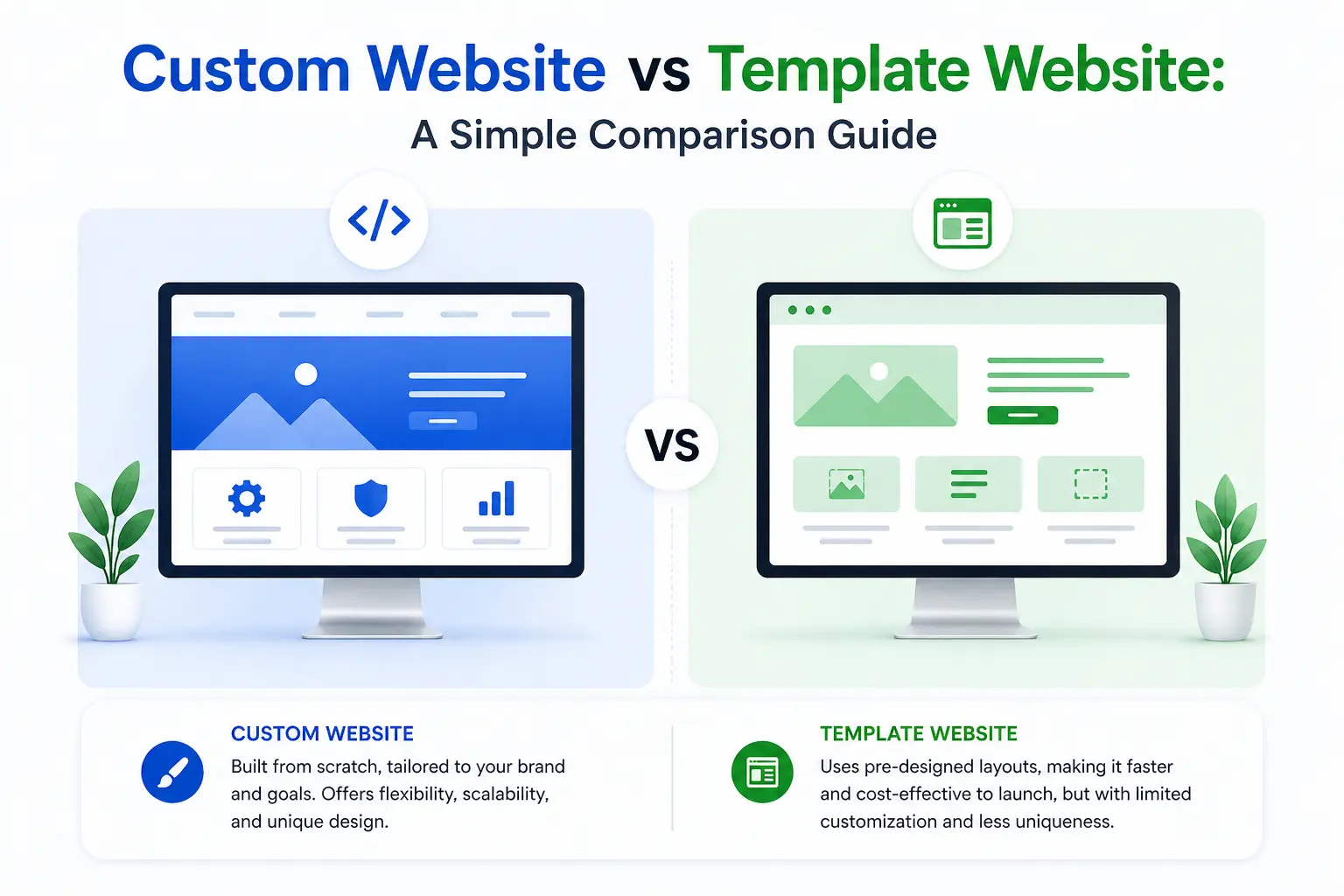
A website design template is a pre-built layout offered by platforms like WordPress, Wix, Squarespace, Shopify, or Webflow. You select a theme, plug in your content (text, images, brand colours), and launch. The structure, design patterns, and most of the code come pre-made.
Templates are designed to suit a broad range of businesses. That is their strength (you can be online in days) and their limitation (thousands of other businesses share the same design foundation).
Modern templates have improved significantly. Drag-and-drop editors, built-in SEO basics, mobile responsiveness, and app integrations make them genuinely useful for many situations. But the underlying architecture is still built for everyone, not specifically for your customers.
What Is a Custom Website?
Custom website development means building a site from the ground up, shaped around your brand, your audience, and your business goals. Every layout decision, every user flow, every line of code is purpose-built.
The process typically starts with discovery: understanding what the business does, who the customers are, how they make decisions, and what the website needs to achieve. Design and development follow from those answers, not from selecting a pre-made layout.
Custom does not always mean “coded entirely from scratch.” Many custom builds use modern frameworks (React, Next.js, Laravel) or headless CMS platforms as a foundation, then build everything else around the business’s specific requirements. The key distinction is that the site is designed for your audience and your goals, not adapted from a generic starting point.
Where Does Static Website Design Fit?
Static website design refers to sites built with fixed HTML and CSS files, with no database or server-side processing. Static sites are extremely fast and secure, making them well-suited for simple brochure sites, portfolios, or informational pages that change infrequently.
Static sites can be template-based (using generators like Hugo or Jekyll with pre-made themes) or custom-coded for full control. They lack dynamic features (logins, e-commerce, user accounts) unless additional development is added, but for straightforward needs, they offer excellent performance at low cost.
How Do Custom and Template Sites Actually Compare?
Rather than listing features in the abstract, here is how the two approaches compare on the factors that directly affect business outcomes.
The Full Comparison
| Factor | Template Website | Custom Website |
| Upfront cost | Lower: ₹50,000 to ₹2-3 lakhs (or DIY builder subscriptions) | Higher: ₹3 lakhs to ₹25 lakhs+ depending on complexity |
| Time to launch | Days to weeks | 3 to 12 weeks (discovery, design, build, testing) |
| Design uniqueness | Limited. Thousands of sites share the same themes | Fully unique. Built around your brand identity |
| User experience | Generic journeys built for broad appeal | Tailored to your specific audience and conversion goals |
| Code quality | Often bloated with unused features and scripts | Clean, purpose-built code with nothing wasted |
| Page speed | Typically 70-80 on PageSpeed Insights | 90+ achievable with optimised builds |
| SEO control | Basic meta tags and sitemaps; limited structural flexibility | Full control over URLs, schema, architecture, and technical SEO |
| Mobile experience | Theme-dependent; quality varies widely | Mobile-first from the start; designed for how users actually browse |
| Scalability | Limited by theme structure; major changes may require a rebuild | Built to evolve as the business grows |
| Security | Popular themes and plugins create known vulnerabilities | Unique code is harder to target with automated attacks |
| Maintenance | Frequent theme and plugin updates; compatibility issues common | Cleaner codebase; well-built custom sites can last 4-6+ years |
| Long-term ROI | Can decline as workarounds and limitations accumulate | Typically improves as the site evolves with the business |
What Does the Cost Picture Really Look Like Over Time?
This is where the custom website vs template decision gets more nuanced than upfront pricing suggests.
A template site might cost ₹1-2 lakhs to set up. But within 12 to 18 months, many businesses find themselves paying for premium plugins, hiring developers to work around template limitations, or facing a full redesign because the site cannot support new requirements. According to a 2026 analysis by WeMisc, template sites often require redesigns or migrations within a year of launch.
A custom site costs more at the start. However, your total cost of ownership over 3-5 years can be the same or lower, as the site is designed to accommodate expansion without major re-engineering of your existing system. Clean code means few or no compatibility problems. A purpose-built architecture means you can easily add new features without breaking current ones.
One way to think about it: a template is cheaper to buy, but a custom site is often cheaper to own.
How Does Each Approach Affect What Customers See and Do?
First Impressions and Trust
When a visitor lands on your website, they are not evaluating your code or your CMS. They are making a snap judgement about whether your business looks credible, professional, and worth their time.
Template sites can look polished. Many modern themes are well-designed. But the visual language is shared. A prospect who visits three competitors in the same industry and sees similar layouts, similar stock photo placements, and similar page structures is not going to feel that any one of those businesses stands out.
Custom design solves this by building the visual experience around your specific brand, your specific messaging, and your specific value proposition. The result is a site that feels intentionally crafted, which directly affects trust.
This is where the business impact becomes measurable.
Template sites are designed for broad appeal. The user journeys, call-to-action placements, and page flows follow generic patterns that work reasonably well for most businesses but are not optimised for any specific one.
Custom sites are designed around how your particular audience makes decisions. Where do they need reassurance? What information do they need before contacting you? What is the shortest path from landing on the page to taking action? These questions get answered in the design process, and the answers are built into the site’s structure.
The data supports this. According to 2026 case studies compiled by Appco Software, businesses that moved from template to custom websites improved their conversion rates by 20 to 40%. One Indian B2C brand went from a 2% conversion rate on a template site to 4.2% after switching to custom. That is the same traffic generating twice the revenue.
Personalised websites (where the design reflects the specific audience’s needs and journey) increase conversions by 10-25% for service and e-commerce businesses. Templates, by definition, offer only basic personalisation.
Page Speed and Performance
Speed has an impact both on user experience and on search ranking. Google Core Web Vitals are direct ranking factors and user behaviour statistics are clear: 53% of mobile visitors abandon a page if it loads in more than 3 seconds. A one-second delay could drop conversions by 7%.
Templates carry code bloat. They include features, scripts, and styling for use cases your business may never need. That extra weight slows everything down. Custom builds include only the code the business requires, and performance is optimised from the foundation.
How Does the Choice Affect SEO and Organic Visibility?
For businesses that rely on search traffic, the SEO implications of custom web design vs website templates deserve careful attention.
SEO Comparison
| SEO Factor | Template | Custom |
| URL structure | Platform-imposed patterns (often rigid) | Fully customisable, clean URLs |
| Schema markup | Plugin-dependent; limited flexibility | Full implementation control; any schema type supported |
| Core Web Vitals | Often struggles due to code bloat and plugin weight | Built to meet or exceed Google’s thresholds |
| Heading hierarchy | Locked to theme structure; sometimes semantically incorrect | Designed with proper H1-H6 hierarchy from the start |
| Internal linking | Limited by template navigation patterns | Designed around topical authority and user flow |
| Mobile optimisation | Theme-dependent; some adapt well, others need retrofitting | Mobile-first from the foundation |
| Site architecture | Generic; follows the template’s default structure | Built around your content strategy and keyword targeting |
| Structured data | Basic, plugin-reliant | Full control; implemented directly in the code |
If a business is competing for “high-value keywords” or aiming for more, in a competitive market, it would benefit from the SEO flexibility that a custom-built solution offers. Businesses that need less from their SEO (a few keywords, information-only content) would work adequately with a well-configured template and a good SEO strategy.
When Does Each Option Make Sense?
Situations Where a Template Works Well
A template website is a sensible choice when:
- The website serves as a simple digital presence (brochure site, basic portfolio)
- Budget is genuinely constrained (under ₹2-3 lakhs total)
- The site needs to launch within two to three weeks for a campaign, event, or deadline
- Content changes rarely and the site plays a supporting role, not a revenue-driving one
- You are testing a new business idea before committing to a larger investment
- A static website design approach fits the need: few pages, minimal interactivity, informational content
Use the most lightweight, code-friendly template possible for those cases. Don’t overload it with plugins. Focus on the content quality and basic SEO. Also, plan for that: the template will likely need to be replaced if the business expands.
Situations Where Custom Development Pays Off
A custom website becomes the better investment when:
- The website is a primary revenue channel (generating leads, sales, or bookings)
- Brand differentiation matters in a competitive market
- Complex functionality is needed: CRM integration, booking systems, custom product builders, multi-language setups
- SEO is a primary acquisition channel and technical control matters
- The business plans to scale across regions, service lines, or product categories
- Conversion rate directly impacts revenue, and generic user journeys are leaving money on the table
For these situations, the higher upfront cost is paid back through better performance, higher conversions, and lower long-term maintenance.
The Hybrid Path
If you plan to migrate eventually, factor that cost into the original decision. Sometimes spending more at the start is cheaper than building twice.
How Should You Decide: Custom Website or Template Website?
Some businesses start with a template to validate the concept, then migrate to a custom build as revenue and requirements grow. This is a valid path, but it comes with a transition cost: URL structures change, content needs restructuring, redirects need managing, and SEO equity can be lost if the migration is handled poorly.
A Quick Decision Framework
| Your Situation | Likely Best Fit |
| Startup testing a new idea, budget under ₹2 lakhs | Template |
| Simple brochure site, rarely updated | Template or static website design |
| Service business generating leads through the website | Custom |
| E-commerce with 50+ products and custom checkout needs | Custom |
| Competitive market where online brand perception matters | Custom |
| Campaign or event site with a short lifespan | Template |
| Business scaling across cities or regions | Custom |
| Budget available but launch deadline is under 3 weeks | Template (with a plan to evolve later) |
| B2B business where website influences buying decisions | Custom (75% of B2B buyers say the website influences their decisions) |
Five Questions to Ask Before Choosing
1. What is the website’s job?
If it is a digital business card, a template works. If it is a sales tool that needs to convert visitors into customers, custom development is worth the investment.
2. How important is brand perception?
In markets where trust matters (professional services, healthcare, financial services, premium consumer brands), a generic-looking website is a liability. Custom design communicates that the business is established, intentional, and credible.
3. What are the SEO requirements?
If organic search is a primary growth channel, the technical flexibility of a custom build (clean URLs, schema control, optimised architecture) gives you more room to compete. If SEO is secondary, a well-configured template handles the basics.
4. What does the three-year plan look like?
A website that fits today but constrains you in eighteen months is an expensive short-term decision. If growth, new services, or market expansion are on the horizon, custom development accommodates change more gracefully.
5. What is the real budget, including years two and three?
Templates save money in year one. But plugin costs, redesigns, workarounds, and eventual migration add up. Calculate the total cost of ownership over three years, not just the launch price.
What Should You Look for in a Website Design Agency?
Whichever approach you choose, the quality of execution matters as much as the approach itself. A poorly built custom site can underperform a well-configured template. A website design agency that understands business goals and customer journeys will deliver better results regardless of platform.
What Separates a Good Agency from a Generic One?
- Discovery before design: Do they start by understanding your business, audience, and goals? Or do they jump straight to theme selection or wireframes?
- Portfolio diversity: Do their sites look and function differently from each other? Or do they follow a house style that gets applied to every client?
- Technical depth: Can they handle performance optimisation, SEO architecture, custom integrations, and accessibility?
- Post-launch support: Is the relationship project-only, or do they offer ongoing maintenance and evolution?
- Honest recommendations: Will they tell you a template is the right choice when it genuinely is? Or do they push custom builds regardless of fit?
For businesses in India, working with a website design agency that understands local market behaviour (mobile-first users, regional payment gateways, Indian SEO patterns, local compliance requirements) adds practical value beyond just technical execution. Website design services in India span a wide range, from freelancers to full-service agencies, and the right fit depends on complexity, budget, and how much strategic guidance you need alongside the build.
The Right Website Is the One Shaped Around Your Business
Website design templates offer speed, affordability, and simplicity. They work well for early-stage businesses, simple informational sites, and situations where budget or timeline is the primary constraint.
Custom website development offers performance, conversion optimisation, SEO control, scalability, and brand differentiation. It works well for businesses where the website is a revenue driver, brand trust matters, and the site needs to evolve with the business over time.
There is no universal winner in the custom web design vs website templates debate. The right choice depends on what the website needs to do for your business today and over the next three to five years.
The Principle That Matters Most
A website exists to communicate. What the business does. Why it matters. What the visitor should do next. The approach you choose to build it matters less than whether the final result achieves those goals. A template that communicates clearly and converts visitors is better than a custom build that looks impressive but confuses people. And a custom site shaped around the customer journey will outperform a template whenever the business needs the website to actively drive growth.
How We Approach Website Development at Savit
At Savit, we do not start with a platform or a theme. We start with the business. What are the services or products? Who is the customer? What does their journey from first visit to conversion actually look like? What does the brand need to communicate in the first five seconds? The website gets shaped around those answers.
Our website design services in India cover the full range. Corporate websites built around business objectives and stakeholder journeys, where every section earns its place and every page moves the visitor closer to action. Responsive designs that perform across every device and screen size, because over 60% of traffic in India comes from mobile and a site that does not work on a phone is a site that does not work. Shopify stores configured for e-commerce brands that need both design quality and conversion efficiency, with product pages, checkout flows, and catalogue structures built to sell.
Whether a project calls for custom website development or a strategically configured template, we make recommendations based on what best serves the client’s growth. Some businesses need a full custom build because their customer journey, product complexity, or competitive landscape demands it. Others are better served by a well-chosen, professionally configured template with a plan to evolve as the business scales. We have built both, and we know the difference between when custom is genuinely needed and when it is overkill.
What stays constant across every project is how we think about the website itself. It is a business tool. Every layout decision, every page structure, every CTA placement is connected to a measurable outcome: leads, sales, enquiries, or trust. Content and user experience sit at the core of everything we build, because a website that does not communicate well does not perform well, regardless of how it was built.
As a Mumbai-based website design agency with over two decades of experience and thousands of websites delivered, we understand how Indian businesses operate, how their customers search and decide, and what it takes for a website to earn its investment back.
Talk to Savit about building a website shaped around your business.