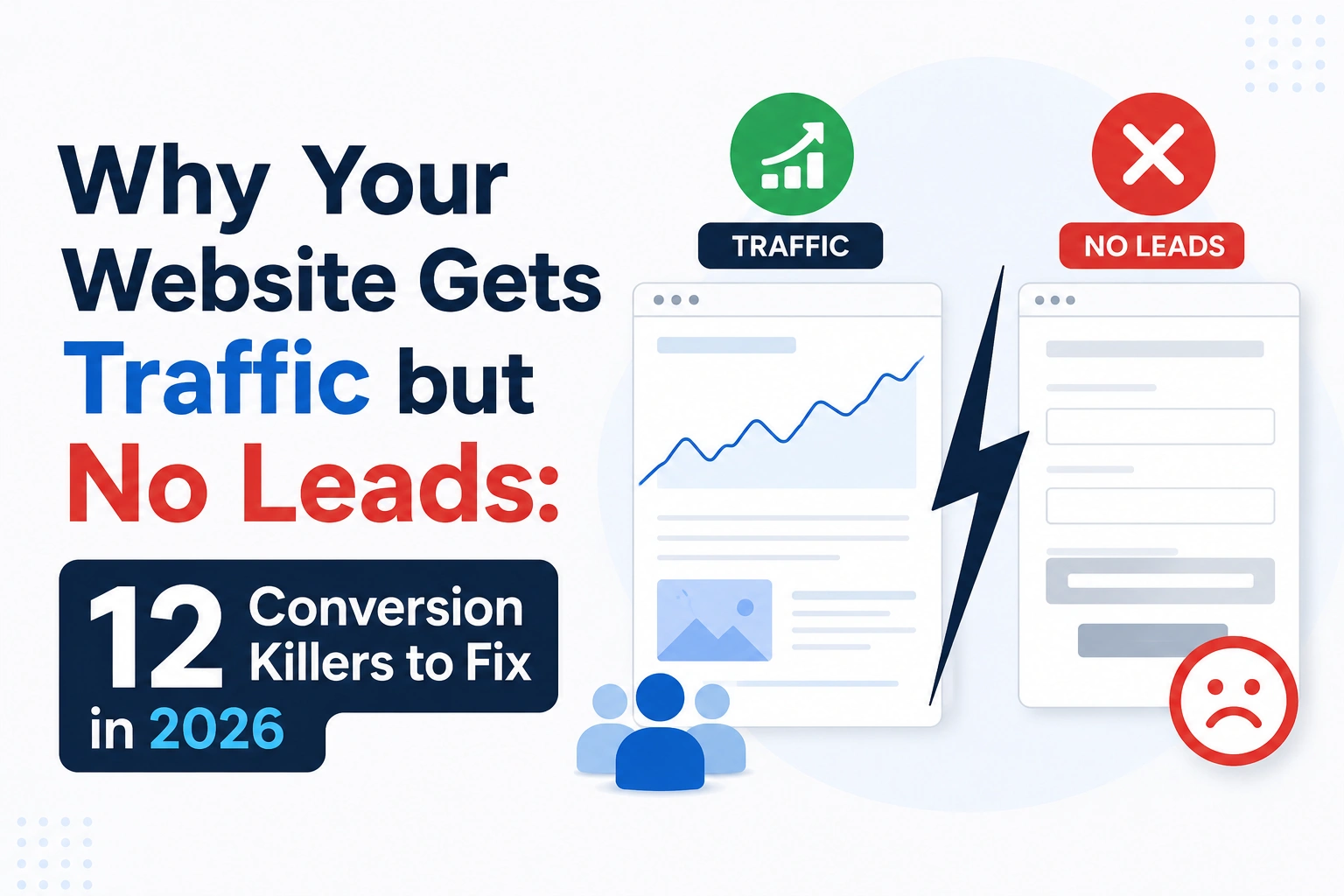
The problem is almost never the traffic.
When a website generates steady visitors but no enquiries, the first instinct is to invest in more traffic. More ads. More SEO. More social media. This is also the most expensive possible response to the wrong diagnosis.
If your website converts at 1% and you double your traffic, you still have a 1% conversion rate. You have just doubled the number of people leaving without contacting you.
The Unbounce analysis of 41,000 landing pages across 57 million conversions found that the median landing page converts at 6.6%, while the bottom 25% convert below 3%.¹ Statista’s Q3 2025 data places global e-commerce conversion at just 1.6%.² The gap between where most websites sit and where they could sit is enormous, and it sits entirely in the conversion experience, not in traffic volume.
This guide identifies the 12 conversion killers most responsible for that gap and explains how to fix each one.
What Is Conversion Rate Optimisation?
Conversion rate optimisation (CRO) is the practice of improving your website so that more of your existing visitors take a desired action, whether that is submitting a form, calling your office, or completing a purchase.
The distinction from lead generation is important. Lead generation brings people to the website. Website conversion optimisation turns that visit into a lead. Most “traffic but no leads” problems are CRO problems, not traffic problems.
A useful working target: if you are below 2% visitor-to-lead conversion for B2B, you have conversion blockers to address. The following twelve are the most common.
The 12 Conversion Killers
Here are 12 conversion killers that hinder lead generation for your business website.
Killer 1: Slow Lead Response Time
This is the single most damaging and most correctable conversion killer in B2B marketing.
According to Harvard Business Review research, the average B2B lead response time is 42 hours.³ An MIT and HBR joint study found that responding to a web lead within one hour makes you 7x more likely to qualify that lead.⁴ Waiting 24 hours or more makes you 60 times less likely to reach a qualified conversation.⁵ And 23% of companies never respond to web leads at all.⁶
These numbers should be alarming. They describe a systematic failure to use what businesses have already paid to acquire.
The critical insight here is that slow response time is rarely a technology failure. Most businesses have email. The problem is process and prioritisation. Web leads are treated as a lower priority than direct calls, when the data is unambiguous: the person who fills in a contact form at 11 in the morning has made a considered decision. They are evaluating you alongside competitors. The business that responds first is substantially more likely to have the conversation.
How to fix it:
- Set up instant notification to a designated lead handler the moment a form is submitted
- Implement an immediate automated acknowledgement that confirms receipt and sets a specific response time expectation
- Target a first human response within five minutes during business hours, not five days
- For Indian businesses managing leads through WhatsApp manually, the first step is eliminating that manual routing with a proper CRM or lead management tool
Killer 2: Slow Page Load Speed
Portent’s research on page speed and conversion found that a site loading in one second converts 3x better than one loading in five seconds, with conversion falling by approximately 0.3% for every additional second of load time.⁷
The practical consequence is that visitors who never see your offer because they left during loading are invisible in your analytics. They appear as high bounce rate entries but the cause load time is often misread as a messaging or relevance problem.
How to fix it:
- Compress all images and serve them in WEBP or AVIF format
- Eliminate render-blocking JavaScript and defer what is not needed for first page render
- Enable browser caching and use a content delivery network for geographically distributed visitors
- Run Google PageSpeed Insights on your highest-traffic landing pages and address any issues scoring below 90
- Target a Largest Contentful Paint (LCP) under 2.5 seconds on mobile
Killer 3: Weak Or Missing Calls-To-Action
A CTA that says “Submit” converts less than one that says “Get My Free Audit.” This is not a minor copywriting point. According to Colorlib’s conversion research, personalised CTAs convert 202% better than generic ones.⁸
The deeper issue is not just word choice. It is placement, prominence, and specificity. Most websites have CTAs that are visually understated, placed below where visitors stop scrolling, or competing with multiple other buttons for attention.
Growth Stack and Unbounce data found that single-CTA landing pages convert at 13.5%, compared to 10.5% for pages with multiple CTAs, a 29% difference driven simply by focus.⁹ Every competing call-to-action dilutes the one you actually want the visitor to take.
How to fix it:
- Write CTAs that state a specific benefit: what the visitor receives, not just what they must do
- Place a primary CTA above the fold on every landing page
- Reduce to one primary action per page on dedicated landing pages
- Test CTA variations systematically: button colour, copy, and placement all affect click-through rates
Killer 4: Too Many Form Fields
According to GenesysGrowth and HubSpot’s analysis of form performance, reducing form fields to five or fewer doubles conversion rates.¹⁰ Yet most contact forms ask for name, email, phone, company, role, company size, specific interest, and a message, before the visitor has any reason to trust you.
HubSpot’s research across 40,000+ pages found that complex field types, specifically dropdowns and multi-line text areas, depress conversions further.¹¹ GenesysGrowth’s data places form abandonment after starting at 81%.¹²
The logic most marketing teams use is that longer forms produce more qualified leads. The data does not support this. Shorter forms produce more leads at a higher volume. Qualification happens in the follow-up conversation, where you have context, a relationship, and the ability to ask the right questions in the right order.
How to fix it:
- Reduce initial capture to name and email at minimum
- Move qualifying questions to the second step of a multi-step form, where abandonment is far lower
- Enable autofill wherever possible (it converts 24% better on mobile)
- Gather additional information progressively through the nurture sequence
Killer 5: Missing Trust Signals
According to BrightLocal’s 2026 consumer research, 97% of consumers read reviews before engaging with a business.¹³ 85% are more likely to engage after reading positive reviews, and 68% require at least a four-star rating before considering a business at all.¹⁴
Trust signals are not decoration. They are decision infrastructure. A visitor considering whether to share their contact details is performing a fast, often unconscious risk assessment. Reviews, testimonials, recognisable client logos, security badges, and certifications all reduce the perceived risk of that decision.
Colorlib’s conversion research found that trust signals collectively increase conversion by 34-42%.¹⁵ The placement matters as much as the presence: trust signals closest to the conversion point (immediately above or below the CTA or form) perform better than those placed elsewhere on the page.
For Indian businesses specifically, the trust gap is acute. A high rate of online fraud and spam exposure has made Indian consumers significantly more sceptical of digital businesses they have not encountered before. Trust signals that might be supplementary elsewhere are often the primary conversion variable here.
How to fix it:
- Add customer reviews with real names and context near your primary CTA
- Display recognisable client logos at the point of conversion, not just in a hero section
- Add specific, outcomes-based testimonials rather than generic praise
- Show certifications and awards that are meaningful to your industry
Killer 6: Wrong Traffic Intent
High traffic with low conversion is sometimes a traffic quality problem rather than a conversion experience problem. Blog readers, social media browsers, and visitors in the research phase of a purchase decision behave differently from visitors who are ready to buy. Sending all of them to the same page with the same offer produces predictable underperformance.
This is a funnel matching problem. A visitor reading a blog post about “how to choose an SEO agency” is likely in an early consideration stage. Showing them a “Get a Free Proposal” form is premature. A more appropriate first conversion is an email subscription, a guide download, or a comparison resource that serves their current stage and starts a relationship.
How to fix it:
- Map your traffic sources to buyer intent stages: awareness, consideration, and decision
- Create separate conversion paths for each stage rather than one path for all visitors
- Match paid campaign landing pages precisely to the search intent or audience segment that drives the click
- Use landing page optimisation to create dedicated pages for high-intent traffic instead of routing all paid visitors to the homepage
Killer 7: Poor Mobile Experience
Digital Applied’s 2026 data found that mobile drives approximately 65% of landing page traffic but converts about 8% lower than desktop.¹⁶ The conversion gap is not primarily caused by mobile users being less likely to buy. It is caused by mobile experiences that create friction for the majority of visitors.
The specific failures are predictable: form fields that open the wrong keyboard type, CTAs positioned where thumbs cannot comfortably reach, text that technically fits the screen but requires zooming to read, and checkout or contact flows that were designed on a desktop and tested on a desktop.
How to fix it:
- Test your full conversion path on at least three physical devices, not browser emulators
- Ensure all form fields trigger the correct keyboard (email fields should show the email keyboard; phone fields should show a number pad)
- Position primary CTAs within comfortable thumb reach, which means roughly the middle third of the screen on most phones
- Run your most important landing pages through Google’s Mobile-Friendly Test and address every failure
Killer 8: Distracting Navigation and Competing Choices
According to Colorlib’s landing page research, removing navigation menus from dedicated landing pages can improve conversion by up to 100%.¹⁷ This is one of the largest single-variable conversion lifts available, and it requires no design work, no copy changes, and no new offers.
The underlying mechanism is choice paralysis. When a visitor lands on a page with a primary navigation menu, they have at least five or six places to go. The average visitor clicks a navigation link rather than the conversion CTA. Removing navigation forces attention onto the single action the page was built to drive.
This applies specifically to dedicated campaign and landing pages, not to general website pages where navigation is expected and useful.
How to fix it:
- Create navigation-free versions of your most important conversion pages for paid traffic
- Remove all links that do not directly support the primary conversion goal
- Use a simplified header with just the logo and the CTA on dedicated landing pages
- Test pages with and without navigation for traffic coming from ads and measure the conversion difference
Killer 9: Unclear Messaging Above the Fold
A visitor who does not understand what you offer within three to five seconds of arriving will leave without converting. The average internet user makes a stay-or-leave decision that quickly. Most website headlines fail this test.
The failure mode is usually abstraction. “We deliver transformative digital experiences for growth-focused brands” tells a visitor almost nothing about what they will receive or why it matters to them. A specific, benefit-led headline, such as “We help Mumbai businesses get more leads from their website,” communicates immediately.
VWO’s testing research found that a single headline change, specifically adding one additional clarifying word, lifted sales by 90% for one brand.¹⁸ This is the leverage available in clear messaging above the fold.
How to fix it:
- State what you offer, who it is for, and what benefit they receive within the headline and subheading
- Remove adjectives that describe the business (“innovative,” “transformative,” “leading”) in favour of specifics that describe the outcome for the visitor
- Test headline variations systematically: even small changes to the primary heading can produce large conversion differences
Killer 10: No Social Proof or Demonstrated Results
Colorlib’s research found that adding video to landing pages can boost conversion by up to 86%.¹⁹ This is not because video is inherently persuasive. It is because a well-constructed testimonial or results video provides evidence, and evidence converts.
The absence of specific, verifiable results is a form of asking visitors to trust claims without supporting them. “We help businesses grow” is a claim. “We increased Ramesh Traders’ enquiry rate by 40% in 90 days” is evidence. The second version is far more likely to convert a visitor who is evaluating whether to contact you.
How to fix it:
- Replace generic testimonials (“great service, would recommend”) with outcomes-based ones (“We went from 5 leads a month to 23 in the first quarter”)
- Add short video testimonials from real clients with names, faces, and specific results
- Use case studies with quantified before-and-after outcomes rather than narrative descriptions of work done
Killer 11: No Lead Nurture After the First Visit
Most visitors are not ready to buy on the first visit. This is not a failure. It is how most considered purchases work. The failure is having no mechanism to stay in contact with visitors who expressed interest but were not ready to act immediately.
A first visit that results in no conversion is not a lost visitor. It is a visitor who needs to see you again before they are ready to decide. Without retargeting and email nurture, that visitor goes cold and eventually chooses a competitor who stayed visible.
How to fix it:
- Offer a lead magnet (guide, audit, checklist, resource) to capture email addresses from visitors who are not yet ready to enquire directly
- Set up an email nurture sequence that provides genuine value over three to eight touches before asking for a sales conversation
- Use retargeting ads to stay visible to website visitors who did not convert
- Track engagement in your nurture sequence to identify when a previously cool lead becomes warm and prioritise follow-up accordingly
Killer 12: No Testing or Measurement
According to findings from Colorlib’s CRO research, only 17% of marketers use A/B testing to improve their landing pages.²⁰ The top-performing landing pages that achieve conversion rates above 10% almost universally share one characteristic: they have been systematically tested and improved over time.
Without testing, conversion decisions are based on assumption. A red button is chosen because someone thinks red is more visible. A long form is retained because someone thinks it produces better leads. A headline is written the way someone would write a headline. None of these assumptions may reflect how actual visitors behave.
How to fix it:
- Install heat mapping and session recording tools to observe real visitor behaviour
- Set up conversion tracking in Google Analytics with defined goals before measuring anything
- Start A/B testing the elements with the highest impact: headline, CTA copy, form length, and page layout
- Run tests for statistical significance before drawing conclusions; changes that look positive in three days may be noise
Which Conversion Killers Should You Fix First?
Not all twelve carry equal impact. Fix in this order for the fastest gains:
| Priority | Conversion killer | Why it comes first |
| 1 | Lead response time | Zero technical cost; immediate impact; 7x qualification multiplier |
| 2 | Page load speed | Affects all traffic before a visitor reads a word |
| 3 | Form fields reduced to five or fewer | Proven to double conversion rates with minimal effort |
| 4 | Trust signals near CTAs | 34-42% uplift with no traffic change required |
| 5 | Clear, specific CTAs above the fold | Immediate and testable |
| 6 | Navigation removed from landing pages | Up to 100% lift on dedicated conversion pages |
| 7 | Mobile experience audit | 65% of your traffic is on mobile |
| 8 | Headline clarity | Test first; changes can lift conversions significantly with zero ad spend |
| 9 | Social proof and video | Addresses scepticism at the decision point |
| 10 | Nurture sequence | Converts visitors not ready on first visit |
| 11 | Traffic intent matching | Requires more structural work but essential for scale |
| 12 | Systematic testing | Makes all other improvements compounding rather than one-off |
How Savit Helps You with Better Conversion and Lead Generation
At Savit, we see this problem regularly: businesses generating consistent traffic with conversion rates stuck below 2%, frustrated by leads that never materialise from marketing spend that continues.
Our approach to conversion rate optimisation starts with diagnosis rather than prescription. Before recommending any changes, we audit where in the conversion path visitors are dropping off, because fixing the wrong thing is as expensive as doing nothing. Heatmaps, session recordings, form analytics, and funnel visualisation together reveal which specific conversion killers are costing each business the most leads.
Our website conversion optimisation work is built around the same evidence base this guide draws from: the HBR response-time research, the Unbounce landing page data, the BrightLocal trust-signal research. Changes we recommend are tied to measurable outcomes, tested against baselines, and refined based on what the data shows.
We treat conversion optimisation as ongoing product development on the website, not a one-time project. Visitor behaviour changes. Offers evolve. What converts well in one quarter may underperform in the next. Our clients see sustained improvement because we keep testing, not because we made one set of changes and moved on.
Our landing page optimisation work runs alongside our SEO and paid traffic programmes, because the best traffic strategy is worthless if the destination converts poorly. We connect traffic acquisition to conversion improvement to lead quality, treating them as one integrated system rather than separate efforts.
As an affordable digital marketing company in Mumbai with over two decades of experience across industries, we have helped businesses across India and internationally turn underperforming websites into lead-generating assets.
Our Internet marketing services cover the complete journey: driving qualified traffic, converting visitors into leads, nurturing leads into sales conversations, and measuring every stage so our clients know exactly what their marketing spend is producing.
Talk to Savit about turning your website traffic into real leads.