Key Highlights
- SEO is about ranking your pages in search results. GEO is about getting your content cited inside AI-generated answers. They are different goals built on the same foundation.
- As per Google’s Q1 2026 disclosures, AI Overviews now reach around 2 billion monthly users, so the shift to AI search is real and large.
- As per Conductor’s 2026 benchmarks, AI search still drives only about 1% of all website traffic, which is why SEO is far from dead.
- GEO, AEO, and SXO are related approaches, not competing replacements. This guide defines each one clearly.
- AI engines cite content that is clear, well-structured, factually accurate, recent, and authoritative. Generic content rarely gets referenced.
- The correct strategy is integration: keep doing strong SEO, and layer GEO improvements on top so the same content earns both rankings and citations.
You type a question into a search bar. Instead of a list of ten blue links, you get a single, written answer. It pulls from several sources, summarises them, and hands you a conclusion. You may never click through to any of the websites that made that answer possible.
This is how a fast-growing share of people now search.
For brands, it raises an uncomfortable question. If the AI answers before anyone reaches your website, how do you stay visible at all?
The internet’s response to this question has been loud and largely unhelpful. “SEO is dead.” “GEO is everything now.” Both claims are wrong, and this guide explains what is actually changing, with the data to support it.
The two ideas at the centre of this shift are search engine optimization and its newer counterpart, generative engine optimisation. Understanding how they relate, where they differ, and what genuinely matters in 2026 is now essential for any business that depends on being found online.
As per Google’s Q1 2026 earnings disclosures, reported via DemandSage, AI Overviews now reach approximately 2 billion monthly users across more than 200 countries. The shift to AI-assisted search is real and enormous. At the same time, as per Conductor’s 2026 AI search benchmarks, AI search still accounts for only about 1% of all website traffic. Both facts are true at once, and holding both in mind is the key to thinking clearly about this topic.
This guide defines GEO SEO terms clearly, explains how the two approaches differ and overlap, separates what is genuinely changing from what is marketing hype, and shows how to stay visible across both traditional and AI-driven search.
What Is the Difference Between GEO and SEO?
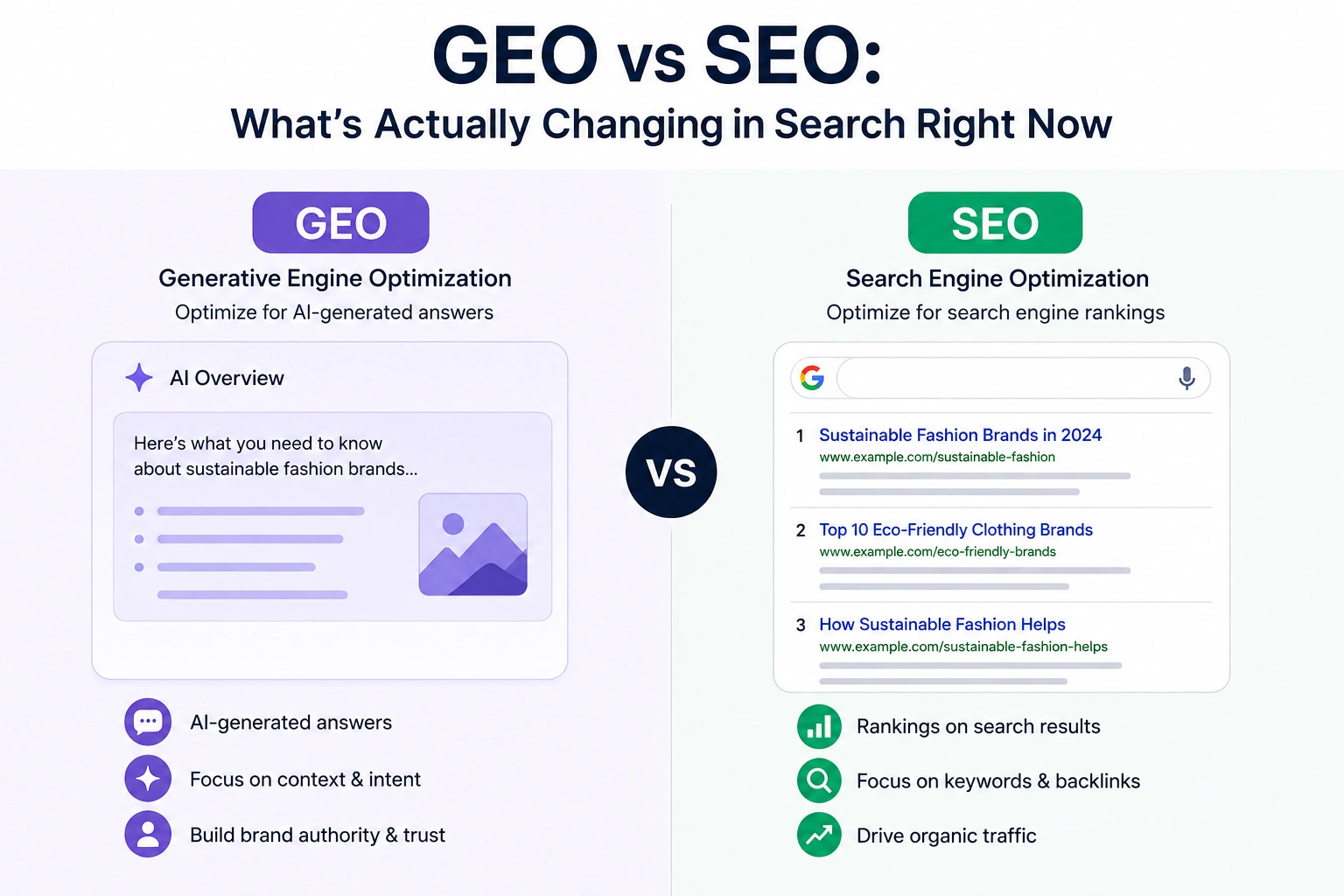
Search engine optimization is about ranking your pages higher in traditional search results. Generative engine optimisation is about getting your content cited as a source inside AI-generated answers. SEO competes for a position on the results page. GEO competes to be the reference an AI answer is built from.
The difference becomes clearer when you look at how each one decides what to surface:
| Factor | SEO (Search Engine Optimisation) | GEO (Generative Engine Optimisation) |
| Primary goal | Rank higher in search results | Get cited in AI-generated answers |
| Key signals | Keywords, backlinks, technical health | Clarity, structure, entity authority, topical depth |
| Success measure | Rankings, clicks, impressions | Citations, mentions, AI visibility |
| Typical query style | Short keyword phrases | Long, conversational questions |
| Where it appears | Google, Bing results pages | ChatGPT, Gemini, Perplexity, AI Overviews |
| What wins | A high ranking position | Being trusted enough to be referenced |
What Is SEO?
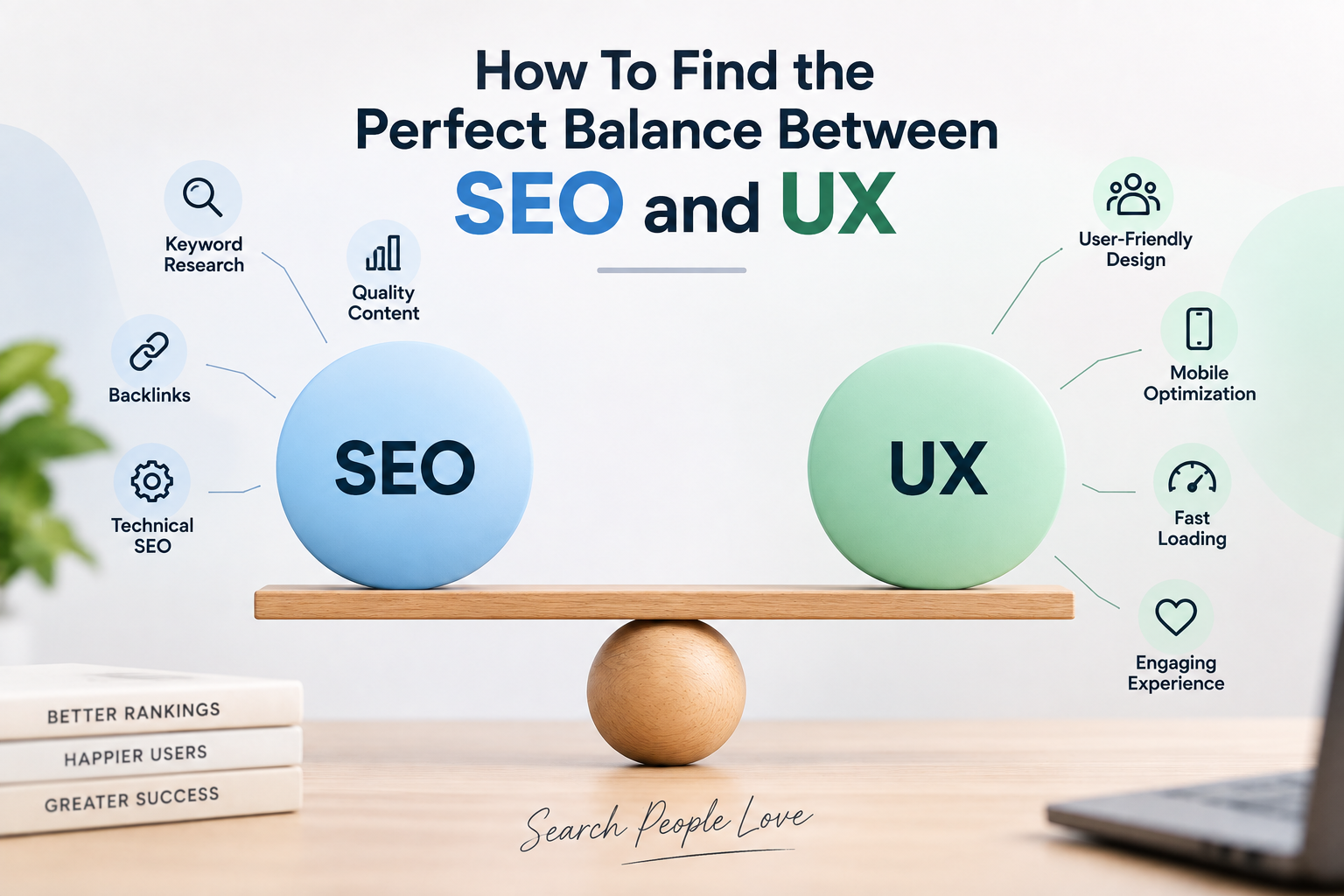
Search engine optimisation improves a website so it ranks higher on search engines like Google and Bing. It rests on four pillars: keyword research (understanding what people search for), quality content (answering those searches well), backlinks (earning links from credible sites to signal authority), and technical health (a fast, mobile-friendly, crawlable site).
When these elements align, your pages fit how search engines judge relevance and quality, and you move up the results. This has been the foundation of online visibility for two decades, and it remains so.
What Is GEO?
Generative engine optimisation structures your content so AI engines treat it as a reliable source they can quote. The goal is to help tools like ChatGPT, Gemini, Perplexity, and Google AI Overviews see your content as accurate, clear, and worth referencing.
Structure carries far more weight here than in traditional SEO. Clear headings, short paragraphs, direct statements, and lists make it easier for an AI model to understand your content and lift the right information from it. Where SEO works to improve your position, generative engine optimization works to make you the reference point the answer is built from.
What Is AEO and SXO? The Related Terms Explained
GEO, AEO, and SXO are related approaches to modern search visibility, not competing replacements. Each focuses on a different part of how people find and consume information.
| Term | Full name | Primary focus |
| SEO | Search engine optimisation | Ranking higher in traditional search results |
| AEO | Answer engine optimisation | Winning direct-answer placements like featured snippets and voice answers |
| GEO | Generative engine optimisation | Being cited as a source in AI-generated responses |
| SXO | Search experience optimisation | Optimising the full journey from search query to user satisfaction |
Answer engine optimization focuses on winning the direct-answer slots: featured snippets, the answer a voice assistant reads aloud, the boxed response at the top of a results page. It is about being the single, concise answer to a specific question.
Generative engine optimisation is described by many as the next evolution of AEO. Where AEO targets answer boxes and snippets, GEO aims to get your brand referenced within the longer, synthesised responses that generative AI systems produce.
Search experience optimization takes the widest view. It covers the entire experience a user has from the moment they search to the moment their need is met, including page speed, content clarity, navigation, and how well the page satisfies the original intent. It blends SEO with user experience thinking.
These are layers of the same underlying goal, which is to be found and trusted by the people looking for what you offer. They are not rival philosophies to choose between. A complete 2026 strategy treats answer engine optimization and search experience optimization as complements to GEO and SEO rather than alternatives, because a user might find you through a voice answer, a featured snippet, an AI citation, or a traditional ranking, and you want to be present across all of those moments.
The terminology matters less than the underlying principle. Whatever label is used, the work comes down to creating clear, credible, well-structured content that both search engines and AI systems can understand, trust, and surface.
How Do AI Engines Decide What to Cite?
AI engines cite content that is clear, well-structured, factually accurate, current, and demonstrably authoritative. They favour pages with clean headings, direct answers, lists, supporting citations, and genuine topical depth over content that is vague or stuffed with keywords.
The underlying process differs from traditional search. Search engines follow three steps: crawling, indexing, and ranking. A bot discovers a page, processes it into an index, and the ranking system decides where it appears for a given query based on signals like content quality, authority, and user experience.
Generative engines work differently. They continuously consume content and, when generating an answer, select sources based on relevance and reliability. If your content presents clear, verifiable statements in a well-organised structure and demonstrates authority on the subject, your chance of being cited rises. The signals that matter most are clean structure, statements that can be extracted as standalone facts, entity clarity (the AI understands who you are and what you are known for), content freshness, and mentions of your brand across other reputable sites.
This is where AI and SEO genuinely converge. As per McKinsey’s AI Discovery research, around half of consumers now use AI-powered search engines, choosing them deliberately over traditional search, and 73% rely on them during the awareness stage of the buying journey. The audience researching your category is already in these tools, which is why being citable within them now matters.
Is SEO Still Relevant in 2026, or Has GEO Replaced It?
SEO is still essential, and GEO has not replaced it. AI search drives only about 1% of web traffic today, traditional organic search still drives the overwhelming majority, and GEO itself is built on the same content quality and authority foundations that SEO depends on.
This is the point where clear thinking matters most, because the loudest voices online are selling a panic that the data does not support.
As per Conductor’s 2026 benchmarks, AI referral traffic averages around 1.08% of all website traffic, with ChatGPT driving roughly 87% of it. The channel is growing quickly, by approximately 1% month over month, but it remains small in absolute terms. Meanwhile, traditional search still sends the vast majority of visitors to most websites.
The professionals who do this work are not abandoning SEO. As per Search Engine Journal’s State of SEO 2026 report, 56.6% of professionals remain confident in SEO’s continued relevance, and 65% do not expect their SEO budgets to decrease in the next year.
The accurate reading is straightforward. Search is not dying. It is expanding into new surfaces. People still type keywords into Google billions of times a day, and they increasingly also ask conversational questions to AI tools. A brand that wants to be found needs to be visible in both places. The relationship between AI and SEO is not one of replacement but of addition, with AI search becoming a new layer on top of the search behaviour that already exists rather than erasing it.
Effective AI SEO is therefore not a replacement for traditional SEO. It is an extension of it onto new ground. The “SEO is dead” narrative is engagement bait, not analysis, and treating it as strategy would be a costly mistake.
What Do GEO and SEO Have in Common?
GEO and SEO share the same foundations. Both depend on high-quality content, clear structure, genuine topical authority, and the principles behind Google’s E-E-A-T framework: experience, expertise, authoritativeness, and trustworthiness.
The overlap is substantial:
- Quality content that matches intent. Both traditional and AI-powered engines reward content that genuinely answers what the user is looking for.
- Clear structure. Logical headings, short paragraphs, and lists help search engines and AI models alike find the value in your content quickly.
- E-E-A-T credibility. Content that demonstrates real expertise and trustworthiness earns recognition from Google and from AI engines that draw on similar quality signals.
- Freshness. Both favour content that is current and regularly maintained over content that has been left untouched for years.
The practical implication is reassuring. Doing the fundamentals well serves both goals at once. You are not building two separate strategies from scratch. You are strengthening one foundation that supports visibility everywhere.
How Do You Optimise for GEO? Practical Strategies
To optimise for GEO, structure your content for easy extraction, answer specific questions directly, write for conversational queries, support your claims with credible sources, and keep your content current.
Here are the strategies that genuinely move the needle:
- Structure for extraction. Use a clear heading hierarchy, short paragraphs, bulleted lists, FAQ sections, and summary blocks. Long, dense paragraphs are hard for AI models to pull facts from. Well-structured content is easy to reference.
- Answer the question directly, then expand. Lead each section with a clear, direct answer to the question it addresses, then provide the detail. AI engines extract these direct statements readily.
- Write for conversational, long-tail queries. People phrase questions to AI tools differently from how they search Google. Google queries are short. AI prompts are longer and more conversational. Forums like Reddit and Quora show how people actually phrase their questions, which is useful research for this.
- Cite credible sources for your claims. Content with supporting data and citations appears more often in AI summaries. Adding a reputable source, a statistic, or a relevant data point to each key section strengthens your credibility with both readers and AI models.
- Build topical authority and entity strength. Become a recognised, consistent source on your subject rather than publishing thin content across many unrelated topics. Depth on a focused set of topics signals authority.
- Refresh content regularly. AI engines favour current information. Auditing your content each quarter to update statistics, verify facts, and improve structure keeps it citable.
The payoff for this work is measurable, not theoretical. Seer Interactive, in a 15-month study comparing brands that appeared in AI Overview citations against those that did not, found that cited brands saw an organic click-through rate of 0.70% versus 0.52% for uncited brands, a difference of roughly 35%. Getting cited is not only a visibility win. It drives measurable clicks back to your site.
How Should Brands Combine GEO and SEO?
The right approach is to integrate the two rather than choose between them. Keep running strong SEO for rankings and traffic, and layer GEO improvements on top so the same content also earns citations in AI answers. You do not abandon what works. You adapt it to be visible in more places.
A practical way to combine the two:
- Start with your best-performing SEO pages. They already have authority and traffic. Adding structure and citations to them is the fastest route to AI visibility.
- Turn subheadings into questions. Instead of a heading like “Integration Approach,” use “How do you integrate GEO and SEO?” This matches how people query AI tools.
- Add FAQ and summary blocks. These give AI engines clean, extractable answers and improve the experience for human readers at the same time.
- Audit content quarterly. Check that facts are current, statistics are recent, sources are credible, and structure is clean. This serves SEO and GEO together.
- Measure both old and new signals. Track rankings, traffic, and conversions as always, and also track how often AI tools cite your brand or surface your content.
A useful shift in mindset closes the loop here. If your click-through rate dips slightly but your brand is being cited more often in AI answers and mentioned more across the web, that can still be a win. It means your authority is growing, even as the way people encounter it changes. A sound GEO SEO strategy accounts for both kinds of visibility rather than treating one as the only measure of success.
What’s Actually Changing, and What Isn’t
What is changing is where people find answers. New AI surfaces like ChatGPT, Gemini, Perplexity, Claude, and Google AI Overviews are becoming part of how people search. Queries are getting longer and more conversational. Being cited as a source is becoming as valuable as ranking in a list of links.
What is not changing is the foundation. Quality content, clear structure, genuine authority, factual accuracy, and freshness still decide who gets surfaced, whether by a search engine or an AI engine. These fundamentals serve both SEO and GEO, which is why the businesses that have done the basics well are best positioned for whatever comes next.
The brands that win in this environment are not the ones chasing every new acronym or panicking over alarming headlines. They are the ones doing the fundamentals well and adapting their content structure thoughtfully so they remain visible everywhere their customers are searching.
How Savit Interactive Approaches GEO and SEO
At Savit Interactive, we have spent over two decades helping businesses stay visible as search has changed, and from our base in Mumbai we now work with brands across India navigating exactly this shift. As a Google Premier Partner in 2026 with an AI-first approach to search, we treat GEO and SEO as one connected discipline rather than a choice between them.
Our view is grounded in the same logic this guide lays out. The foundation that earns rankings, quality content, clean structure, and genuine authority, is the same foundation that earns citations in AI answers. So we build for both at once rather than treating AI search as a separate project bolted on later.
Correct implementation is where this is won or lost. The algorithm, whether it is Google’s ranking system or the selection logic inside an AI engine, has a real part to play in what gets surfaced and what gets cited. Getting the technical implementation right, the structured data, entity clarity, E-E-A-T signals, content freshness, and clean architecture, is what decides whether a brand appears in a search result and inside an AI-generated answer. We focus on getting these details correct, because in both search engine optimization and generative engine optimization, the difference between visibility and invisibility often comes down to implementation quality.
We help brands stay discoverable across both traditional search and AI-driven surfaces, so a business is found whether its customer types a keyword into Google or asks an AI assistant a full question. Our AI SEO work measures both the traditional signals, rankings and organic traffic, and the new ones, citations and brand mentions in AI responses, because visibility now lives in more than one place. We adapt the approach to each brand’s market and goals, because correct implementation depends on the specifics of a business, not a single template applied to everyone.
If you want your brand to be found by the people searching for your products and services, across search engines and AI engines alike, we would welcome a conversation about where you stand today and what it will take to stay visible as search keeps evolving.
Get in touch with our team at savit.in to start the conversation.
Footnotes and References
- Google / Sundar Pichai, Q1 2026 earnings disclosures (reported via DemandSage and Digiday, 2026): AI Overviews reach approximately 2 billion monthly users across more than 200 countries. Source: demandsage.com (Google AI Overview statistics, 2026).
- Conductor, 2026 AI Search Benchmarks: AI referral traffic averages approximately 1.08% of all website traffic, growing roughly 1% month over month; ChatGPT drives approximately 87.4% of AI referrals. Source: Conductor benchmarks, cited via Superlines AI Search Statistics 2026 (superlines.io/articles/ai-search-statistics).
- Advanced Web Ranking / Digital Applied (2026): AI Overviews appear on approximately 48% of Google search queries as of March 2026, up from approximately 31% in February 2025. Source: thestacc.com/blog/google-ai-overview-statistics
- Search Engine Journal, State of SEO 2026: 56.6% of professionals remain confident in SEO’s relevance; 65% do not expect SEO budgets to decrease in the next 12 months. Source: searchenginejournal.com/state-of-seo/
- McKinsey & Company, AI Discovery Survey (New Front Door to the Internet: Winning in the Age of AI Search): Approximately half of consumers use AI-powered search engines; 73% use them during the awareness stage of the purchasing journey. Source: mckinsey.com/capabilities/growth-marketing-and-sales/our-insights
- Seer Interactive (15-month study, cited via Taylor Scher SEO, 2026): Brands cited in AI Overviews saw organic CTR of 0.70% versus 0.52% for uncited brands, a difference of approximately 35%. Source: taylorscherseo.com/blog/ai-seo-statistics
- Topic structure and definitions cross-referenced from: CreativeWeb, GEO vs SEO: How Generative Search Is Changing Online Visibility (cbwebsitedesign.co.uk, December 2025); Search Engine Land, SEO vs GEO (searchengineland.com).