Key Highlights
- Conversational marketing is real-time, two-way, personalised communication between brands and customers, replacing one-way forms and emails
- It emerged because customer patience collapsed; people now expect to talk to brands the way they talk to friends, instantly and on messaging apps
- As per HubSpot’s research, 82% of consumers expect an immediate response to a sales or marketing question
- The global chatbot market reached $11.8 billion in 2026, and conversational tools can lift conversion rates by around 23%
- Trust is the deciding factor: customers want transparency about AI and a clear path to a human when they need one
- The future is proactive conversation, reaching customers at the moment of maximum relevance rather than waiting to be asked
Think about the last time you were stuck on hold, listening to the same loop of music, waiting for someone to pick up.
Now think about the last time you filled in a contact form and waited two days for a reply that, more often than not, never came.
Then think about the last time a brand answered you within seconds on WhatsApp and actually solved your problem.
You know which experience you preferred. So does every customer you are trying to win.
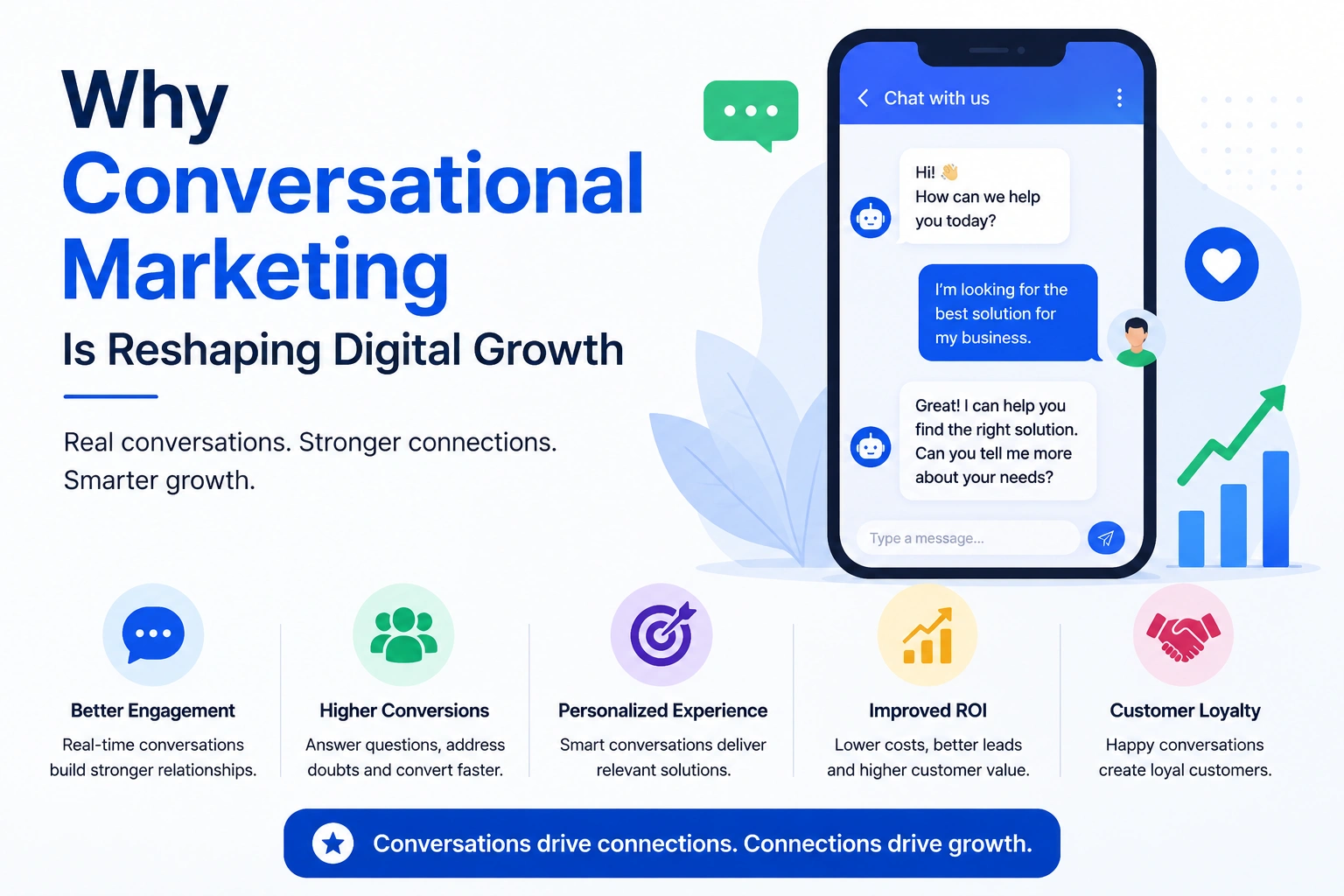
For decades, marketing was a monologue. Brands broadcast messages, and customers listened, or more often, ignored them. Conversational marketing has changed that completely. It has turned marketing into a dialogue, where customers ask, brands respond in real time, and the relationship deepens with every exchange.
This shift is not a passing trend. It reflects a fundamental change in what people expect from the businesses they buy from. As per HubSpot’s research, 82% of consumers now expect an immediate response to a sales or marketing question. Waiting is no longer acceptable, and the brands that meet customers in the moment are the ones earning trust, loyalty, and growth.
This guide covers how conversational marketing came to be, what it actually is, how customers now want to interact, the benefits it delivers, the strategies and best practices for getting it right, and where it is heading next.
How Did Conversational Marketing Come About?
Conversational marketing emerged because customer expectations outgrew traditional marketing. As messaging became the default way people communicate, and patience for forms, emails, and hold queues collapsed, brands had to move from one-way broadcasting to real-time, two-way conversation.
The change did not happen overnight. Several shifts stacked on top of each other to make it inevitable.
First came the messaging revolution. Billions of people made WhatsApp, Instagram DMs, and Messenger their primary way of communicating with the people in their lives. Once messaging became second nature for personal conversations, it became the expected way to reach businesses too. In India in particular, WhatsApp has become the default channel for everything from booking appointments to resolving complaints.
Then came the collapse of patience. The same customers who once accepted a 48-hour email reply now abandon a website if a question goes unanswered for a few minutes. Mobile-first behaviour trained people to expect instant everything, and that expectation carried directly into how they interact with brands.
Finally, AI made real-time response affordable at scale. Before, responding to every customer instantly meant hiring an army of support staff. Now, AI-powered chatbots can handle routine questions around the clock, which means even a small business can offer the kind of responsiveness that once required a large team.
There is also a generational dimension to the shift. The customers with the most buying power entering the market now grew up with messaging as their primary mode of communication. For them, picking up a phone to call a business or waiting on an email feels unnatural, almost inconvenient by default. They expect to tap out a question and get an answer, the same way they would message a friend. As this generation becomes the dominant share of most markets, conversational interaction stops being a preference and becomes the baseline expectation.
Put together, these shifts created a clear demand: customers wanted to talk to brands the way they talk to friends, instantly, conversationally, and on their own terms. Modern customer experience strategies are built around meeting exactly that demand. The businesses that recognised this early gained a real advantage, because responsiveness became a competitive differentiator long before most of their rivals treated it as one.
What Is Conversational Marketing?
Conversational marketing is a customer-centric approach that engages people through real-time, two-way communication. Instead of making customers wait for email replies or fill in long forms, it lets them talk to a brand instantly through chatbots, live chat, and messaging apps, and it makes them feel heard in the process.
The difference between this and traditional marketing is best seen side by side:
| Factor | Traditional Marketing | Conversational Marketing |
| Communication direction | One-way (brand to customer) | Two-way (real dialogue) |
| Response time | Hours or days | Seconds |
| Primary channels | Forms, email, ads | Chatbots, live chat, WhatsApp, DMs |
| Personalisation | Generic, broadcast | Tailored to the individual |
| How the customer feels | Talked at | Heard and helped |
| Role in the journey | Awareness and broadcast | Every stage, from discovery to support |
The channels that power conversational marketing include website live chat, AI-powered chatbots, messaging apps like WhatsApp and Messenger, social media direct messages, voice assistants, and in-app messaging. What unites them is immediacy and dialogue. The customer is not waiting and not being broadcast at. They are in a conversation.
This is what makes conversational marketing such a powerful driver of customer engagement. A form collects information. A conversation builds a relationship. When a customer asks a question and gets a helpful, personal answer in seconds, the interaction does the work that trust-building usually takes much longer to achieve.
How Do Customers Want to Interact with Brands Now?
Customers now expect fast, personal, on-demand interaction on the channels they already use. They prefer messaging over forms, want answers in seconds, expect availability around the clock, and will switch to a competitor that responds faster.
This is not a soft preference. It is a hard expectation with real commercial consequences.
As per the Zendesk Customer Experience Trends Report 2026, which surveyed 18,000 consumers across 22 countries, the share of customers expecting real-time chatbot communication rose to 83%. The same report found that 54% of respondents had switched to a competitor in the previous 12 months specifically because that competitor offered superior real-time support. More than half of customers changed who they buy from over response speed alone.
The preference for instant, conversational interaction runs deep. Tidio, in its research, found that 82% of customers would rather talk to an AI chatbot than wait for a human representative. The willingness to engage with automation is not about preferring machines over people. It is about preferring an answer now over an answer later.
Here is what customers expect from brand interactions today:
- Speed. An answer in seconds, not a promise of a reply within one business day.
- Availability. Support and information at any hour, not only during office hours.
- Their channels. Communication on WhatsApp, Instagram, or website chat, not a phone number they have to call.
- Personalisation. Responses that reflect who they are and what they have asked before, not a generic script.
- Continuity. A conversation that carries context across the whole customer journey, so they never have to repeat themselves.
Brands that meet these expectations hold their customers. Brands that do not, quietly lose them to competitors who do.
What Are the Benefits of Conversational Marketing?
Conversational marketing delivers faster responses, more personal experiences, higher engagement, better-qualified leads, and higher conversions, all while being available around the clock. It improves both the customer’s experience and the business’s results at the same time.
The core benefits:
- Instant response times. Quick replies keep customers engaged and dramatically reduce the drop-off that happens when people are made to wait.
- Personalised experiences at scale. AI-powered conversations can tailor every interaction to the individual, something impossible to do manually across thousands of customers.
- Higher engagement. A real conversation holds attention in a way that a static page or a broadcast email cannot, guiding customers smoothly from question to decision.
- Better lead qualification. Conversational tools ask the right questions in real time, segmenting prospects so sales teams focus on those most likely to convert.
- Higher conversions. By answering objections and guiding decisions at the exact moment of interest, conversational marketing turns more interest into action.
- Round-the-clock availability. A conversation can happen at midnight or on a holiday, capturing customers who would otherwise be lost outside business hours.
- Richer customer data. Real conversations reveal what customers actually want, in their own words, producing insight that forms and surveys never capture.
The business case is backed by hard numbers. As per Grand View Research, the global chatbot market reached $11.8 billion in 2026, a 23.2% jump from the previous year, which reflects how broadly businesses have adopted these tools because they work. On the results side, Glassix, in its research, found that chatbots improve conversion rates by around 23% for websites that use them.
Conversational marketing is therefore not only a customer service upgrade. It is a measurable digital marketing strategy lever that affects engagement, lead quality, and revenue directly.
It is worth dwelling on the lead qualification benefit, because it is the one businesses most often underestimate. A traditional contact form captures a name and an email and leaves the sales team to work out, days later, whether the person was a serious buyer or a casual browser. A conversation does that work in real time. By asking a few natural questions, a well-designed chatbot can establish budget, intent, timeline, and need within the first minute of contact, then route a genuinely qualified lead straight to a salesperson while the interest is still warm. The result is a sales team that spends its time on prospects who are actually ready to buy, rather than chasing cold form-fills.
The data benefit compounds over time as well. Every conversation is a record of what real customers actually ask, in their own words, including the questions, objections, and confusions that surveys never surface. Over months, this becomes one of the richest sources of insight a business has, feeding back into product decisions, content, and the rest of its marketing.
What Are the Best Conversational Marketing Strategies?
Effective conversational marketing strategies meet customers on their preferred channels, personalise every interaction, map conversations to the customer journey, and blend automation with human support. The strategy matters more than the tool. A chatbot bolted onto a website with no thought behind it produces frustration, not growth.
Meet Customers Where They Already Are
The most effective conversational marketing happens on the channels customers already use daily. For most Indian audiences, that means WhatsApp first, followed by Instagram DMs, Messenger, and website chat. Forcing customers onto a channel they do not use, or making them call a number when they would rather message, adds friction at exactly the wrong moment. Be present where the conversation already wants to happen.
Personalise Using CRM and Behavioural Data
A generic chatbot that treats every visitor identically is barely better than a form. A conversational system connected to your CRM and customer data can greet returning customers by name, reference past purchases, and tailor recommendations to actual behaviour. The difference between “How can I help?” and “Welcome back, still thinking about the items in your cart?” is the difference between a script and a relationship.
Map Conversations to the Customer Journey
Different moments in the customer journey call for different conversations. At the discovery stage, the right conversation answers questions and builds confidence. At the point of purchase, it removes friction and objections. After a sale, it provides support and opens the door to repeat business. Identifying these key touchpoints, and designing the right conversation for each, is what turns scattered chats into a coherent growth system.
Blend Automation with Human Support
Automation handles scale. Humans handle nuance. The strongest strategies use AI chatbots for routine, repetitive queries, which is most of them, and route complex, sensitive, or emotionally charged conversations to a real person. The handoff between the two must be smooth, with full context passed along so the customer never has to start over.
How Do You Implement Conversational Marketing?
Implementing conversational marketing follows a clear sequence: choose your channels, deploy and train an AI chatbot, connect it to your customer data, map it to key journey touchpoints, and set up a human escalation path. Done in order, it turns a good idea into a working system.
- Audit where customers already talk to you. Look at where enquiries currently come from: website, WhatsApp, Instagram, phone. Start where the demand already exists rather than guessing.
- Choose your priority channels. You do not need to be everywhere at once. Pick the one or two channels where most of your customers already are, and do those well before expanding.
- Deploy an AI-powered chatbot. Add a chatbot to your website or store to handle frequent questions, guide users, and assist with purchases around the clock. This is the workhorse of the system.
- Train the chatbot properly. A chatbot is only as good as its training. Teach it your brand voice, product details, and the questions customers ask most, so every conversation feels natural and genuinely helpful rather than robotic.
- Integrate with your CRM. Connecting the conversation layer to your customer data turns generic exchanges into personalised ones, and ensures information captured in a chat is not lost.
- Map conversations to journey touchpoints. Set up specific conversations for product discovery, cart abandonment, and post-purchase support, so the right message reaches the customer at the right moment.
- Set up smooth human escalation. Define clearly when and how a conversation moves from bot to human, and make sure context travels with it. A customer should never have to repeat themselves.
- Measure and refine continuously. Track what is working and what is not, and keep improving. Conversational marketing is not a set-and-forget tool.
This sequence works whether conversational marketing is a standalone initiative or part of broader online marketing services that connect it to a brand’s wider digital presence.
What Are the Best Practices for Conversational Marketing?
The best practices for conversational marketing are to keep responses fast and accurate, blend automation with a human touch, be transparent about AI, personalise every interaction, and track the right metrics. These practices are what separate conversational marketing that builds trust from automation that quietly erodes it.
- Be transparent that customers are talking to AI. This matters more than many brands realise. As per Salesforce’s research, 72% of customers say they need to know upfront if they are talking to an AI agent, and 46% say they would only engage with an AI agent if there was a clear path to escalate to a human. Hiding the fact that a bot is a bot damages trust. Being honest about it builds trust.
- Keep a human in the loop. Use chatbots for routine tasks, but ensure a real person is available for complex, sensitive, or emotional conversations. The most frustrating customer experiences come from being trapped in a bot loop with no way out.
- Train your chatbots continuously. Keep them updated with new products, new questions, and refinements to tone. A chatbot trained once and left alone becomes less useful over time as the business and its customers evolve.
- Focus on genuine helpfulness over scripts. Every interaction should feel like a smart, friendly assistant, not a rigid menu of pre-written replies. The goal is a conversation that helps, not a deflection that frustrates.
- Personalise every interaction. Use the data you have to make each conversation relevant. Generic responses signal to the customer that they are just another ticket in a queue.
- Track the right metrics. Measure response times, conversion rates, customer satisfaction, and resolution rates. These numbers tell you whether your conversational marketing is genuinely working or simply present.
Strong customer experience strategies treat these practices as non-negotiable, because the fastest way to lose the trust that conversational marketing builds is to deploy it carelessly.
It helps to know the mistakes that most commonly undermine conversational marketing, because avoiding them is half the work. The first is the dead-end bot, one that cannot answer the question and offers no way to reach a human, leaving the customer more frustrated than if no chatbot had existed at all. The second is over-automation, where a business tries to handle every interaction with a bot, including the sensitive and complex ones that genuinely need a person. The third is the neglected bot, set up once and never updated, slowly drifting out of step with the products and questions it is meant to handle. The fourth is the pushy bot that interrupts every visitor with the same scripted prompt regardless of context, which feels less like help and more like a salesperson following you around a shop. Each of these turns a tool meant to build trust into one that erodes it.
The Present and Future of Conversational Marketing
The present is clear: conversational marketing is already what customers expect, not a nice-to-have feature. The brands meeting customers in real time, on their preferred channels, with genuinely helpful conversations, are the ones winning trust and converting more of the interest they generate. The brands still relying on forms and slow email replies are losing customers they never even realise they had a chance to win.
The future is more interesting still. The next stage of conversational marketing is proactive rather than reactive. Most conversational tools today wait for the customer to start the conversation. The most advanced approaches read behavioural signals, which page a visitor is lingering on, how long an item has sat in their cart, what they looked at before arriving, and begin the conversation at the moment of maximum relevance. A message like “Still deciding? Here is what helped other customers choose” arrives exactly when it is useful, without the customer having to ask.
Alongside this, personalisation will deepen as AI gets better at understanding context, and voice will become a larger part of how people interact with brands. Conversations will flow more seamlessly across channels, so a customer can begin on WhatsApp, continue on the website, and never lose the thread.
Through all of this change, one principle stays constant. The technology only works when the conversation feels genuine, helpful, and human. Automation for its own sake frustrates people. Automation in service of a better, more personal experience earns their trust and their business. That is the real lesson of conversational marketing, and it will hold true no matter how the tools evolve.
How Savit Interactive Approaches Conversational Marketing
At Savit Interactive, we have spent over two decades helping businesses across India connect with their customers, and from our base in Mumbai we have watched conversational marketing grow from a novelty into something customers now simply expect. Our view of it is straightforward: it works when it feels human, and it fails when it feels like a machine built to deflect you.
That belief shapes how we approach every conversational marketing engagement. Our philosophy is that technology should make conversations more personal, not less. We use AI and automation to help businesses respond faster and personalise better, while keeping the human touch exactly where it matters most, because trust is built person to person, even when the conversation happens at scale.
We help businesses design customer experience strategies and conversational journeys that build trust and drive customer engagement across the channels their customers actually use, from WhatsApp and Instagram DMs to website chat, each mapped thoughtfully to the real customer journey rather than bolted on as an afterthought. We believe a conversation that makes a customer feel genuinely heard is worth more than a hundred broadcast messages they scroll past.
Conversational marketing works best when it is part of a connected whole, so we integrate it into a broader digital marketing strategy and full online marketing services, ensuring the conversations a brand has with its customers connect to the rest of its growth rather than sitting in isolation. We stay transparent about where AI is used, we keep humans in the loop, and we measure success by genuine engagement and trust rather than vanity metrics.
If you want to personalise your marketing, build real trust with your customers, and connect with them on a personal level, on the channels where they already are and in the moments that matter most, we would welcome the conversation.
Get in touch with our team at savit.in to start the conversation.
Footnotes and References
- HubSpot (cited via Small Business Trends): 82% of consumers expect an immediate response to sales or marketing questions. Source: smallbiztrends.com/real-time-response-to-customers
- Zendesk, Customer Experience Trends Report 2026 (survey of 18,000 consumers across 22 countries): The share of customers expecting real-time chatbot communication rose to 83%; 54% switched to a competitor in the previous 12 months due to superior real-time support. Source: Zendesk CX Trends 2026, cited via Amra & Elma chatbot statistics (amraandelma.com/chatbot-lead-conversion-statistics).
- Grand View Research: The global chatbot market reached $11.8 billion in 2026, a 23.2% increase from 2025, projected to reach $27.29 billion by 2030. Source: Grand View Research, cited via Ringly (ringly.io/blog/chatbot-statistics-2026).
- Glassix: Chatbots improve conversion rates by approximately 23% for websites that use them. Source: Glassix, cited via Ringly (ringly.io/blog/chatbot-statistics-2026).
- Tidio: 82% of customers would rather talk to an AI chatbot than wait for a human representative. Source: Tidio, cited via Nextiva conversational AI statistics (nextiva.com/blog/conversational-ai-statistics.html).
- Salesforce: 72% of customers say they need to know upfront if they are talking to an AI agent; 46% would only engage with an AI agent if there was a clear escalation path to a human. Source: Salesforce, cited via Nextiva conversational AI statistics (nextiva.com/blog/conversational-ai-statistics.html).
- Topic structure and definitions cross-referenced from: DigiChefs, Understanding the Role of Conversational Marketing in Modern Digital Strategies (digichefs.com, May 2025); InsiderOne, Conversational Marketing in 2026: Strategy and Key Channels (insiderone.com, May 2026).