Google’s search results have changed significantly over the past few years, and one of the biggest shifts for SEO professionals is the gradual removal of FAQ rich results from standard search listings. For years, FAQ schema markup was considered one of the easiest ways to improve search visibility, increase click-through rates, and occupy more space on the search engine results page (SERP). Today, that strategy no longer delivers the same impact.
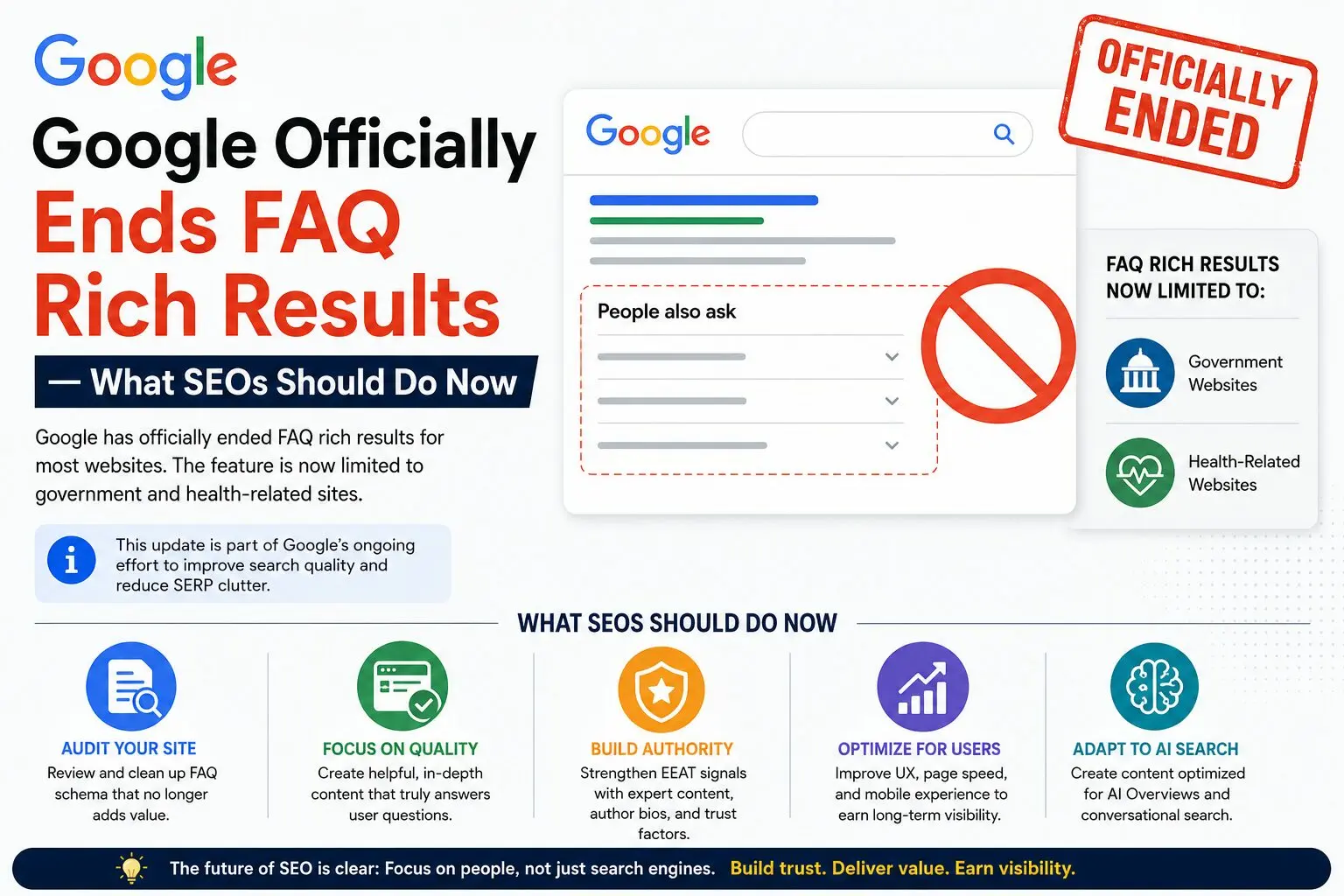
Google has officially limited FAQ rich results to only a small set of authoritative government and health-related websites. As a result, most commercial websites, blogs, ecommerce stores, agencies, and service-based businesses will no longer see expandable FAQ sections appearing beneath their search listings.
This update is more than just the removal of a SERP feature. It reflects a broader change in how Google evaluates content quality, user experience, and search relevance. Businesses that relied heavily on structured data for visibility now need to focus on building authority, trust, and genuinely useful content.
In this blog, we’ll explore what changed, why Google made this decision, how it affects SEO strategies, and what website owners should focus on moving forward.
Understanding FAQ Rich Results
FAQ rich results were enhanced search snippets that displayed expandable questions and answers directly within Google Search. They were generated using structured data markup called FAQPage schema, which helped Google understand the content of a webpage.
When implemented correctly, these rich results allowed websites to gain additional visibility on search engine result pages. Instead of showing only a title and meta description, listings could display multiple dropdown questions beneath the result.
For example, a digital marketing agency page could show questions such as:
- What is SEO?
- How long does SEO take?
- Why is SEO important for businesses?
Users could expand these questions directly in search results without visiting the page.
Initially, this feature improved user experience because it provided quick answers and helped users understand the content before clicking. However, as more websites adopted FAQ schema, misuse became increasingly common.

Why Google Reduced FAQ Rich Results
Google’s decision was primarily driven by quality control and search experience improvements. Over time, FAQ schema became excessively overused by websites attempting to dominate SERP space rather than help users.
Many websites began adding irrelevant or repetitive FAQs purely for ranking purposes. In several industries, search results became crowded with expandable sections that often provided little real value.
Below is a comparison of how FAQ rich results evolved over time:
| Earlier Use of FAQ Rich Results | Current Google Perspective |
|---|---|
| Helped users get quick answers | Often created SERP clutter |
| Improved content understanding | Frequently overused for SEO manipulation |
| Increased CTR for websites | Reduced search result consistency |
| Encouraged structured content | Many FAQs became repetitive or spammy |
| Enhanced visibility for all sites | Now limited to authoritative sources |
Google also noticed that many FAQ sections were generated automatically using AI tools or copied across multiple pages with minimal customization. This reduced the usefulness of the feature for searchers.
As part of Google’s broader Helpful Content and Spam updates, the company began limiting the visibility of FAQ rich results. Eventually, the feature was restricted mainly to trusted government and health websites where factual accuracy is critical.
What This Update Means for SEO
The removal of FAQ rich results does not mean structured data is useless. Instead, it means SEO strategies need to evolve beyond technical enhancements alone.
Previously, many websites used FAQ schema to increase SERP visibility quickly. Some pages gained additional screen space without significantly improving content quality. That shortcut is no longer effective.
Modern SEO now focuses more heavily on:
- Helpful content
- User intent
- EEAT signals
- Topical authority
- Brand trust
- Real expertise
Google’s algorithms increasingly prioritize websites that demonstrate genuine value rather than websites that simply optimize technical elements.
Should You Still Use FAQ Schema?
This is one of the most common questions after the update.
The answer depends on the quality and purpose of your FAQ section.
If your FAQs genuinely help users understand a topic, solve a problem, or make informed decisions, keeping FAQ schema can still be beneficial. Structured data continues to help search engines understand page context and organization.
However, if your FAQs exist only for SEO purposes and provide little value, they should be removed or rewritten.
The table below explains when FAQ schema still makes sense.
| Keep FAQ Schema If… | Remove FAQ Schema If… |
|---|---|
| Questions genuinely help users | FAQs are keyword stuffed |
| Answers are unique and useful | Same FAQs are repeated across pages |
| Content improves user experience | FAQs were created only for rankings |
| FAQs match search intent | Questions are irrelevant or generic |
| Content is visible on the page | Hidden content is marked up |
Google has not penalized websites simply for using FAQ schema. The issue arises when the implementation becomes manipulative or low quality.
The Shift Toward Helpful Content
One of the biggest takeaways from this update is that Google wants websites to prioritize people over search engines.
This means businesses should focus on creating comprehensive, trustworthy, and experience-driven content rather than relying on SERP enhancements.
For example, instead of adding generic FAQs to every service page, brands should invest in detailed informational content that genuinely addresses user concerns.
A company selling solar panels would benefit more from publishing:
- Installation guides
- Cost breakdowns
- ROI calculations
- Maintenance tutorials
- Government subsidy information
than simply adding repetitive FAQs across dozens of pages.
This approach builds topical authority, which has become one of the strongest ranking factors in modern SEO.
EEAT Is Becoming More Important Than Ever
Google continues emphasizing EEAT:
- Experience
- Expertise
- Authoritativeness
- Trustworthiness
Websites that demonstrate real-world expertise are more likely to perform well in search results.
This means businesses should focus on adding trust signals throughout their website.
Important EEAT improvements include:
| EEAT Element | SEO Benefit |
|---|---|
| Author profiles | Builds credibility |
| Industry certifications | Increases trust |
| Real case studies | Demonstrates experience |
| Customer reviews | Improves authority |
| Updated content | Signals accuracy |
| Reliable citations | Enhances trustworthiness |
Google’s systems are increasingly capable of distinguishing between surface-level content and genuinely authoritative information.
How SEOs Should Adapt After the FAQ Update
The end of FAQ rich results does not reduce the importance of SEO. Instead, it changes where efforts should be focused.
SEO professionals now need to prioritize content depth, semantic relevance, and user experience.
One major area of focus should be AI-driven search experiences. Google’s AI Overviews and conversational search systems rely heavily on content clarity and authority.
Websites that answer questions naturally and comprehensively are more likely to remain visible in these evolving search formats.
Content should also be optimized for readability using:
- Clear headings
- Short paragraphs
- Natural language
- Structured formatting
- Visual elements
- Tables and comparisons
These improvements help both users and search engines understand content more effectively.
Better Alternatives to FAQ Rich Results
Although FAQ rich results are disappearing, other visibility opportunities still exist within Google Search.
Featured snippets continue to drive strong visibility for informational searches. Websites can optimize for featured snippets by answering questions clearly and concisely within content.
Video SEO is also becoming increasingly important. Google frequently prioritizes video content for tutorials, product demonstrations, and educational searches.
Image optimization, AI Overview optimization, and topical authority development are now stronger long-term SEO investments than excessive schema implementation.
The table below compares older SEO tactics with modern SEO priorities.
| Older SEO Tactics | Modern SEO Priorities |
|---|---|
| FAQ schema stuffing | Helpful content |
| SERP manipulation | User satisfaction |
| Quantity-focused pages | Topical authority |
| Generic AI FAQs | Original insights |
| Keyword repetition | Semantic relevance |
| Technical tricks | Brand trust |
The Future of Structured Data
Structured data is not disappearing entirely. In fact, schema markup still plays an important role in helping search engines understand content.
However, the role of structured data is evolving.
Instead of acting as a shortcut for increased visibility, schema is becoming part of a broader content optimization strategy.
Businesses should continue using relevant schema types such as:
- Article schema
- Product schema
- Organization schema
- Review schema
- Breadcrumb schema
- Video schema
But the focus should remain on supporting high-quality content rather than manipulating search appearance.
Final Thoughts
Google’s decision to end FAQ rich results for most websites marks the end of a major SEO tactic that dominated search optimization strategies for years. While many marketers initially viewed FAQ schema as an easy visibility boost, Google’s latest updates show a clear preference for cleaner search experiences and more valuable content.
This change reflects the future direction of SEO. Search engines are becoming smarter, more context-aware, and more focused on user satisfaction.
Websites that succeed moving forward will be those that:
- Build trust
- Demonstrate expertise
- Publish genuinely useful content
- Prioritize user experience
- Adapt to AI-driven search behavior
Instead of chasing temporary SERP features, businesses should focus on becoming authoritative sources within their industry.
That strategy will continue delivering long-term SEO success regardless of future Google updates.
Frequently Asked Questions
Google has not completely removed FAQ rich results, but they are now primarily limited to government and health-related authoritative websites.
FAQ schema can still help search engines understand page structure and improve user experience, but it no longer provides the same visibility benefits for most websites.
Not necessarily. If the FAQ section genuinely helps users and improves content quality, you should keep it.
No. FAQ schema itself is not a direct ranking factor.
SEOs should focus on:
- Helpful content
- EEAT
- Topical authority
- AI search optimization
- User experience
- Brand trust
Yes. Structured data still helps search engines understand content and remains useful for several other rich result types.