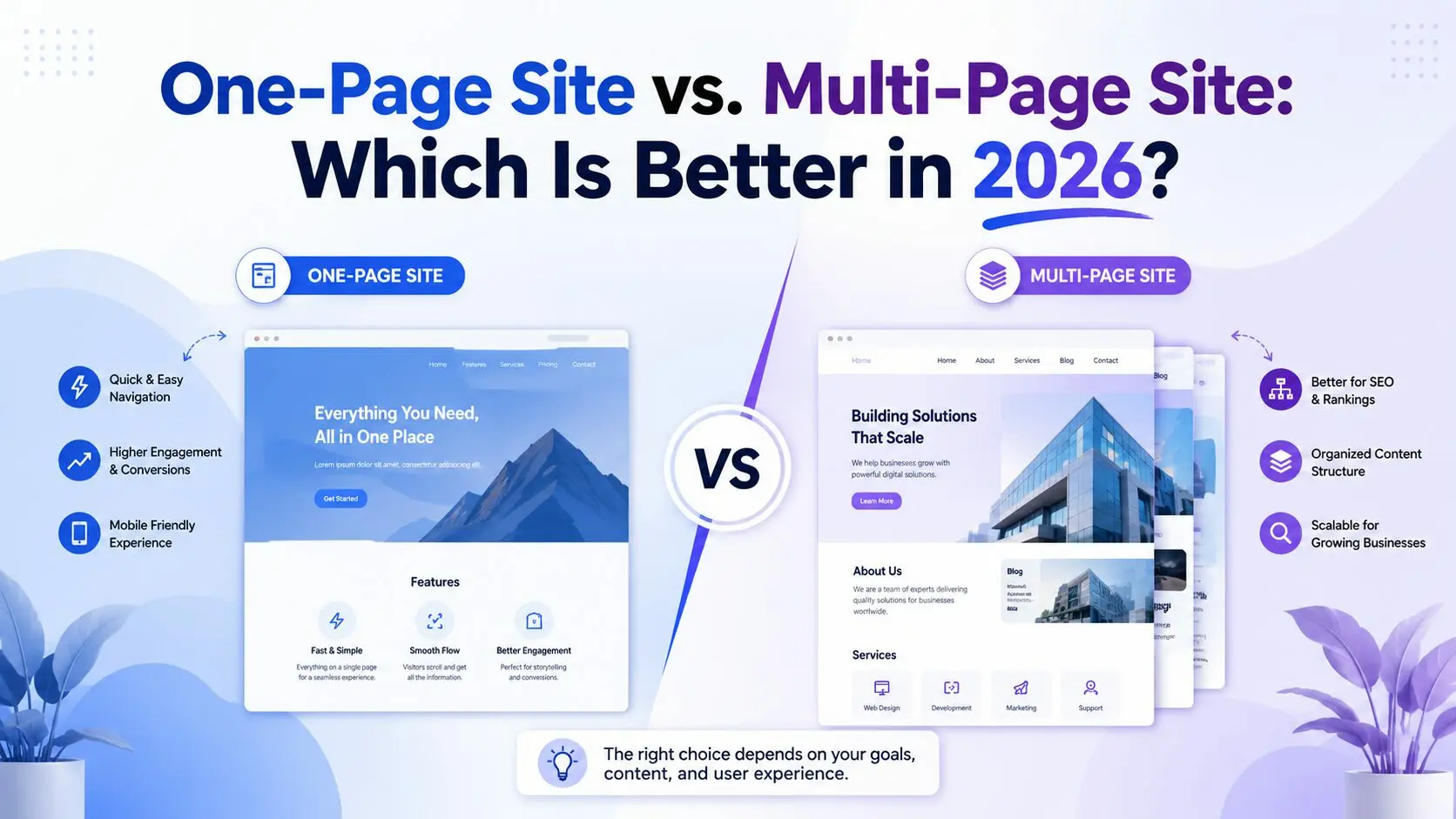
Not sure whether to choose a one-page or multi-page website? This blog explains the key differences, benefits, and use cases to help you make the right decision.
In 2026, the structure of your website plays a major role in how users interact with your brand and how search engines rank your pages.
Businesses often focus on design, but the way content is organised across pages can directly impact SEO, user experience, and conversions. This is why choosing between a one page website and a multi-page website is an important decision, not just a design preference.
A one page website keeps all content on a single scrollable page, while a multi-page website separates information across different pages with clear navigation. Both approaches have their own advantages, depending on the type of business and its goals.
The challenge is that there is no single answer that works for every website. Some businesses benefit from a simple layout, while others need a structured system to support growth and visibility.
In this blog, we will compare the two approaches and help you understand which website structure works best for your needs in 2026.
What Is a One Page Website?
A one page website is a website where all the content is placed on a single page, and users navigate by scrolling instead of clicking through multiple pages.
Instead of separate pages for services, about, or contact, everything is organised into sections on a single page. Users can move through these sections using scroll or navigation links that jump to specific parts of the page.
This type of design is commonly used in single page website design, as it enables viewers to easily browse the content. This method is particularly effective if the purpose is to convey a message to the user through information with minimum navigational steps.
One page website templates are also commonly adopted by companies that want to build their landing pages or websites quickly. The main objective of these templates is to guide the user through each step until they take action.
Common Use Cases
- Landing pages for campaigns or ads
- Personal portfolios and resumes
- Small business websites with limited services
- Event or product launch pages
In simple terms, a single page website is best suited for situations where the content is limited and the goal is to guide users through a clear, focused journey without distractions.
What Is a Multi-Page Website?
A multi-page website is one in which content is divided across multiple pages, each with its own purpose and URL.
Instead of placing everything on a single page, the information is organised into separate sections such as Home, About, Services, Blog, and Contact. Users navigate through these pages using menus, links, and buttons.
Such a format is frequently employed by companies when they have to convey comprehensive information, provide various services, or cater to different audiences. This helps in organising information and makes the website more user-friendly.
From a development perspective, most businesses working with a web design and development company prefer multi-page websites because they are flexible, scalable, and easier to expand over time.
Common Use Cases
- Ecommerce websites with multiple product categories
- Service-based businesses offering different solutions
- Corporate websites with detailed company information
- Content-driven platforms like blogs and guides
In simple terms, a multi-page website is ideal when a business needs more space to organise content, improve navigation, and support long-term growth.
One-Page Site vs Multi-Page Site: Key Differences
To understand which structure works better, it helps to compare both side by side. While both serve the same purpose of presenting content, the way they organise and deliver that content is very different.
| Factor | One-Page Website | Multi-Page Website |
| Structure | All content on a single page | Content divided across multiple pages |
| Navigation | Scroll-based or section jumps | Menu-based navigation with multiple links |
| SEO Potential | Limited keyword targeting | Higher potential to rank for multiple keywords |
| Content Depth | Best for short, focused content | Suitable for detailed and structured content |
| Load Time | Faster initially, can slow if overloaded | Balanced load across pages |
| Best For | Simple goals and quick journeys | Complex websites and long-term growth |
The key difference lies in how content is structured and accessed. A one page website keeps everything simple and linear, while a multi-page website offers a more organised and expandable structure.
In simple terms:
A one-page site is built for simplicity, while a multi-page site is built for flexibility and scalability.
SEO Capabilities: One-Page vs Multi-Page Websites
One Page Website
A one page website keeps all content on a single URL, which can limit SEO.
- Targets limited keywords since all content is on one page
- Difficult to rank for multiple search queries
- No separate pages for different services or topics
- Limited internal linking opportunities
This structure works for simple goals but can be challenging for long-term SEO growth.
Multi-Page Website
A multi-page website allows each page to focus on a specific topic, which improves overall SEO performance.
- Each page can target different keywords
- Better chances to rank for multiple search queries
- Strong internal linking between pages
- Easier to optimise content for search engines
Businesses aiming for consistent organic growth often rely on structured websites, supported by an experienced SEO company in India.
Clear takeaway:
Multi-page websites offer greater flexibility and long-term SEO benefits than one page websites.
Content Strategy: Depth vs Simplicity
One-Page Website (Simple & Focused Content)
A one page website is designed to deliver all information in a single flow. This makes the content simple, direct, and easy to consume.
- All key information is placed on one page
- Works best for short, goal-oriented messaging
- Ideal for highlighting one product, service, or offer
- Limited space for detailed explanations or multiple topics
This approach is effective when the goal is to guide users quickly from introduction to action without distractions.
Multi-Page Website (Detailed & Structured Content)
A multi-page website allows content to be divided into separate sections, each focusing on a specific topic.
- Dedicated pages for services, products, and information
- More space to explain offerings in detail
- Supports blogs, guides, and long-form content
- Helps organise content in a clear and structured way
This makes it easier for users to explore information and for search engines to better understand the website.
User Journey & Navigation Experience
The way users move through your website directly affects how they interact with your content and make decisions.
- One Page Website
A one page website creates a guided journey. Users scroll through sections in a fixed sequence. This makes the experience smooth and easy to follow, especially when the goal is to present information step by step. However, it also limits how freely users can explore different parts of the website.
- Multi Page Website
Multi-page sites provide flexibility as well. The user can move between menus, access various pages and quickly go to where he needs to go. This is especially true in case the site consists of several services or different categories and content that users would like to access.
Control makes all the difference here. With one page websites, users are led along a predetermined path while with multi-page sites, they are free to take whichever path they desire.
Key insight:
A guided journey works well for simple goals, but flexible navigation is better suited to complex websites and informed decision-making.
Scalability & Business Growth
- If your website is small and fixed
A one page website works well when your content is limited and not expected to grow much. It keeps everything simple and easy to manage in one place.
- If your business is expanding
As you add more services, products, or content, a single page can become cluttered. Managing everything on a single page becomes difficult and negatively affects the user experience.
- If you plan long-term growth
A multi-page website makes it easier to expand step by step. You can add new pages without disturbing the existing structure.
- If you want flexibility
Multi-page websites allow better organisation as your business evolves. You can scale content, improve navigation, and adjust structure over time.
- Final takeaway:
For short-term or simple needs, a one-page form works. For long-term growth and flexibility, a multi-page website is the better choice.
When Should You Choose a One Page Website?
A one page website works best when your business has a clear and focused goal. It is designed to guide users through a single, distraction-free journey, making it easier to communicate your message quickly.
This type of structure is suitable when you do not have a large amount of content to present or when you want users to take a specific action without navigating across multiple pages.
You can consider a one page website design in the following situations:
- When you are promoting a single product or service
- When you need a landing page for marketing campaigns or ads
- When you are building a personal portfolio or resume
- When you are creating a website for events or short-term projects
In these cases, a simple structure helps users stay focused and move smoothly from understanding your offering to taking action.
In simple terms:
Choose a single page website design when your content is limited, and your goal is clear.
When Should You Choose a Multi-Page Website?
A multi-page website is the better choice when your business requires more space to organise content and present information in detail. It allows you to separate different sections, making it easier for users to explore and understand your offerings.
This structure is ideal for businesses that want to grow, target different audiences, or build long-term visibility through search engines.
You should consider a multi-page website in the following situations:
- When you offer multiple services or product categories
- When you run an ecommerce store with different listings
- When you plan to create blogs, guides, or detailed content
- When your business depends on SEO and long-term traffic
Even when comparing with a single page website, a multi-page structure provides better flexibility for expansion and organisation.
In simple terms:
Choose a multi-page website when your business needs scalability, detailed content, and better support for long-term growth.
One-Page vs Multi-Page: Which Is Better in 2026?
When a One Page Website Works Better
- Simple business goals
A one page website template is effective when you want to present one clear message or offering without dividing attention across multiple pages.
- Limited content requirements
If your website does not need detailed sections or multiple topics, keeping everything on a single page helps maintain clarity and focus.
- Campaign or short-term use
It works well for landing pages, promotions, or event-based websites where the objective is quick engagement and action.
When a Multi-Page Website Works Better
- Multiple services or products
A multi-page structure allows you to organise different offerings separately, making it easier for users to explore and understand.
- SEO and visibility focus
Each page can target specific keywords, which improves your chances of ranking across different search queries.
- Content depth and expansion
It supports detailed content like service pages, blogs, and guides, which helps in building trust and authority.
What Makes the Difference in 2026
- Scalability matters more than simplicity
Most businesses today need a website that can grow with them, and a multi-page structure makes that easier.
- Search visibility is a priority
Ranking for multiple queries requires structured content, which a multi-page website supports better.
- User expectations have evolved
Users now expect detailed information and easy navigation, especially for services and products.
Final verdict:
For most businesses in 2026, a multi-page website is the more practical and scalable choice. A one page website is best suited for simple, focused use cases where the content and goals are limited.
Best Practices for Website Structure in 2026
Choosing the right structure is important, but how you implement it matters even more. These best practices help ensure your website performs well in terms of SEO, user experience, and conversions.
- Keep your structure clear and organised
No matter whether you opt for a one page layout or more, make sure that the information provided can be easily found by users because of proper structuring.
- Focus on mobile-first design
As most people surf the Internet using their phones, it is crucial that your website is optimised for mobile browsing.
- Optimise for speed and performance
Fast-loading websites keep users engaged and reduce bounce rates. Avoid heavy elements and ensure your pages load quickly across all devices.
- Use SEO-friendly structure
Proper headings, clean URLs, and well-organised content make it easier for search engines to crawl and understand your website. Many businesses work with a web design and development company to ensure their site is built correctly from the start.
- Make navigation simple and intuitive
Users should be able to move through your website without confusion. Clear menus, links, and section flow improve the overall experience.
Final Thoughts: Choosing the Right Website Structure
Choosing between a one-page and multi-page website is not about following trends. It is about selecting a structure that aligns with your business goals, content needs, and future plans.
A one page website offers simplicity and a focused user journey. It works well when the objective is clear, and the content is limited. On the other hand, a multi-page website provides better structure, flexibility, and room for growth. It allows businesses to organise content properly, improve visibility in search results, and expand over time.
Businesses in 2026 will no longer suffice with having merely an online presence. Rather, their website will be one that enables growth, provides a positive user experience, and delivers excellent search engine optimisation performance. For this reason, multi-page websites are more likely to make sense for many businesses.
At the same time, the right decision depends on how well the website is planned and executed. A well-structured website ensures that users can navigate easily, find relevant information, and take action without confusion.
This is where working with the right experts becomes important. At Savit, the focus is on building websites that are structured for both performance and growth. As an experienced SEO company in India, we combine technical SEO, user-focused design, and scalable website architecture to help businesses achieve better rankings and long-term results.
FAQs
- What is a single page website?
A single page website is a website where all content is displayed on one page. Users navigate by scrolling instead of visiting multiple pages, making it simple and easy to follow.
- What is the difference between single page website design and multi-page design?
A single page website design keeps all content on one page with scroll-based navigation, while a multi-page design separates content across different pages for better organisation and scalability.
- Do I need a web design and development company for my website?
Working with a web design and development company helps ensure your website is properly structured, responsive, and optimised for both users and search engines, especially for business websites.
- Should I hire an SEO company in India for my website?
Hiring an SEO company in India can help improve your website’s visibility, rankings, and traffic. It is useful if you want to optimise your website structure, content, and performance for better results.
- Do multi-page websites rank better on Google?
Yes, multi-page websites usually rank better because each page can target different keywords. This improves visibility and helps search engines better understand the website’s structure.