
Search has forked. Most brands are only walking one path.
For 25 years, search marketing meant one thing: rank on Google. Users type a query. They see a list of results. They click. They arrive at your website.
That model still works.
It is also no longer the only model that matters.
A second system now runs alongside it. Users type queries into ChatGPT, Perplexity, or Google’s own AI Overviews and get a synthesised answer not a list of links. That answer names brands, recommends products, and cites sources. It does all of this with or without your participation.
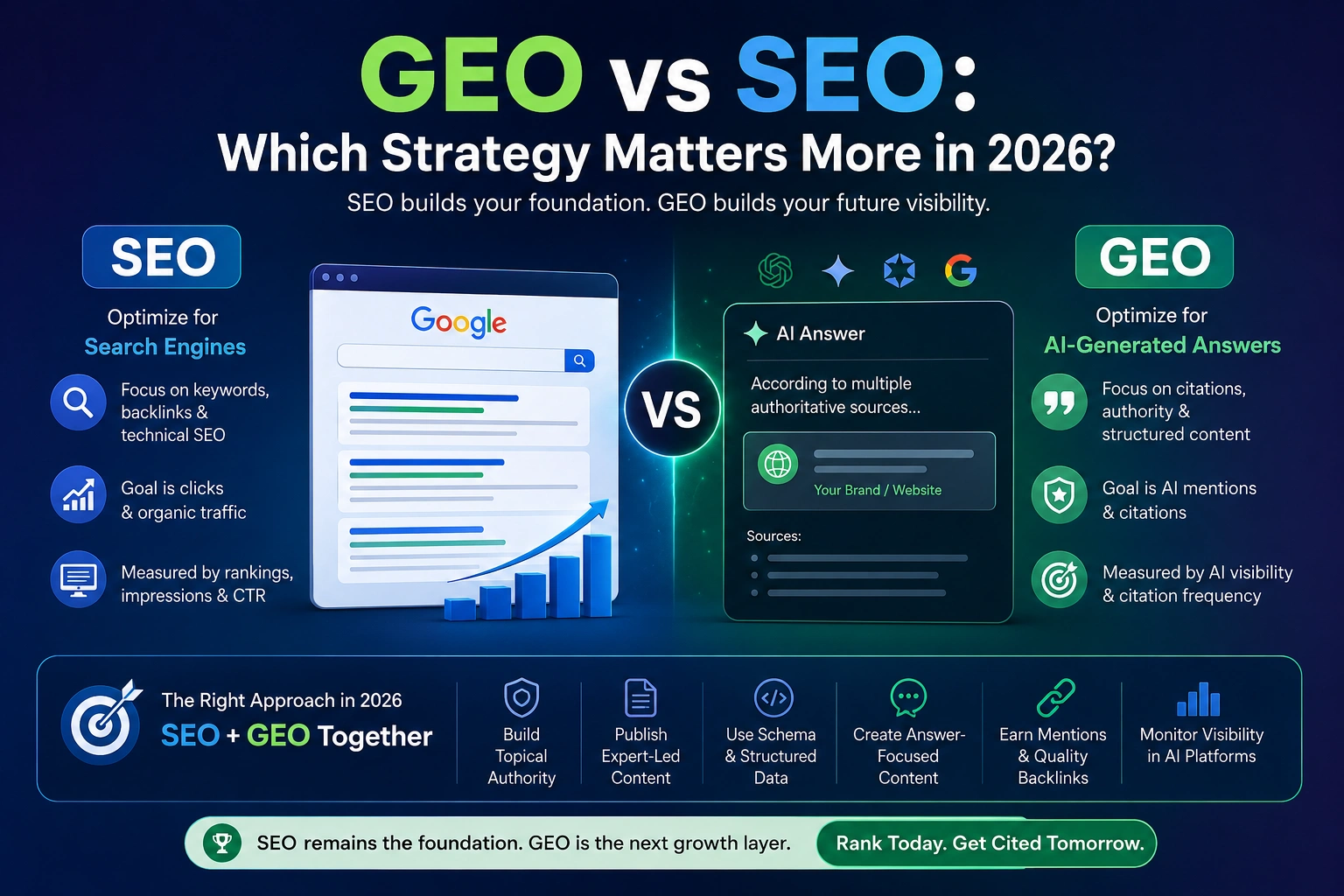
This is the fork in the diagram above. The left path still leads to your website. The right path often does not but your brand can still appear in it. Whether it does depends on a discipline most businesses have not yet built.
This guide starts from the beginning: what each discipline is, how they differ, what’s changed in 2026, and what to do about it.
What is Search Engine Optimization (SEO)?
SEO is the practice of improving your website’s visibility in search engine results pages (SERPs), so that users searching for relevant terms find and click through to your site.
Search engine optimization targets the ranked list of links. The goal is a position: page one, top three, number one.
The five core pillars of SEO:
- Content quality. Helpful, accurate, depth-first content that genuinely answers what the user is looking for.
- Keywords. The specific terms your audience types into search engines, used naturally throughout your pages.
- Backlinks. Links from other credible websites pointing to yours, signalling trust and authority to Google.
- Technical health. Fast load times, mobile-first design, clean site architecture, proper indexing, Core Web Vitals.
- E-E-A-T signals. Experience, Expertise, Authoritativeness, and Trustworthiness — Google’s quality framework for evaluating which content to surface.
Why SEO still matters in 2026:
Google still receives billions of searches daily. For most Indian businesses, organic search is still the largest single contributor of website traffic. And a well-built SEO strategy continues to generate leads, build authority and compound for months/years to come.
But the ground has shifted.
AI Overviews now appear at the top of many Google results pages before the first organic link. The click-through rate for position one on Google drops to approximately 2.6% when an AI Overview is present. Zero-click searches (queries that end without a click to any website) now account for roughly 60% of all searches.
SEO is necessary. It is no longer sufficient on its own.
What is Generative Engine Optimization (GEO)?
GEO is the practice of structuring your content, brand signals, and web presence so that AI systems cite or recommend your brand when generating answers to user queries.
Where SEO targets ranked results, generative engine optimization targets AI-generated answers. The systems it optimises for are different: ChatGPT, Google AI Overviews, Perplexity, Gemini, and every AI engine that sits between a user’s question and a website.
In SEO, success is a position.
In GEO, success is whether the AI mentions you at all.
The origins of GEO:
The discipline was formally defined in a 2024 paper co-authored by researchers at Princeton, Georgia Tech, and IIT Delhi. The core finding: how you structure and present content directly influences whether AI systems choose to cite it. GEO is not guesswork. It has measurable signals.
The six signals that drive GEO visibility:
- Entity consistency. Your brand name, description, and details match perfectly across your website, Google Business Profile, LinkedIn, directories, and every other surface an AI might cross-reference.
- Original statistics with attribution. Proprietary data, case studies, and named research. Adding attributed statistics lifts AI visibility by up to 40% (Princeton/IIT Delhi GEO paper, 2024).
- Source citations within your content. Content that names and links to credible external sources is treated as more trustworthy by AI engines.
- Third-party brand mentions. Other credible sites referencing your brand. With or without a link.
- Structured data / schema. Organisation, FAQ, HowTo, Article, and Author schema help AI systems parse and correctly attribute your content.
- Content freshness. Visible “Last Updated” dates, current statistics, and recent examples signal to AI that your content is reliable.
SEO vs GEO: The Core Differences
In SEO, a link is the currency.
In GEO, a mention is the currency.
That single sentence contains most of the strategic implication. Here is the full comparison:
| Dimension | SEO | GEO |
| Goal | Rank higher in search engine results pages | Get cited in AI-generated answers |
| Target systems | Google, Bing | ChatGPT, Gemini, Perplexity, Google AI Overviews |
| Success metric | Position, organic traffic, CTR | AI citation share, brand mention in AI answers |
| Core signals | Content quality, backlinks, technical health | Entity consistency, original data, brand mentions, schema |
| Content approach | Keyword-optimised pages | Answer-structured, fact-dense content |
| Authority model | Domain Authority, backlink profile | Mention frequency across credible sources |
| Measurement tools | Google Search Console, rank trackers | AI citation tracking (emerging), manual testing |
| Discipline age | 25+ years of methodology | Formally defined 2023; operational 2025-26 |
| Risk of ignoring | Loss of organic traffic | Invisible to a growing share of all search behaviour |
What they share:
Both reward depth, accuracy, and E-E-A-T signals. Both benefit from structured data and entity consistency. A well-built SEO foundation makes GEO significantly easier to layer on top.
The relationship, stated simply: GEO builds on SEO. It does not replace it.
What is Changing in Search Marketing in 2026?
This is where theory becomes urgent.
The numbers:
- 50–60% of US searches now trigger a Google AI Overview — up from just 6–8% in early 2024
- ~60% of searches end without a click
- 2.6% click-through rate for position one on Google when an AI Overview appears
- 6.82% overlap between ChatGPT citations and Google’s organic top 10 (ConvertMate, 2026 — based on 12,500 queries / 8,000 domains)
- 28.3% of the most-cited ChatGPT pages rank nowhere on Google
- 1 in 3 consumers now skip Google entirely, starting on AI tools or social platforms — for Gen Z, over 50%
- 73% of B2B buyers use AI tools in their research process
- 1,850% year-on-year increase in leads from AI platforms (HubSpot, 2026)
What these numbers mean together:
The search channel has forked. Traditional SEO serves users who type into Google and click links. Generative engine optimization serves users who ask an AI and get a direct answer.
The two populations are growing at different rates.
Three structural shifts driving this:
1. AI Overviews went from experiment to being the default. They were rolled out quickly and subtly by Google. A brand that has invested over a decade to climb and dominate search results can suddenly see an AI overview take over the top of its results page and answer the search query before anyone can click.
2. Engines have vastly different citation logic. It has been found that for a specific query, only 11% of domains are cited by both ChatGPT and Perplexity (Averi, 2026) in analysing 680 million AI citations. What ranks in Google doesn’t automatically show up in ChatGPT. What appears in ChatGPT doesn’t automatically appear in Perplexity. Engines work on their own metrics.
3. The revenue impact is invisible in traditional dashboards. Most reporting tools track the number of clicks and sessions that are received. When the answer shown for the search query suggests your competitor, no event occurs that is trackable through conventional analytics systems. The loss is tangible. The measurement is not.
This is the gap that AI SEO exists to close.
Insight 1: GEO is brand defence before it’s brand growth
Most GEO content frames the discipline in growth terms. More visibility. More valuable traffic. Higher conversion rates.
The more urgent framing is defensive.
When a user asks ChatGPT “best accounting software for Indian SMEs” or asks Gemini “alternatives to Razorpay,” the AI generates an answer. It names brands. It makes recommendations. It does this whether or not your brand has done anything to earn a citation.
If you haven’t built the signals that make AI engines cite you, you are absent from a conversation happening at scale.
Your competitors are being recommended in your place. And there is no analytics report telling you.
The hidden costs add up. The customer prospect starts browsing in ChatGPT. There are 6 brands displayed. They pick 3 to consider. You were not on the list. They never get to your site. The conversion was lost before it even made it into the funnel, and your Google Analytics registers nothing.
Multiply this across thousands of queries. Across twelve months of growing AI search adoption.
ConvertMate’s 2026 study found AI search visitors convert at roughly 4.4x the rate of traditional organic visitors, with AI search traffic growing at 527% year-over-year. These are real gains. But they compound on the foundation of being present in AI answers at all.
The defensive minimum: appear when AI discusses your category. The growth upside follows from there.
Insight 2: AI reads the web about you, not just your website
This is the structural shift most GEO guides miss.
Traditional search engine optimization is mostly about your own pages. You write the content. You earn the links. The signals Google reads are from your site and the sites pointing to it.
AI engines work fundamentally differently.
They aggregate signals from across the entire web:
- Reddit threads where users discuss your category
- Quora answers comparing options in your space
- News articles mentioning your business
- Review platforms and comparison sites
- Industry reports and analyst coverage
- Wikipedia and structured knowledge sources
Brand mention frequency across authoritative sources is approximately 3x stronger as a predictor of AI citation than traditional backlinks.
This changes the discipline significantly.
Earning AI citations is not a content-on-your-site exercise. It is a brand-across-the-web exercise.
For Indian brands, this means:
- Building genuine presence in forums and communities where users ask questions about your category
- Earning mentions in business press, industry publications, and analyst reports
- Maintaining consistent brand descriptions across every platform an AI might cross-reference
- Creating content other people want to cite — then earning those citations through quality, not manipulation
The brands winning at GEO in India have built this kind of distributed authority over years. Zerodha Varsity is cited heavily by AI engines for investing queries because its content has earned mentions across thousands of financial discussions, not just because the Zerodha website is well-structured. Cleartax appears in AI answers for tax queries because structured Q&A content has been referenced and discussed across the Indian personal finance ecosystem for a decade.
The skill this requires sits closer to digital PR than to technical SEO.
Insight 3: The vernacular GEO opportunity most Indian brands are ignoring
This is the most India-specific insight in this guide, and one almost no agency is surfacing.
According to the IAMAI-KANTAR Internet in India Report 2024:
- India has 886 million active internet users
- 98% access digital content in Indic languages
- 57% of urban internet users prefer regional-language content over English
- 488 million rural users account for 55% of the total internet population
The Google-KPMG research adds a sharp commercial number: 88% of Indian-language internet users are more likely to respond to digital advertising in their vernacular language than in English.
Now consider how AI engines are built.
Large language models are trained overwhelmingly on English-language data. Hindi, Tamil, Telugu, Marathi, Bengali, Gujarati, Kannada, and Punjabi are significantly under-represented — both in training data and in the web indexes AI systems draw from.
When an Indian user asks an AI engine a question in Hindi or Tamil, the model has far fewer authoritative sources to draw from than for the same question in English. The competition for AI citations in vernacular languages is genuinely low right now.
The brands that produce well-structured, fact-dense, citation-ready content in Indian languages now will own AI citations for vernacular queries for years.
Almost no Indian brand is doing this seriously yet.
The practical first steps:
- Identify the 20–30 queries your customers most commonly type in their native language
- Produce structured, answer-first content for those queries
- Ensure schema markup, entity consistency, and FAQ formatting apply to vernacular pages, not just English ones
- Track vernacular AI citation manually until tooling catches up
The window is open. It will close as more brands move on it and AI engines absorb more Indian-language training data.
Insight 4: What AI engines cite and what they don’t
The data on what AI engines prefer to cite is counterintuitive, and it changes how you should build content.
Only 6.82% of ChatGPT results overlap with Google’s top 10. This is not a measurement error. It is AI engines telling you they value different things than Google does.
Content AI engines disproportionately cite:
- Forum discussions (Reddit, Quora) – discussions among actual people that explain problems using natural language
- Comparison and “best of” content – lists comparing and contrasting multiple products/services
- Definition and explainer pages – directly answer the “what is X” question
- Step-by-step tutorials – sequential, easy-to-follow content
- Original stats with clear sourcing (“According to NASSCOM…”, not “studies have shown…”).
One critical structural finding: pages that front-load their key claim in the first sentence are cited 2.1x more often than pages that build toward a conclusion.
Content AI engines under-cite:
- Corporate boilerplate and brand landing pages
- Sales-heavy content with thin or unsupported claims
- Content that delays the answer in favour of long preambles
- Pages with generic statistics and no named source
The implication for your content team:
Reorganise high-value pages by inverting the pyramid. Make the claim first. Follow the claim immediately with proof. Reference the claim statistics and don’t talk in vague generalisations. Implement schema and FAQ sections. Make content extractable, not just readable by humans.
Each engine also behaves differently:
| Platform | Citation behaviour |
| Perplexity | Weights forum content and recent sources heavily |
| ChatGPT | Draws on training data + web search; favours cited, comprehensive content |
| Google AI Overviews | Prioritises indexed content with strong E-E-A-T and entity signals |
| Gemini | Leans on Google’s Knowledge Graph and indexed content |
Tracking AI visibility as one combined number misses 89% of the citation landscape.
Insight 5: GEO is concentrating visibility at the top
The optimistic story is that anyone can earn AI citations with great content.
It is partly true. The fuller picture is less democratic.
AI engines heavily favour brands already mentioned frequently across authoritative sources. The mention signal compounds. Brands already widely referenced get cited more. New entrants face a higher wall than traditional SEO ever presented.
The Indian brands dominating AI citations in their categories share one thing: years of distributed entity authority.
- Zerodha for investing queries — Varsity and TradingQnA have earned mentions across thousands of discussions for over a decade
- Cleartax for tax queries — structured Q&A content, cited consistently across personal finance forums and news
- Razorpay for payments — developer documentation, Razorpay Learn, and broad industry press coverage
- RBI, NPCI, SEBI for regulatory queries AI engines default to official sources for high-stakes information
For established brands: invest now to lock in citation patterns before competitors consolidate around you.
For newer entrants: focus GEO on the niches where category leaders have not built authority yet. The white spaces in AI citation coverage are real find them before they fill.
A Practical GEO + SEO Playbook
This is the integrated approach, in three phases.
Phase 1: Audit the foundation
Start with the SEO health check:
- Technical audit: site speed, mobile experience, crawlability, Core Web Vitals
- Content quality: E-E-A-T signals, author credentials, sourcing transparency
- Backlink profile review
Then add the GEO layer:
- Schema audit. Does every key page have Organisation, Article, FAQ, and Author schema? Validate against Google’s Rich Results Test.
- Entity consistency check. Does your brand name, description, and category match across your website, Google Business Profile, LinkedIn, major directories, and Wikipedia if applicable?
- AI citation audit. Test your 20–30 most important queries in ChatGPT, Perplexity, Google AI Overviews, and Gemini. Log which platforms cite you, which cite competitors, and what language is used.
Phase 2: Layer in GEO optimisation
Restructure high-value content for AI extraction:
- Front-load every section with the core claim in the first sentence
- Add attributed statistics in the body name the source, not just “studies show”
- Build FAQ schema sections formatted for AI extraction
- Add TL;DR summaries at the top of long pages
- Add “Last Updated” dates visibly on all pages
Build mention-earning habits:
- Build genuine presence in the forums and communities where users discuss your category
- Pursue industry publication coverage and analyst mentions
- Expand to vernacular content for your highest-volume regional language queries
SEO optimization tools that support this phase:
- Google Search Console (track AI Overview appearances)
- Semrush AI Visibility or Ahrefs AI citation data
- Google’s Rich Results Test (schema validation)
- Brandwatch or Mention (third-party brand mention tracking)
Phase 3: Measure, scale, and refine
Track dual KPIs: traditional rankings alongside AI citation share. Audit citation presence monthly. Update high-value content quarterly with fresh data. Expand vernacular GEO as measurement improves.
Key note on budget: Most GEO optimization builds on existing SEO work. Content restructuring, schema, and entity consistency are largely one-time efforts. The incremental investment is in mention-earning and citation monitoring. For most businesses, this adds roughly 15–25% to an existing SEO strategy, not a doubling.
New KPIs for the AI Search Era
| Metric | What it measures | Why it matters |
| AI citation share | How often your brand appears in AI answers for category queries | The primary GEO performance signal |
| Cross-platform consistency | Whether you’re cited on ChatGPT, Perplexity, Gemini, and AI Overviews | Gaps reveal where to focus |
| Zero-click brand impressions | AI summary appearances without a click to your website | Measures brand recall, not just traffic |
| Citation quality | Whether you’re cited as the recommendation or a passing mention | Context matters as much as presence |
| Brand mention velocity | Rate at which credible third-party sites reference your brand | The signal that drives AI visibility |
| Vernacular citation share | AI citation rate for regional-language queries | India-specific opportunity metric |
An honest note on measurement:
The tooling is still maturing. Google Search Console does not yet provide comprehensive AI Overview data. GEO measurement currently relies on manual testing, brand monitoring tools, and emerging platforms like Semrush’s AI Visibility feature and Otterly. The discipline of measuring imperfectly is far better than not measuring at all.
How Savit Approaches GEO SEO
At Savit, GEO SEO is one integrated discipline with two output channels.
Traditional search engine optimization remains the foundation. Generative engine optimization is the second layer built on top. We run both from the same brief, because the brands doing best in 2026 are the ones treating them as one connected strategy.
Our SEO strategy work starts with the full technical and content audit. Then we add the GEO layer: schema treated as infrastructure, entity consistency audited across all platforms, content restructured for AI extraction, and mention-earning work that crosses into digital PR.
For Indian brands, the vernacular opportunity is part of every engagement. The IAMAI-KANTAR data on regional language preference is unambiguous. Our online marketing services include vernacular content strategy and AI citation tracking for regional language queries alongside English.
Our AI SEO and generative engine optimization work goes beyond owned content. We build the off-page brand signals AI engines use to verify credibility the forum presence, the publication mentions, the cross-platform entity consistency that AI cross-references when deciding whether to recommend a brand.
We use the best SEO optimization tools available for both traditional and AI-driven search monitoring. Where tooling is still catching up, we close the gap with manual citation audits.
As a Mumbai-based digital marketing company in India with over two decades in search marketing, we have navigated every major shift in how people find businesses online. The progression from keyword optimization to E-E-A-T to mobile-first indexing to AI-powered discovery has been continuous, and our approach has moved with it.
What stays constant: understand what the systems reward, build the client’s presence around those signals, and measure what connects to real business outcomes.
If you want to know where your brand stands in AI-generated answers today, or what it would take to be where your customers are increasingly looking, we can help.