In early 2026, a website called Grokipedia had published 885,000 articles. Every one of them was AI-generated. It had built what looked like the most comprehensive information resource on the internet hundreds of thousands of pages covering everything from chemistry to cooking to cryptocurrency.
After Google’s March 2026 core update, Grokipedia’s organic visibility collapsed.
Around the same time, Sports Illustrated was caught running AI-generated articles under fake author names complete with AI-generated headshots for writers who did not exist. When the story broke, the content was removed and the editorial trust the publication had built over decades took a significant public hit.
Both stories illustrate the same lesson. The problem is not AI. The problem is the strategy: using AI to manufacture rankings at scale without commensurate expertise, editorial oversight, or genuine value for the reader.
The question businesses need answered is not “can AI content rank?” It is “why does the data show such a stark difference between AI content and human content and what should I do about it?”
The data is now sufficient to answer this specifically.
Does AI Content Actually Rank on Google?
Google does not penalise content for being AI-generated. It penalises content for being low-quality, generic, and unhelpful, regardless of who or what produced it.
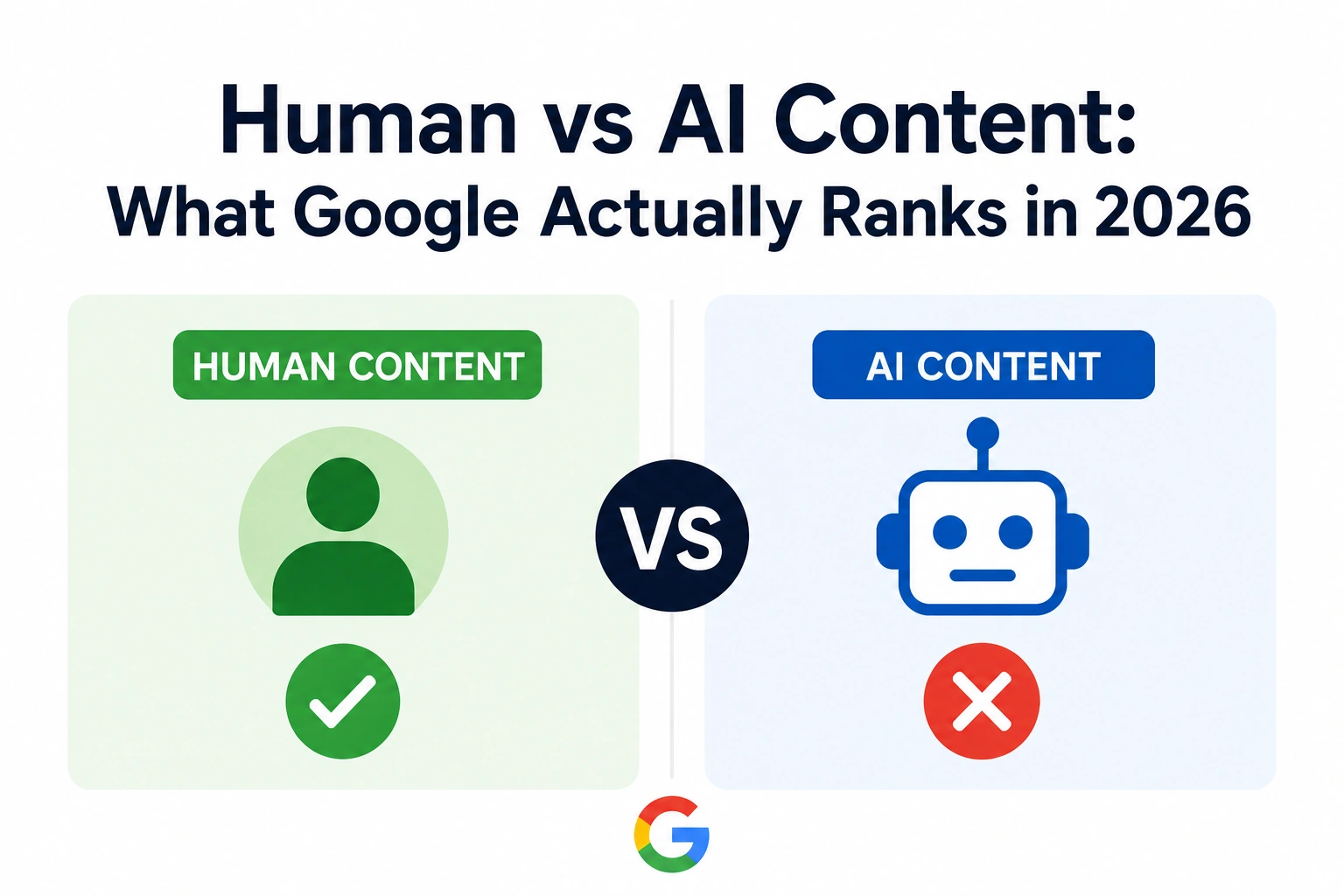
This is an important distinction. Google has maintained from the outset that quality content should rank; it’s the production method that shouldn’t. In fact, an Ahrefs study analysed more than 600,000 web pages and discovered that 86.5% of top-ranking pages had at least some AI-generated content, with the correlation between AI use and any penalties near zero (0.011).
And yet, the same body of research shows a sharp divergence when AI is used without human oversight.
What the major studies found:
| Study | What was measured | Finding |
| Semrush (42,000 blog posts, 20,000 keywords) | Position 1 ranking by content type | Human content holds #1 position 80% of the time; AI-only content just 9% — 8x difference |
| Digital Applied (4,200 articles, 16 months) | Ranking performance by production method | Pure AI content ranked 23% lower; AI-assisted with human editing within 4% of full human content |
| Rankability (487 articles tested) | Top search results by authorship | 83% of top results were human-generated content |
| AHREFS Study (600,000+ pages) | AI use vs ranking penalties | 0.011 correlation; original data drives +22% visibility |
The pattern across all four studies is the same. AI as a production tool, used under human editorial direction, does not hurt rankings. AI as a replacement for human expertise produces content that Google consistently ranks lower — not because of what created it, but because of what it lacks.
What Google’s March 2026 Update Was About
The March 2026 core update was one of the wildest algorithm shifts in recent years. The Semrush Sensor volatility index reached 9.5 out of 10, with more than 55% of monitored sites having rank changes within 14 days.
Industry analysts believe the update deployed a Gemini-powered semantic filter capable of evaluating content quality at the individual-article level rather than the domain level, which is a significant capability increase from previous updates.
What the update targeted:
Sites publishing from a large-scale, unedited AI publishing process (like the Grokipedia style model) were seeing traffic decrease by 60-90%. This wasn’t a small drop for these sites. Many were seeing their organic search visibility go away.
What the update rewarded:
Sites publishing from their original data saw a 22% increase in visibility. The sites that were performing were authoritative in their space, had experts behind their content and were providing information not available on the internet prior to their post. The March update was a double bet: it punished high-volume, no-value content and rewarded original content with verifiable experience.
The pattern is clear in who was hurt and who was not. Bankrate and NerdWallet, YMYL financial sites with editorial policies that require human expert review of all content, maintained strong rankings throughout the update. Content farm sites that had built massive libraries of thin AI-generated financial advice lost their visibility substantially.
This is not a coincidence. It reflects what Google’s Quality Rater Guidelines had been building toward since the January 2025 update, which explicitly assigned its lowest quality rating to “low-effort AI content with little added value.
Why Human Content Ranks Better: The Structural Advantage
Human content does not rank better because Google has an ideological preference for it. It ranks better because it has something AI content structurally cannot produce: genuine experience.
When Google added the first “E” Experience to its E-E-A-T quality framework, it was encoding a specific signal. Experience means: the person who wrote this has actually done the thing they are describing. They have used the product. They have treated the patient. They have managed the campaign. They have eaten at the restaurant.
AI has no experience. It synthesises information from existing sources about other people’s experiences. It can produce text that describes an experience accurately because it has read thousands of descriptions of similar experiences. But it cannot provide the detail, the unexpected insight, or the corrective perspective that comes from someone who has actually done the work.
This is why Google AI Overviews cite Reddit in 28% of cases. Reddit is full of poorly formatted, casually written, grammatically imperfect posts by people who have actually done things. Those posts beat polished AI-generated content for certain queries because Google is explicitly looking for the signal of genuine first-person experience, and Reddit has it in abundance.
The backlink signal tells the same story. The Digital Applied study found that pure AI content acquired 61% fewer editorial backlinks than human-written articles. This is structural, not accidental. When human experts read something that adds genuinely new information to a field, they cite it. When they read a synthesised summary of what other people have already written, they do not. AI content that merely recombines existing information does not generate the “this is new and worth citing” response that earns editorial links.
The CNET example is instructive here. In 2023, CNET published AI-generated financial articles that contained factual errors. The errors were not random they were the specific kind of error an AI makes when it synthesises information from multiple sources that contain slightly different numbers and resolves the ambiguity incorrectly. A human financial expert would have caught the discrepancy because they understand the underlying reality. The AI produced text that was internally plausible but factually wrong.
CNET had to issue corrections and remove content. The editorial trust damage extended well beyond the AI articles themselves.
The Self-Referential Loop: Why Pure AI Content Devalues Itself Over Time
Here is an original problem that most discussions of AI content miss.
AI language models are trained on existing web content. As AI-generated content becomes more prevalent on the web, future AI models are increasingly trained on AI-generated content. The result is an accelerating cycle: AI writes content based on what AI previously wrote, based on what AI previously wrote before that.
The information on the web becomes increasingly homogenised. Every article about “the best marketing strategies” increasingly sounds like every other article because they are all synthesised from the same upstream sources, which were themselves synthesised from earlier sources.
In this environment, the content that stands out is precisely the content that cannot be replicated this way: content with first-hand data that has never been published anywhere else, content with specific examples from direct experience, content with an original argument that contradicts the existing consensus.
Websites that publish original research proprietary surveys, internal data analyses, case studies with specific measurable outcomes saw a 22% visibility increase after the March 2026 update. This is the market rewarding originality. As generic AI content floods the web, original content becomes rarer and its ranking premium increases.
Investopedia has maintained ranking dominance in financial content not through volume but through depth articles reviewed by certified financial planners with named credentials and verifiable expertise. When Google’s algorithms assign E-E-A-T scores, an article signed by a CFP with 20 years of practice scores differently from an AI summary of common financial advice, even if the surface content is similar.
Where AI Content Works and Where It Reliably Fails
AI content works well in specific, well-defined conditions:
- First drafts of content that will be substantially edited by experts
- Structured data reformatting and content variations at scale
- Real-time updates with factual inputs (product specifications, sports scores, regulatory changes)
- Research assistance and source aggregation before human analysis
- SEO outline generation for human writers to execute against
AI content reliably fails when:
- The content requires verifiable first-hand experience (product reviews, clinical observations, case study analysis)
- The query is YMYL health, finance, legal where factual accuracy is both critical and easy to verify against authoritative sources
- The content needs to take a specific original position, not synthesise existing positions
- The topic requires citation of primary sources (AI frequently hallucinates citations or attributes quotes incorrectly)
- The audience is expert enough to detect the characteristic patterns of AI synthesis
The Rankability dentist test is instructive. Rankability compared AI-generated content with human-written content for dental practice queries standard local business SEO keywords. Human content outperformed AI content consistently in search rankings. The reason: dental content that ranks needs specific, verifiable information about procedures, qualifications, and local context that AI cannot generate from general training data and that humans need to verify carefully. When Google evaluates YMYL content, the verification standard is high. AI content that fails that standard does not rank.
What Works for Content: The AI-assisted Formula
The Digital Applied finding is the most practically useful data point in this entire debate. AI-assisted content with substantive human editing performed within 4% of fully human-written content. The 23% ranking gap disappears when qualified humans direct the AI, review its output, add original insight, correct factual errors, and provide the first-hand context the AI cannot generate.
This is the formula that works:
| Use AI for | Keep humans responsible for |
| Research synthesis and first drafts | Original insight and first-hand experience |
| Content outlines and structure | Expert fact-checking and source verification |
| Scaling production of repetitive formats | Brand voice, tone, and editorial judgement |
| Generating testing variations | E-E-A-T signals — the experience Google rewards |
| Speed and volume within a framework | Strategic decisions about what to publish and why |
The key variable is human editorial investment at the stages that matter. AI-generated content left raw and unedited ranks 23% lower. AI-generated content substantially shaped and validated by subject-matter experts ranks within 4% of fully human work.
For AI content creation in practice, the prompt quality also makes a significant difference. AI output improves dramatically when given specific brand voice guidelines, business context, target audience parameters, and the kind of expert context the AI cannot infer from general training. The closer the human is to the AI’s process, the better the output.
For businesses managing both search rankings and AI citations:
The formula for Google and the formula for AI Overviews (ChatGPT, Perplexity, Gemini) is increasingly the same. Original data, clear structure, demonstrated expertise, and verified sourcing rank on Google and get cited by AI platforms. Optimising for AI and SEO now means building content that is genuinely original, carefully structured, and backed by verifiable experience not content that is merely well-formatted or keyword-optimised.
The Social Media Parallel
The same principle applies to a social media content strategy, in a different way.
Social media algorithms on Instagram, LinkedIn, and X increasingly favour content that generates genuine engagement saves, shares, and comments that signal the post resonated with someone’s real experience. AI-generated social content tends to produce polished, generic posts that get surface-level engagement (likes) without the depth of engagement (comments and saves) that the algorithms use to distinguish content worth distributing widely.
The brands that perform best on social media in 2026 are the ones with founder-voice posts that share specific experiences and opinions, with behind-the-scenes content that is clearly real, and with posts that take positions rather than summarising consensus. These are not things AI can generate from general training they require the kind of specific context that only humans inside a business can provide.
AI can help draft captions, suggest content angles, and optimise post timing. It cannot provide the authentic specific perspective that makes a social post worth engaging with. For any social media content strategy, the human layer is where the value is created; AI handles the production work around it.
What Savit Thinks About Content and AI SEO In 2026
At Savit, we have been watching the evidence on AI content and search rankings for two years, and the conclusion is clear enough to run a business on.
We use AI extensively. Research synthesis, first-draft generation, content outlines, structural frameworks, and production scaling AI makes all of these faster and more consistent. It is a genuine productivity tool.
We do not use AI as a replacement for human expertise. Every piece of content we produce for clients is shaped by people who understand the subject, the audience, the competitive landscape, and the brand. The original insight, the first-hand examples, the editorial judgement, and the fact-checking all of that is human work. This is not an ideological position. It is the formula that the data shows works.
We rely on the very same evidence base that this blog is built on for our AI SEO strategy. The March 2026 update hasn’t changed what Google rewards; it just refined what it sees as worthy of ranking. Original research is seen and found. Domain Authority is trusted. Editing and content quality are link-worthy. These have always been the criteria. AI for SEO is most effective when it serves these criteria, not when it bypasses them.
For clients who need content that ranks on Google, gets cited in AI Overviews, and genuinely engages their audience, we build content strategies around original insight and expert authority. AI content creation handles the production. Human expertise handles the value.
As your go-to digital marketing company in India with 25 years of experience working across industries, we understand what content builds sustainable search visibility versus what generates short-term traffic that collapses in the next core update. We have seen both patterns repeatedly, and we build our work around the one that lasts.
Whether you need blog content, landing page copy, a social media content strategy, or a content programme designed to rank and earn AI citations, our team can help you build it in a way that holds up.
Talk to Savit about content that earns rankings and trust.