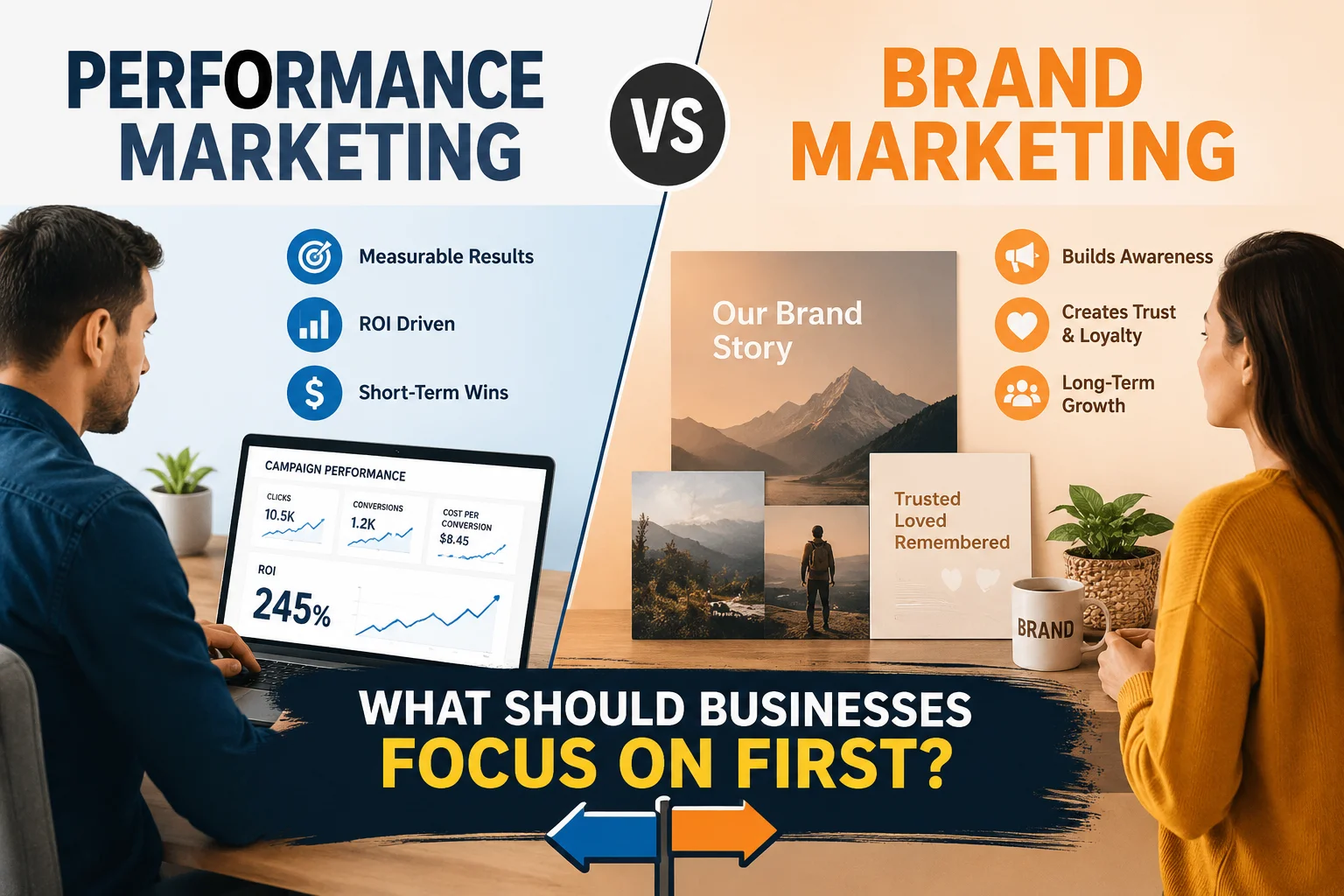
The question is usually asked the wrong way.
Most businesses treat this as a choice. Performance marketing or brand marketing. Immediate results or long-term awareness. What you can measure now or what pays off later.
It is not a choice. It is a sequence and a ratio.
The most rigorous study of advertising effectiveness ever conducted Les Binet and Peter Field’s analysis of 996 IPA campaign case studies spanning over thirty years found that the optimal budget split for most businesses is 60% brand building and 40% performance activation. That ratio maximises combined short-term and long-term profit.
Moving from a brand-plus-performance mix to performance-only cuts ROI by 40%. Moving back the other way from performance-only to a balanced mix delivers a +90% average ROI uplift.
The businesses that are most confidently running performance-only strategies are the ones that will feel this 40% shortfall most acutely in two years.
This guide explains what each approach does, what the data says about balancing them, and how to decide what to focus on first based on where your business is right now.
What Is Performance Marketing?
Performance marketing is advertising designed to produce a specific, measurable action a click, a lead, a purchase, an app install whose result can be tracked and whose spend can be justified against direct output.
Every campaign is built around a measurable outcome. Every rupee is evaluated against a return. What works gets scaled. What does not gets cut.
The main performance marketing channels:
- Search ads (Google Ads, Bing PPC)
- Social media direct-response ads (Meta, LinkedIn, YouTube)
- Retargeting and remarketing campaigns
- Affiliate and performance-based partnerships
- Shopping and catalogue ads
What performance marketing does well:
It captures demand that already exists. When someone searches “best CRM software for small businesses” or “digital marketing agency Mumbai,” they are already in purchase mode. Performance marketing meets them at that moment with a relevant offer and a direct path to conversion.
It is fast, trackable, and scalable. You can see results within days, test variations against each other, and invest more in what is working within the same budget cycle.
What performance marketing cannot do:
It cannot create demand that does not exist. If no one knows your brand, performance campaigns have to work harder and pay more to earn the same click. A user who has never encountered your brand before is harder to convert than one who has seen it three times in the past month. Performance marketing cannot build that prior familiarity. Only brand marketing can.
What Is Brand Marketing?
Brand marketing is the long-term work of building awareness, recognition, and emotional connection with an audience so that when a purchase occasion arrives, your brand comes to mind first.
Where performance marketing captures demand at the moment it exists, brand marketing ensures you are part of the consideration set before that moment arrives. It is not about the click. It is about mental availability being present in memory when the decision is being made.
The main brand marketing channels:
- Social media content and storytelling
- Video campaigns and organic creative
- Influencer partnerships and editorial coverage
- PR and thought leadership
- Community building and events
What brand marketing does well:
It builds the world your performance campaigns operate in. A user who knows your brand converts at a higher rate, costs less to acquire, and stays longer than one who has never heard of you.
High-awareness brands see 30-50% lower customer acquisition costs and achieve conversion rates 2.5x higher than unknown competitors. These are not soft benefits. They are direct economic advantages that compound over time.
What brand marketing cannot do on its own:
Brand marketing builds awareness. It does not, by itself, drive people to act at the moment they are ready to buy. Without performance marketing capturing the demand that brand investment creates, brand-only strategies build recognition without revenue. The two disciplines require each other.
The Honest Comparison: Performance Marketing Vs Brand Marketing
| Factor | Performance marketing | Brand marketing |
| Goal | Immediate, measurable action | Long-term awareness and trust |
| Timeline | Days to weeks | Months to years |
| What it does | Captures existing demand | Creates future demand |
| Measurement | Direct: clicks, CPA, ROAS | Indirect: recall, sentiment, share of voice |
| Cost trend | Rises as competition and targeting friction increase | Reduces CAC and improves efficiency over time |
| Risk if used alone | Diminishing returns, rising costs | Awareness without conversions |
| Main channels | PPC, paid social, affiliate, retargeting | Content, PR, influencers, community |
The critical row is cost trend. Performance marketing costs do not stay flat. As more competitors bid on the same keywords, as privacy changes reduce targeting precision, and as ad fatigue sets in with audiences who see the same formats repeatedly, the cost of acquiring a customer from performance channels increases.
Brand marketing works in the opposite direction. The more familiar an audience is with a brand, the cheaper and more effective performance campaigns become. These two trends interact directly: brand investment suppresses the cost inflation that performance-only strategies inevitably produce.
What The Data Says
The Binet and Field research is the most comprehensive analysis of advertising effectiveness in existence. It draws on 996 documented IPA campaign cases across industries and decades. Its conclusions have been tested, replicated, and corroborated across different methodologies.
The 60:40 finding. Allocating approximately 60% of marketing budget to brand building and 40% to performance activation maximises combined short-term and long-term profit for most consumer brands.
Why this ratio. Short-term activation campaigns produce returns quickly but decline if not supported by ongoing brand work. Long-term brand campaigns build cumulative effect over years — the IPA data shows brand campaign effectiveness grows from 1.3x in year one to 2.1x by year three as associations accumulate in memory. The two approaches compound each other when combined.
The imbalance penalty. Moving too far toward performance (80-90% on conversion media) produces declining ROI over multi-year horizons. Moving too far toward brand (80-90% on awareness) builds recognition that never converts. The 60:40 split sits at the intersection where both effects reinforce rather than undermine each other.
The 60:40 is a median, not a prescription. The optimal ratio shifts by business type and stage:
| Business situation | Suggested brand : performance ratio |
| New market entrant, building awareness | 70 : 30 |
| Consumer brand at growth stage | 60 : 40 |
| FMCG / low-involvement category | 65 : 35 |
| E-commerce or D2C brand | 50 : 50 to 60 : 40 |
| Established brand with strong awareness | 40 : 60 |
New entrants need more brand investment relative to their size because they are building mental availability from zero. Established brands have accumulated brand equity that makes their performance campaigns more efficient, so they can tilt toward activation without the same cost penalty.
The CAC Spiral That Performance-only Strategies Create
This is the mechanism most businesses do not see until they are already inside it.
Year one of a performance-only strategy typically delivers solid results. The brand is new enough that there is untapped demand to capture, and ad costs are not yet elevated by sustained bidding. ROAS looks good. Leadership sees the returns and commits more budget to performance.
By year two, something shifts. CAC is climbing. The same spend is producing fewer leads at a higher cost. The team tries optimising campaigns, improving landing pages, and testing new ad formats. Some of these work temporarily. But the underlying trend continues upward.
By year three, CAC may have risen 60-80% from the original baseline. The business is spending significantly more to acquire the same customers it was acquiring cheaply at the start.
What caused this? Not bad campaigns. The performance marketing was often well-executed. The problem is that performance marketing captures demand from people already inclined to buy. Over time, you exhaust the most easily convertible segment. The remaining prospects need more convincing and convincing costs more. Without brand investment creating new familiarity, the pool of easily convertible prospects does not refill.
This is the compounding cost of a brand deficit. And recovering brand position once it has eroded costs significantly more than maintaining it would have. The competitive share of voice that was vacated gets occupied by competitors who continued investing in awareness.
India’s startup ecosystem has documented this pattern extensively. Several high-profile consumer brands, particularly in EdTech and e-commerce, ran aggressively performance-heavy marketing strategies, generated impressive growth metrics in early years, and then faced mounting customer acquisition costs that made profitability increasingly difficult to achieve. The pattern was consistent: performance-heavy early, brand deficit accumulated silently, CAC spiral arrived later.
The sustainable alternative is not spending less on performance. It is building brand investment alongside performance from early enough that the two compound rather than conflict.
What Should Your Business Focus on First?
The right answer depends on where the business is, not on what is easiest to defend in a budget review.
If you are a new business or startup: You need performance marketing for immediate revenue. You cannot build awareness before you have income. But build a brand foundation alongside performance from the start; even at a modest proportion. A 70:30 brand-to-performance tilt early, with performance dominating if budget is constrained, protects you from the CAC spiral that 100% performance-focused businesses hit in years two and three.
If your CAC is rising and performance returns are declining: You almost certainly have a brand deficit problem. The solution is not more performance optimisation. It is brand investment that rebuilds familiarity and mental availability, suppresses competitor share of voice, and creates the conditions where your performance campaigns work more efficiently again.
If you are in a highly competitive market: Brand investment is more important, not less. In markets where products and prices are similar, brand is what creates preference. Performance marketing cannot manufacture differentiation. It can only amplify the differentiation that already exists in people’s perception of the brand.
If you have strong awareness but weak conversions: You have a performance problem. Brand is working. The conversion infrastructure, i.e. campaigns, landing pages, offers, and targeting, is not capturing the demand the brand creates.
How to know when to rebalance:
Watch customer acquisition cost over a rolling 12 months. If it is rising quarter over quarter despite consistent or improving campaign quality, brand investment is insufficient. If conversion rates are declining despite strong awareness metrics, performance execution needs attention. The balance is dynamic: review it every six months and adjust based on what the data shows.
How Do You Measure Both?
Measuring performance marketing is straightforward. Conversion rate and cost per acquisition. Return on ad spend. Click-through rate. Leads, sales, and revenue directly attributed to campaigns. These metrics are visible within the campaign period.
Measuring brand marketing requires a longer measurement window and different metrics. Brand awareness and recall (measured through surveys). Share of voice and excess share of voice (how your brand presence compares to competitors relative to market share). Branded search volume trends in Google Search Console. Sentiment analysis. Direct and organic traffic growth as a proxy for growing brand familiarity.
The measurement gap is a management problem, not a marketing one. Brand marketing’s returns are real and documented media-mix models like Meta’s Robyn and Google’s Meridian consistently show brand-building media outperforming bottom-funnel channels once long-term effects are included in the analysis. The challenge is that most businesses measure marketing on quarterly cycles, where brand effects are not fully visible. Short measurement windows systematically undervalue brand investment and create the structural incentive for performance-only strategies that the data consistently shows are suboptimal.
How Savit Approaches This
At Savit, we start by understanding where a business is in its development and what the data says about that situation; not by defaulting to the easiest thing to sell.
For businesses that need immediate results, our performance marketing work covers PPC, paid social, retargeting, and conversion optimisation, tracked against ROAS and CPA targets. For businesses investing in awareness, differentiation, and long-term demand creation, our brand marketing work covers content, social storytelling, PR, and community building. In most cases, the right answer is a calibrated mix of both.
We have worked with businesses at both extremes: brands that have invested heavily in awareness without performance infrastructure to capture the demand they create, and brands that have run performance-heavy strategies until rising CAC made growth unsustainable. The pattern is consistent. The businesses that grow efficiently over a five-year horizon are the ones that run brand and performance together, weighted appropriately for their stage.
As a digital marketing agency and performance marketing agency serving businesses across India and internationally, with our base as a digital marketing company in Mumbai, we understand the Indian market’s specific pressures: the quarterly revenue expectations that drive over-investment in performance, the brand deficit that accumulates quietly, and the CAC spiral that becomes visible too late. We build marketing mixes that avoid these patterns.
Our online marketing services span both disciplines performance marketing (PPC, paid social, affiliate, retargeting) and brand marketing (content strategy, social, PR, community) delivered as one integrated plan rather than two disconnected workstreams. The budget allocation between them is determined by the business’s situation, the data on what is working, and the Binet and Field evidence on what drives long-term growth.
Whether you need immediate leads and revenue, a brand strategy that lowers your long-term costs, or a clear answer on how to balance both for your specific market and stage, our team can help you build the right approach.
As a performance marketing agency India’s businesses trust, we focus on what the evidence says actually grows businesses not what is easiest to measure in a monthly report.
Talk to Savit about building the right mix of performance and brand marketing for your business.