When someone uses Siri, Google, or ChatGPT to ask something on their phone, they get one answer. Not ten.
That is the single most important thing to understand about voice search.
Traditional search returns a page of links. The user scans, clicks, and compares. There are ten competing answers, and the user decides which one wins.
Voice search returns one answer. The assistant reads it aloud or displays it as the definitive response. There is no second place. The business that wins the voice query gets the full value of that search. Everyone else gets nothing.
This changes the competitive stakes of search in a fundamental way. For traditional SEO, the goal is page one, and page two is bad but not catastrophic. For voice search SEO, the goal is to be the answer, and anything else is invisible.
There are now approximately 8.4 billion active voice assistants globally more than the global population across smartphones, smart speakers, cars, and wearables. Voice search accounts for roughly 27% of all queries in 2026, rising to 30-35% for mobile, local, and navigation searches. Yet only 13% of marketers currently optimise for voice.
That gap is the opportunity.
What Is Voice Search and How Does It Produce Answers
Voice search is the technology that lets people search the internet by speaking to a device instead of typing. Using voice assistants like Google Assistant, Siri, or Alexa, users ask questions in natural language and receive spoken or displayed answers.
The process runs in four steps:
- Speech recognition converts spoken words into text
- Natural language processing interprets the meaning and intent behind the words
- Search and retrieval finds the most relevant single answer
- Response reads or displays that answer
The key phrase is “single answer.” Voice assistants do not recite ten results. They pick one.
Which platform controls which answers:
| Voice assistant | Primary source | What you need to know |
| Google Assistant | Google Search | Handles approximately 67% of all voice queries; draws heavily from featured snippets |
| Siri | Apple-curated sources | Pulls from multiple sources; local queries often use Yelp or Google Maps data |
| Amazon Alexa | Bing (general), Amazon (shopping) | Dominant in voice commerce; strong for product and retail queries |
Google Assistant’s dominance means one thing practically: if you are not optimised for Google Search and featured snippets, you are not in most voice answer pools.
The Fundamental Difference: How Voice Queries Are Phrased
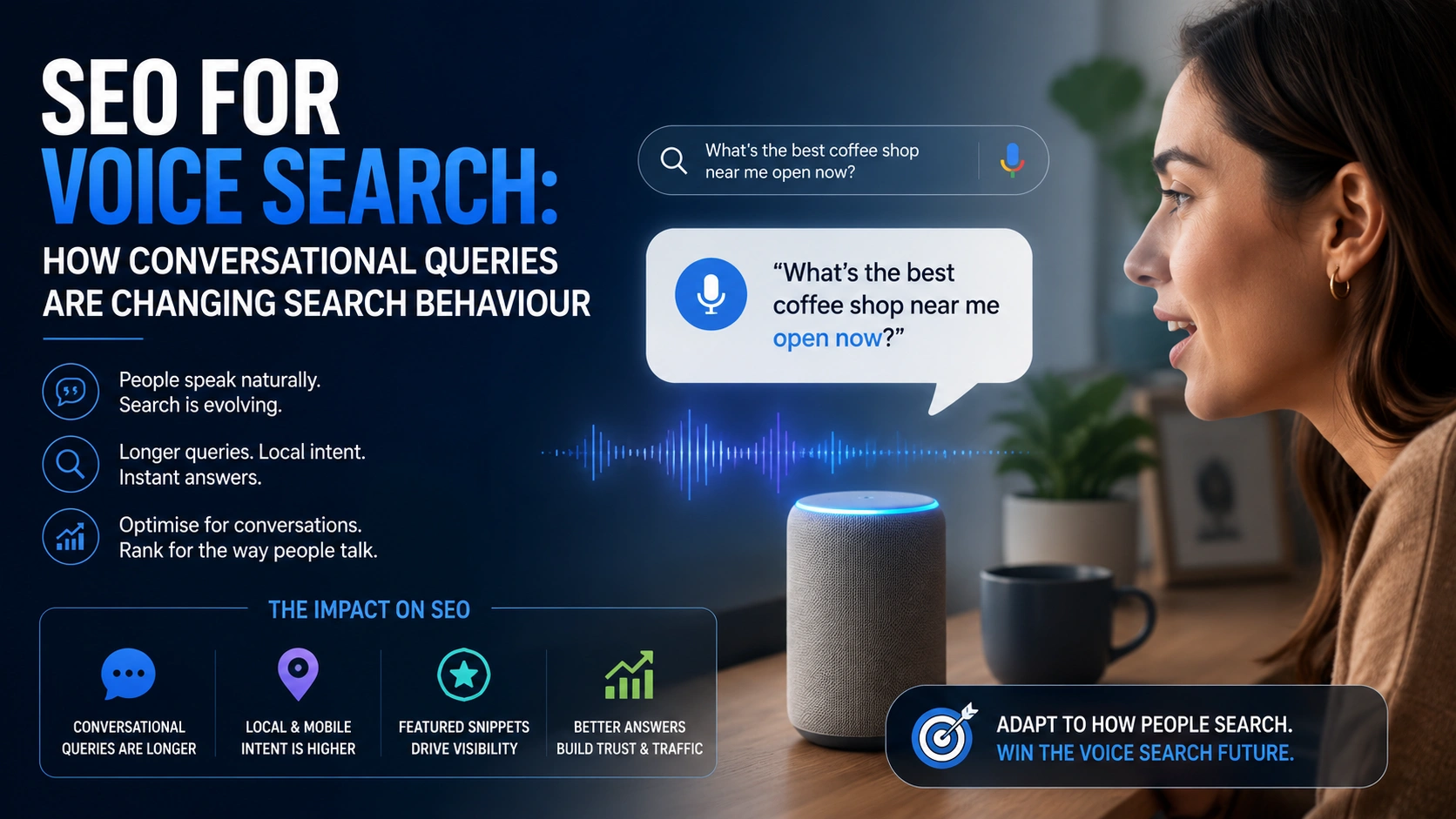
Voice queries are not shorter versions of typed searches. They are different sentences entirely.
When someone types, they compress. “Weather Pune weekend.” When someone speaks, they ask naturally. “What’s the weather going to be like in Pune this weekend?”
This is not a minor stylistic difference. It changes which queries your content needs to answer, which keywords matter, and how your pages should be structured.
How the same search intent looks in each format:
| Typed query | Voice query |
| “italian restaurant mumbai” | “Where’s a good Italian restaurant near me open right now?” |
| “iphone 16 price” | “How much does the iPhone 16 cost in India?” |
| “fix leaking tap” | “How do I fix a leaking tap at home myself?” |
| “SEO services pune” | “Who offers the best SEO services in Pune?” |
| “dentist near me” | “Is there a dentist near Koregaon Park who takes walk-in appointments?” |
Question-format queries make up 60-70% of voice searches versus just 15-20% of typed searches. Voice queries average 7-10 words. Typed queries average 2-3.
For businesses still optimising only for short typed keywords, roughly a quarter of all searches are being left unaddressed entirely.
Voice Search and The Featured Snippet: They Are the Same Strategy
Here is the mechanism that most voice search guides describe but few make explicit enough.
You cannot optimise for voice search directly. There is no “voice search” setting in Google Search Console. There is no separate voice ranking algorithm to target.
What you can do is win featured snippets for conversational queries. And featured snippets are exactly where voice assistants go for answers.
Approximately 40-50% of voice search results come from featured snippets. Over 80% of Google Assistant voice answers come from the top three organic results. The route to voice visibility runs almost entirely through structured, answer-first content that earns position zero.
This means voice search SEO services is not a separate strategy. It is answer-engine-ready content applied to conversational query formats. The same content that earns featured snippets in traditional search becomes the voice answer.
What wins featured snippets:
- Answer the primary question directly in the first 40-50 words of the section
- Use clear, question-based headings (H2s and H3s phrased as actual questions)
- Keep answers factual, concise, and structured. In such cases, lists, tables, and short paragraphs extract well
- Write at an accessible reading level; voice result pages average 9th-grade readability
- Add FAQ sections that mirror natural spoken questions
The brands that should think of voice search SEO first are not enterprise brands with large content teams. They are local businesses answering specific, high-intent questions about their services, hours, location, and expertise.
Site Speed Is a Qualifying Criterion
Pages that rank for voice search load 52% faster than the average web page.
This statistic is usually presented as a correlation between speed and voice ranking, as if faster pages rank slightly better. That framing misses the point. The implication is stronger: below a certain speed threshold, a page is not in the voice answer pool at all. The assistants are pulling from pages that load fast enough to be functionally usable in a voice context. Slow pages are not just penalised. They are excluded.
What this means in practice: Site speed for voice is pass-fail, not a slider. Getting from “very slow” to “average” is not a minor improvement. It is the difference between eligibility and ineligibility for voice visibility.
For most Indian businesses, core speed improvements overlap with core mobile SEO improvements: image compression, caching, minimising render-blocking resources, and choosing hosting adequate for your traffic. 58% of voice searches happen on smartphones. A page that works well on mobile and loads quickly is a page that is in contention for voice answers.
Schema Markup: The Infrastructure That Voice Assistants Rely On
Schema markup is how voice assistants understand what your content is about, who created it, and whether it is trustworthy enough to cite.
Without structured data, an AI system reading your page must infer everything from prose. With schema, you are directly telling it: this is an FAQ page, and these are the questions and answers; this is a local business, here is the address, phone number, and opening hours; this is a step-by-step guide, here are the steps.
The schema types that matter most for voice search:
- FAQPage schema — directly marks up question-and-answer content that assistants can extract and read
- LocalBusiness schema — tells assistants your business name, address, phone, hours, and service area
- HowTo schema — marks up step-by-step instructional content
- Speakable schema — explicitly designates which sections of your content are suitable for text-to-speech
This is not advanced technical work. It is structured metadata that, once implemented, runs quietly in the background and makes your content verifiable to machines.
An important intersection: AI Overviews appear alongside featured snippets in approximately 63.67% of cases. Content with an accurate schema and a featured snippet is positioned for both voice answers and AI-generated responses in the same structure. The optimisation work compounds across both surfaces.
The Local Opportunity Is Where Voice Search Has the Clearest ROI
76% of voice searches are “near me” or local queries. People use voice to find businesses, check hours, get directions, and ask about services while they are already on the move.
This creates conversion rates that outperform most other search channels:
- 28% of local voice searches result in a phone call to the business
- 19% lead to an in-person visit within 24 hours
These are not awareness interactions. They are high-intent, near-purchase touchpoints. A user asking their phone, “Where’s the nearest pharmacy open right now?” is not browsing. They need something. The business that answers that query is positioned for an immediate transaction.
What local businesses need to do specifically:
- Complete your Google Business Profile. Business listings with complete information get 3.2x more voice search visibility. Hours, address, phone, services, photos, and category all of it matters.
- Maintain NAP consistency. Name, Address, and Phone number must match exactly across your website, GBP, and every directory where your business appears. Inconsistency confuses voice assistants and reduces citation confidence.
- Create location-specific answer content. Pages that answer “which [service] in [city/neighbourhood]” questions in natural conversational language are how you appear for local voice queries beyond just “near me” generic searches.
- Collect and maintain reviews. Voice assistants frequently read ratings and reviews when answering “best” or “top-rated” queries. Your review volume and recency directly affect voice answer content.
In India specifically, two dynamics make this local opportunity particularly underdeveloped. In Tier 2 and Tier 3 cities across Maharashtra, Rajasthan, Gujarat, and Tamil Nadu, voice search has become a primary discovery channel for users who adopted smartphones relatively recently and often find spoken queries faster and more natural than typed ones. These users are searching locally, at high intent, and frequently. And yet, the majority of Indian SMEs businesses whose customers actively search for them by voice have incomplete or unclaimed Google Business Profiles. The mismatch between voice search demand and local business visibility is wide, and closing it is among the most direct path to increased local customer acquisition available.
Voice And AI Search Are Converging into the Same Problem
Voice search and AI-generated search answers AI Overviews, ChatGPT responses, Perplexity summaries are not separate disciplines. They are solving the same problem from different directions.
Both are trying to give a single, directly useful answer to a natural-language question. Both draw from structured, credible, answer-first content. Both favour pages with strong schema, fast loading, high E-E-A-T signals, and clear, extractable prose.
The content that wins voice answers is the same content that gets cited in AI responses. Build for one, and you build for both. This is one of the most important SEO trends 2026 has produced the convergence of voice, AI, and featured snippet strategies into a unified approach to answer-ready content.
The practical implication is that voice search optimisation is not a niche tactic for businesses with smart speakers among their customers. It is part of the fundamental shift in how search surfaces information, and it is heading in one direction.
Voice commerce is projected to reach $164 billion by 2028, growing at 24% annually. Voice search is moving from queries to transactions. The infrastructure you build now structured content, complete local listings, fast-loading mobile pages, schema markup is the same infrastructure you will need as voice moves deeper into the purchase journey.
Voice Search Optimization Mistakes That Need to Be Avoided
The most common voice search mistakes, stated plainly:
- Optimising only for short, typed keywords. Voice queries are long and conversational. If your keyword strategy doesn’t include the full questions your audience asks, you’re missing the channel.
- Burying answers. If the answer to the question appears in paragraph four of a long content section, a voice assistant won’t surface it. Lead with the answer.
- Ignoring Google Business Profile. For local businesses, this is the single highest-leverage fix available. An unclaimed or incomplete profile is invisible to local voice queries.
- Slow mobile pages. 52% faster than average is the bar. Below it, you are disqualified from most voice answer sets.
- Writing for reading, not for listening. Voice responses are heard, not skimmed. Short sentences, direct language, and clear structure work far better than dense prose when the content is being read aloud.
How Savit Approaches Voice Search
We integrate voice search optimization into the same content and SEO structure that’s used for featured snippets, AI search visibility, and local SEO at Savit. It is not an alternative engagement to this. It is simply how we create content for the way we actually search in 2026.
We approach our voice search SEO work by first examining how a client’s customers speak when asking for what they require. Not how they type it. How they ask it. We map out the natural-language questions people search for, structure the content to answer that exact question in the first 40-50 words, and employ the appropriate schema markup to indicate the voice assistant/AI’s attributability and trustworthiness.
For local businesses, we start by reviewing the completeness of a client’s Google Business Profile, as this is where the vast majority of Indian SME voice search visibility is currently being lost. It includes correct completion. NAP consistency across directories. Localised conversational content for the precise queries most likely to result in phone calls and physical visits.
From a technical standpoint, we see site speed as a qualifier, not a modifier to rank. Pages not within the voice-ready speed range are removed from the competition altogether. We are prioritizing Core Web Vitals improvements on mobile, as it’s where the largest share of voice searches occurs.
As a top digital marketing agency in Pune with clients across India and global markets, our search engine optimization services now routinely include voice search readiness assessment, featured snippet strategy, and schema implementation alongside traditional SEO because the businesses that rank well in standard search and are structured for voice and AI responses will have a compounding visibility advantage as these channels converge.
Our internet marketing services cover the full picture: technical SEO, conversational content architecture, local SEO, schema implementation, and ongoing measurement to show whether voice-relevant queries are driving actual business outcomes phone calls, directions requests, and in-store visits.
Talk to Savit about getting your business visible where your customers are already searching.