PPC hasn’t got simpler. It has got different.
Three years ago, running a pay per click campaign meant managing a lot of variables yourself. Bid on this keyword. Target this audience. Test this headline against that one. Pause this ad set. Increase budget on Fridays.
The platforms have taken most of those decisions away. Not all at once, but gradually, campaign type by campaign type, setting by setting.
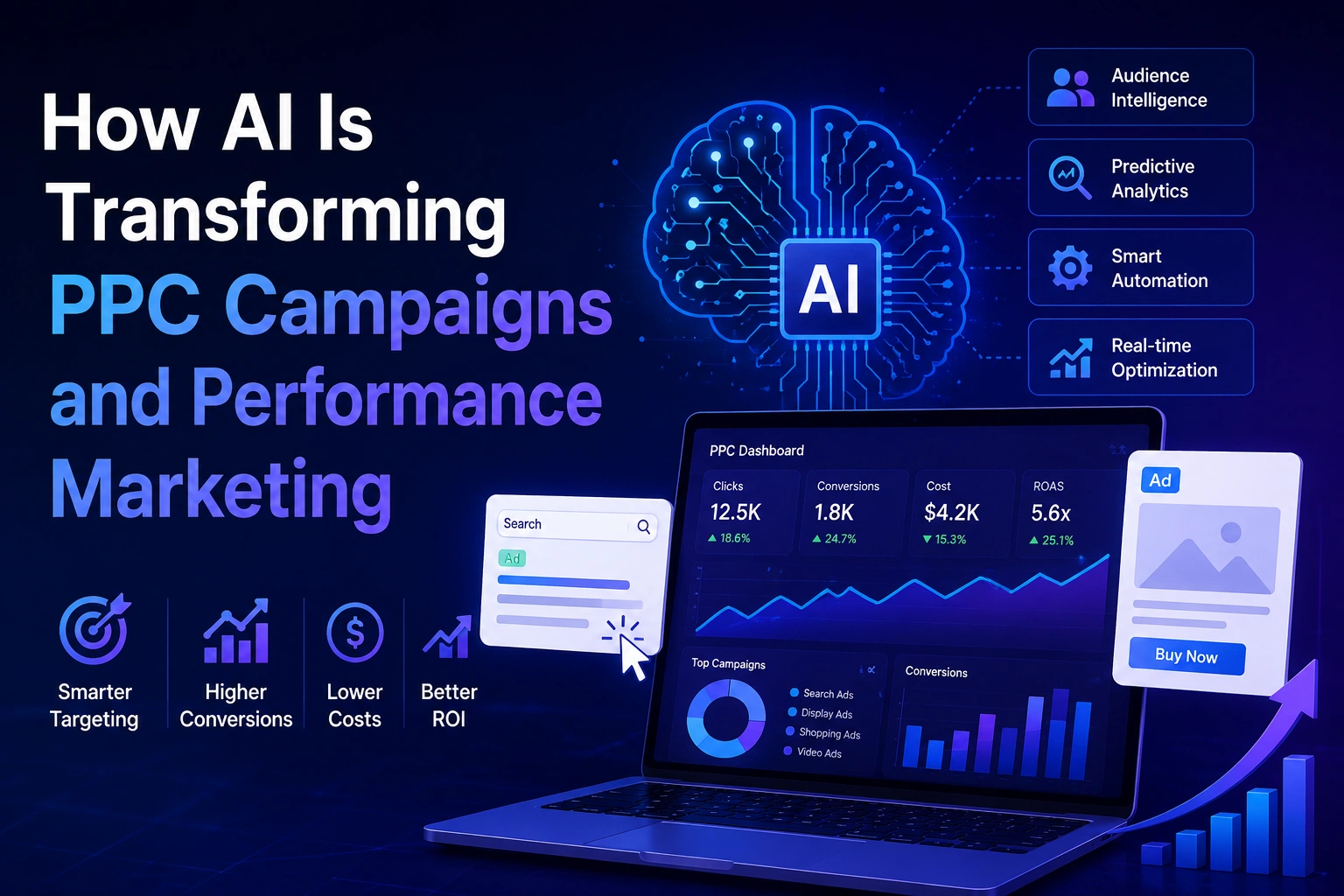
Smart Bidding now sets bids automatically, adjusting per auction based on hundreds of real-time signals. Responsive Search Ads test headline and description combinations without the advertiser scheduling tests. Performance Max distributes budget across all Google surfaces: Search, YouTube, Display, Shopping, Gmail, and Discover, without the advertiser choosing placements.
Each of these changes is presented as an improvement. Often, it is. Together, they represent something bigger: the advertiser’s role has fundamentally changed. Less configuration. More inputs. Less manual control. More oversight.
The question is not whether to accept this shift. It is happening regardless. The question is how to make AI work for your business rather than Google’s revenue.
This guide explains exactly how.
What AI Does Inside A PPC Campaign
AI in PPC is a decision-making layer that acts on the goals and data you give it. It doesn’t think. It optimizes what you define as success, using signals and patterns from your campaign’s performance history.
Three AI systems now dominate PPC advertising:
| System | What it controls | What it needs from you |
| Smart Bidding | Sets the bid at each individual auction | Accurate conversion data ideally 100+ monthly conversions per campaign to stabilize |
| Responsive Search Ads | Generates and tests headline and description combinations automatically | Strong, varied assets with clear value propositions |
| Performance Max | Allocates your budget across all Google channels simultaneously | Creative assets, audience signals, and precisely defined conversion goals |
The common thread across all three: the AI optimizes toward whatever you tell it to measure. If you tell it to find form submissions, it will find form submissions. If you tell it to find customers who pay, it will find customers who pay.
That distinction is everything.
Where AI Delivers Real Improvement
AI consistently outperforms manual management in three specific conditions.
High conversion volume. Smart Bidding needs enough data to make confident predictions. With 100 or more monthly conversions per campaign, the system identifies patterns, i.e., which users, which times, which devices convert most reliably, and bid more precisely than any human could manually. Below that threshold, predictions are unstable and CPA swings 20-30% week to week.
Creative testing at scale. Responsive Search Ads can determine the best-performing headline combination across millions of impressions in days. Manual A/B testing at the same statistical confidence would take months. For businesses running multiple products or audience segments, this learning speed is a genuine edge.
Audience discovery. AI finds conversion patterns in data that no analyst would think to look for manually. It can identify a segment of users based on behavioural signals who convert three times better than your defined target audience, and it will find them faster and more reliably than any manual audience research.
Google reports 14-18% conversion rate increases for brands running AI-powered campaigns alongside standard Search campaigns. The State of PPC 2026 survey of 1,306 professionals found AI saves practitioners an average of 5.2 hours per week on routine campaign management tasks.
These gains are real. They are also conditional on getting five specific things right.
The Five Things That Determine Whether AI Helps Or Hurts
Most AI-in-PPC guides celebrate the technology. Few explain clearly what causes it to fail. These five points do.
1. Conversion tracking quality is the whole game
If you track form fills, the AI will get very good at generating form fills. Including from people who will never become customers.
This is the most expensive mistake in AI-driven PPC, and it is extremely common.
Smart Bidding and Performance Max both optimize toward whatever you have marked as a conversion event. If that event is a form submission, a page view, a brochure download, or any proxy for a sale rather than an actual sale, the AI will optimize toward that proxy with full confidence. Click volume looks good. Form fills look good. Revenue does not match.
The fix: measure what the business actually values. For e-commerce, that means purchase events with real revenue values attached. For lead generation, that means feeding actual sales data back to the platform telling Google or Meta which leads became customers, not just which leads submitted a form. This requires integrating your CRM with your ad platform. It is more work to set up. It is the single highest-leverage improvement available in any AI PPC campaign.
If your tracking is right, AI is a multiplier. If it’s wrong, AI is an accelerant for the wrong direction.
2. The Performance Max transparency problem
PMax delivers results. It also hides where those results are coming from.
Performance Max does not separate brand traffic from non-brand traffic in its default reporting. Brand traffic means users who search for your company by name. It means people who were already looking for you and would very likely have found you through your organic results regardless. Non-brand traffic means genuinely new customers the campaign actually earned.
PMax optimizes conversions. Brand searches convert at very high rates. So the system naturally gravitates toward branded queries, reports excellent ROAS, and produces a dashboard that looks like success while a significant share of those conversions were going to happen anyway for free.
You are paying to acquire traffic that was already coming to you. The ROAS figure is real. The incrementality is not.
The fix is straightforward: add brand keyword exclusions to your Performance Max campaigns so it does not compete with your own organic listings. Run a separate branded search campaign to serve your brand-name searches at low cost. Evaluate ROAS from branded and non-branded traffic separately before drawing conclusions.
3. Campaign structure: Clean signals vs Conflicted signals
AI learns from the structure you build. Campaigns competing against themselves produce inflated CPCs and confused learning.
An account running branded search, generic search, Performance Max, and retargeting all targeting the same audience will have those campaigns bidding against each other in the same auction. The AI in each campaign is pulling from overlapping data. The result is higher CPCs from self-competition, distorted attribution, and performance that looks average without a clear explanation why.
Clean account architecture separates objectives: brand campaigns isolated from generic, prospecting audiences separate from retargeting, each campaign with a clear and singular job. AI rewards clean inputs. Give it clear directions and learn faster. Give it conflicted signals and it produces mediocre results confidently.
4. Creative quality is now the primary competitive edge
When every advertiser uses Smart Bidding with similar data, the bid advantage is gone. Creative is what remains.
This is the implication of AI bidding that most advertisers miss. Five years ago, a skilled human could outmaneuver competitors through smart manual bid management. That edge has been largely commoditized. Smart Bidding has given most advertisers roughly equal access to bid precision.
What cannot be commoditized is distinctive creative: headlines that communicate a genuine unique value proposition, ad copy that addresses what the specific audience actually worries about, landing pages that deliver precisely what the ad promised.
In Performance Max specifically, the quality and variety of creative assets determine what the AI has to work with. Generic assets produce generic results. Specific, high-quality creative assets with clear differentiation give the system better options and produce better outcomes.
This is why the most important hire for a PPC team in 2026 is not a bid manager. It is a copywriter who understands the audience.
5. Learning periods: why constant changes cost you money
Every significant change to an AI campaign resets its learning period. During that reset, performance is unstable and bid decisions are less accurate.
Changes that trigger a new learning period include switching bidding strategy, adjusting target CPA or ROAS significantly, changing budget substantially, updating conversion goals, or making major creative changes.
The learning period for most AI PPC campaigns runs two to four weeks. Make three changes in a month and the campaign may never leave learning mode.
The practical implication: AI campaigns require a fundamentally different management rhythm than manual campaigns. Evaluate over four-week windows, not weekly. Make deliberate, infrequent changes rather than constant adjustments. Test new creative in separate campaigns rather than changing existing ones. Give the AI time to learn before concluding it isn’t working.
Advertisers who manage AI campaigns the way they manage manual campaigns reacting to every data fluctuation, changing settings weekly often spend their entire year in an interrupted learning cycle.
Two Things That Are Different About PPC In India
India’s seasonal concentration changes how AI campaigns need to be managed.
For many product and service categories, PPC advertising spend in India is heavily concentrated around a handful of calendar moments: Diwali, wedding season, the back-to-school period, and major e-commerce sale events. AI campaign systems learn from historical data. They calibrate bids and audience predictions based on periods when they have the most conversions.
When a seasonal surge arrives, competitive intensity changes rapidly, CPCs spike, audience behavior shifts, and the AI is operating on assumptions calibrated to quieter periods. It adapts, but it adapts slowly. Brands that do not manually review budget caps, target CPAs, and creative assets before peak periods arrive often find the AI optimizing confidently toward yesterday’s market conditions during today’s most competitive window.
The lead quality problem is a specific challenge for Indian B2B and high-consideration categories.
Form fill volumes from PPC campaigns in India are frequently high. Lead-to-sale conversion rates at the bottom of the funnel are frequently lower than the top-of-funnel numbers suggest. When AI campaigns are optimized for form fills without downstream sales data fed back to the platform, the result is volume without proportionate revenue.
The AI reports success. The business does not experience it. This is fixable with CRM integration, lead quality scoring, and offline conversion imports, but it requires deliberate setup that most Indian advertisers running AI campaigns have not done.
What We Have to Own
The AI manages execution. Humans manage everything that gives execution its direction.
This is not a vague platitude. The specific work that remains irreducibly human in an AI-driven PPC programme:
- Defining what success actually means. What is a qualified lead? What is an acceptable CPA at this stage of the business? What conversion events actually reflect customer value?
- Building the right inputs. What creative assets go into the system? What audience signals? What conversion events are tracked and how accurately?
- Reading what the data is really saying. Strong ROAS can hide brand cannibalization, poor lead quality, or a favourable seasonal period. Only someone who understands the business can distinguish real performance from flattering metrics.
- Making structural decisions. Campaign architecture, budget distribution across objectives, brand exclusion strategy – all of these require business judgement the AI doesn’t have.
- Knowing when to intervene. Learning periods should be respected, but some problems require human intervention: broken conversion tracking, a landing page that has stopped working, a competitive environment shift that changes how the brand should be positioned.
The platforms want advertisers to believe PPC now runs itself. It runs better than it used to, with fewer manual bid adjustments consuming time. It runs well only when someone is responsible for the layer of thinking above the automation.
How Savit Approaches AI-driven PPC
At Savit, our starting point for every PPC engagement is conversion tracking. Not campaign structure. Not a bidding strategy. Tracking first.
If what the AI is measuring doesn’t reflect what the business actually values, nothing we build on top of it will work reliably over time. We configure conversion tracking to capture real business events purchases with revenue values, qualified leads distinguished from unqualified ones where the data allows it, and downstream performance fed back to the platform through CRM integration where the client’s setup supports it.
Our Performance Max campaigns are built with brand exclusions from day one. We run separate brand search campaigns, so branded traffic is always isolated and accounted for. We build creative asset sets with genuine variety: different value propositions, different formats, different audience angles, to give the AI real choices rather than minor variations on the same message.
For clients below the conversion volume threshold where Smart Bidding stabilizes, we apply manual or enhanced CPC bidding with clear targets and scale automation selectively as conversion data builds. Smaller Indian businesses are better served by this hybrid approach than by full automation running on insufficient data.
As your top-performing digital marketing firm in Pune working with businesses in Mumbai, Pune, and across India, we understand that Indian PPC has specific dynamics that standard global playbooks don’t fully account for: the seasonal concentration problem, the lead quality gap in high-consideration categories, the high CPCs in finance, education, and real estate that require more disciplined bidding than AI will apply on its own.
Our PPC management services cover the full programme: conversion tracking audit and setup, campaign architecture, creative development, bidding configuration, performance advertising strategy across Google and Meta, and the reporting that tells you what is actually working rather than what the AI wants you to see. We treat performance advertising as a system that needs expertise at every layer; not as a dashboard that manages itself.
Talk to Savit about PPC campaigns that use AI intelligently and give you honest visibility into what is working.