Not sure whether to use pagination or infinite scroll for your ecommerce website? This blog breaks down both approaches and helps you choose the best one for SEO and user experience.
When it comes to ecommerce SEO, even small decisions about how your product listings are displayed can have a big impact on rankings and traffic.
One of the most common debates in website design is pagination vs infinite scroll. Both are used to display product listings and category pages, but they behave very differently in terms of search visibility.
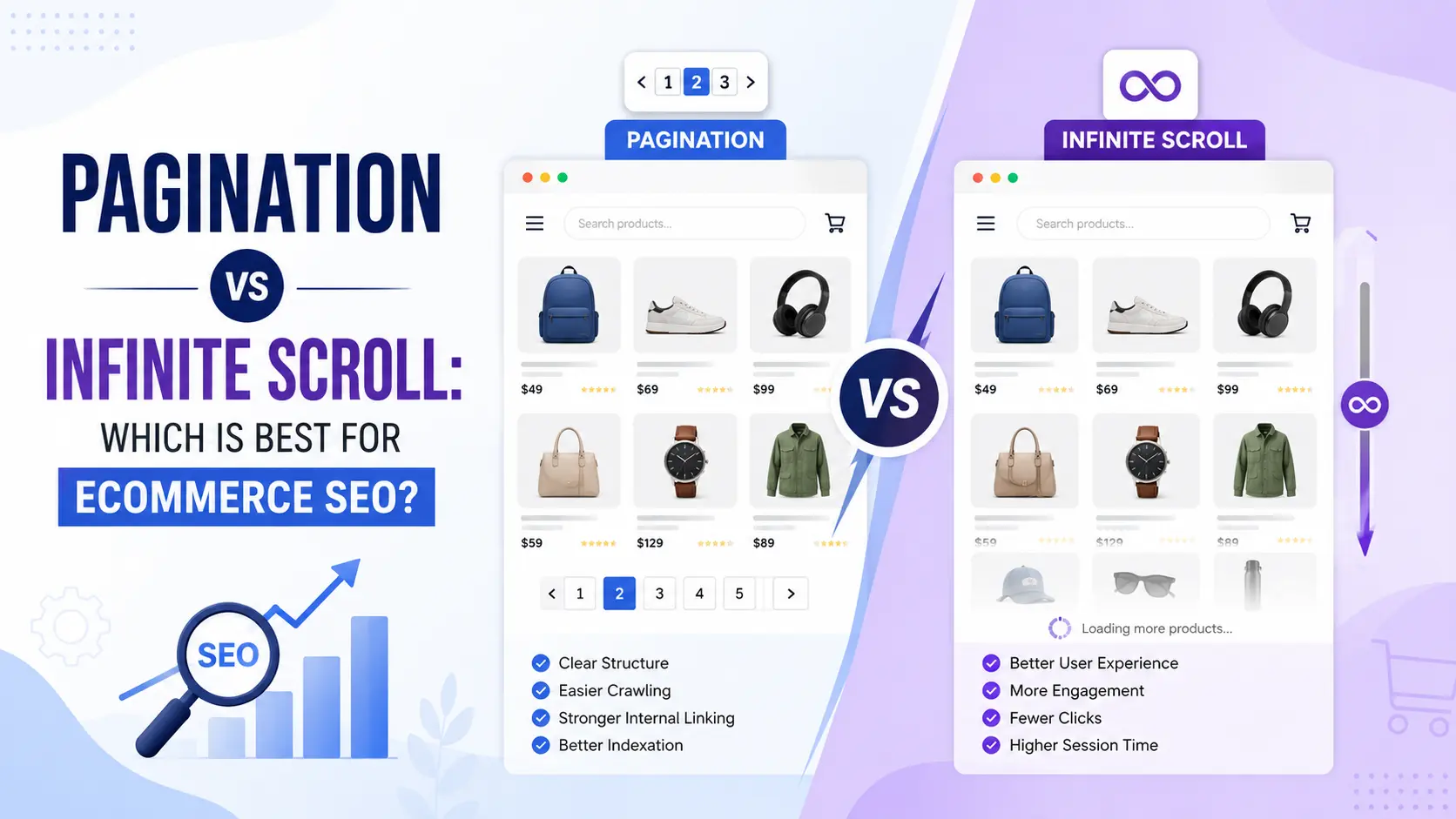
Pagination breaks content into multiple pages, such as pages 1, 2, 3, and so on, while infinite scroll continuously loads products as users scroll.
Although infinite scroll often feels smoother for users, it is not always the best choice for SEO. On the other hand, pagination is widely used because it helps search engines crawl and index content more effectively.
Choosing between the two is not just a design decision; it directly affects SEO best practices, indexing, and the ease with which your ecommerce pages rank in search engines.
In simple terms, the way your site handles product listing structure can decide how visible your store is in search results.
What Is Pagination?
Pagination is a way of organising content by splitting it into multiple pages instead of showing everything at once.
In ecommerce websites, pagination scroll is commonly used on category and product listing pages. For example, instead of loading 100 products on one page, the products are divided into page 1, page 2, page 3, and so on.
Each page has its own URL, such as:
/category/shoes?page=1
/category/shoes?page=2
This structure helps both users and search engines navigate content in an organised way.
From an SEO perspective, pagination is widely used in ecommerce SEO because it makes product pages easier to crawl and index. Search engines can move from one page to another using internal links such as “Next” and “Previous,” helping them discover more products.
It also allows different pages in a category to rank for related search queries, improving overall visibility.
In simple terms, pagination creates a clear path for both users and search engines to explore all products in a structured manner.
What Is Infinite Scroll?
Infinite scroll is a website design method in which content loads automatically as the user scrolls down the page.
Instead of clicking on page numbers, users keep scrolling, and new products load continuously without moving to a new page.
This is commonly seen on mobile apps and modern ecommerce websites, where the goal is to make browsing feel smooth and uninterrupted.
For example, when a user scrolls down a product listing page, more products automatically appear without clicking “Next page.”
Infinite scroll is mainly used to improve user experience, especially when users are casually browsing and not looking for something specific.
However, for SEO, it works differently from pagination. Since content is often loaded dynamically, search engines may not always reach or index all products properly unless they are technically optimised.
In simple terms, infinite scroll offers a smooth browsing experience, but it needs careful setup to ensure search engines can still access all content.
Pagination vs Infinite Scroll: Key Differences
To determine which is more appropriate for e-commerce SEO, one should consider pagination versus infinite scrolling head-to-head. Although both techniques aim to showcase products on their site, they function in quite different ways.
Below is a simple comparison to make it clear:
| Factor | Pagination | Infinite Scroll |
| Structure | Content is divided into multiple pages | Content loads continuously on one page |
| Navigation | Users click page numbers or “Next” | Users scroll down to load more products |
| Crawlability | Easy for search engines to crawl all pages | Can be difficult if not properly optimized |
| SEO Impact | Strong SEO performance | Risk of incomplete indexing |
| URL Structure | Each page has a unique URL | Often relies on a single URL |
| User Experience | Structured browsing | Smooth and continuous browsing |
| Best Use Case | Search-driven users looking for specific products | Users casually browsing products |
From an ecommerce SEO perspective, pagination provides search engines with a clearer structure for understanding and indexing content. Each page can be discovered individually, which improves visibility in search results.
In contrast, infinite scroll emphasises user experience. It lets consumers view items continuously, although it can hinder search engines’ ability to index deep content if implemented incorrectly.
To put it simply, pagination scroll is SEO friendly while infinite scroll is consumer-oriented.
How Search Engines Handle Pagination
Search engines understand pagination better because it is built on clear, crawlable URLs.
How it works
- Each page in a paginated series has a separate URL
- Google follows internal links like “Next” and “Previous”
- All pages are connected in a sequence
What Google does
- Crawls each paginated page individually
- Indexes multiple pages from the same category
- Uses internal links to understand page hierarchy
SEO impact
- Better content discovery across product listings
- Stronger indexation of deeper pages
- Improved visibility for large ecommerce catalogues
Pagination works well in ecommerce SEO because it provides search engines with a structured path to access all products without missing any.
In simple terms, pagination makes it easier for Google to find and index every page in a category.
How Search Engines Handle Infinite Scroll
Infinite scroll differs from pagination because content loads dynamically as the user scrolls. This poses challenges for search engines if not implemented properly.
How it works
- Products load automatically when a user scrolls down
- Content is often loaded using JavaScript
- There may be no separate pages or URLs for deeper content
What Google does
- Googlebot does not scroll like a user
- It may only see the initially loaded content
- Additional products may not be discovered unless a special setup is done
SEO impact
- Risk of incomplete indexing of product listings
- Difficult for search engines to reach deeper content
- Weak or missing URL structure for ranking individual sections
Because of this, infinite scroll requires additional technical setup (such as a pagination fallback or crawlable links) to ensure search engines can access all products.
In ecommerce SEO, if the infinite scroll is not properly optimised, some products may remain invisible in search results even though they exist on the website.
In simple terms, infinite scroll improves browsing experience, but can limit search engine visibility if not handled correctly.
SEO Impact: Pagination vs Infinite Scroll
When it comes to pagination vs infinite scroll, the SEO impact mainly depends on how easily search engines can crawl, index, and understand your ecommerce product listings.
Both approaches display products, but they behave very differently in terms of search visibility.
Pagination (SEO Advantages)
- Each page has a unique, crawlable URL
Pagination creates separate URLs for page 1, page 2, page 3, etc. This makes it easier for search engines to discover and index every section of a category.
- Better indexation of product listings
Since each page is accessible individually, Google can index more products across multiple pages, improving overall visibility in search results.
- Stronger internal linking structure
Links like “Next,” “Previous,” and page numbers help search engines move through the site and understand how pages are connected.
- Improved keyword targeting opportunities
Different paginated pages can potentially rank for variations of category or long-tail keywords, helping ecommerce SEO performance.
SEO takeaway: Pagination scroll ensures search engines can access and index all product pages in a structured, reliable way.
Infinite Scroll (SEO Challenges)
- Content loads dynamically through scrolling
The product will be displayed when the page scrolls down, mostly via JavaScript that cannot be fully crawled by search engines.
- Risk of incomplete crawling
Google does not scroll pages like humans do; therefore, products further down the page may not be found.
- No clear URL structure for deeper content
Since content is often on a single page, there are fewer opportunities for individual product sections to rank separately.
- Weaker internal linking signals
Without separate pages, it becomes harder for search engines to understand content hierarchy and distribution.
SEO takeaway: Infinite scroll can limit how much of your product catalog is visible in search results unless additional technical SEO is implemented.
Direct SEO Comparison
- Pagination scroll provides structured crawling and full indexation coverage
- Infinite scroll focuses more on smooth browsing, but may hide deeper content
- Pagination supports strong ecommerce SEO scalability for large catalogues
- Infinite scroll requires a hybrid implementation (pagination fallback or crawlable links) to avoid SEO loss
Final Insight
From an ecommerce SEO perspective, pagination is generally more reliable because it ensures that search engines can fully crawl and index all product listing pages.
Infinite scroll can still be effective for user experience, but only when it is supported with a proper technical SEO structure.
In simple terms:
Pagination helps search engines see everything clearly, while infinite scroll improves browsing, but can hide content if not optimised properly.
UX Perspective: Which One Is Better for Users?
From a user experience perspective, pagination and infinite scroll create two very different browsing behaviours.
- Pagination Scroll
Pagination gives users a clear structure. They move through the pages one by one, which makes it easier to track their position in the product list. This works well when users are comparing products or searching with intent, because the navigation feels controlled and predictable.
- Infinite Scroll
The infinite scroll takes away from the structure and introduces constant motion. The products continue to be loaded as the user scrolls through them, without clicks or page refreshes. It is more natural on mobile and effective when the user is casually browsing through content.
The difference comes down to intent. Pagination supports focused shopping where users want clarity and control. Infinite scroll supports relaxed browsing where users prefer discovery over structure.
Pagination is better for clarity, while infinite scroll is better for continuous engagement.
Can Infinite Scroll Be Made SEO-Friendly?
Infinite scroll can work for SEO, but only when it is built with the right technical foundation. Without it, search engines may struggle to access all the content.
One effective approach is to pair infinite scroll with background pagination. While users scroll continuously, the system still creates structured pages that search engines can crawl.
Another method is to ensure that each loaded product section has a crawlable, indexable URL. This allows search engines to reach deeper content instead of stopping at the initial view.
Many ecommerce websites now use a hybrid model because it solves both problems—users get a smooth browsing experience, and search engines still get a clear path to index all products.
Simply put, infinite scroll becomes SEO-friendly only when it is supported by a crawlable pagination structure behind the scenes.
Best Practices for Ecommerce SEO
To get the best results from pagination or infinite scroll, ecommerce websites should follow a few important SEO practices that improve both visibility and user experience.
- Use a crawlable page structure
Search engines must have access to every page where your product listings appear. Regardless of whether you employ infinite scrolling, ensure that a backup structure exists that makes it easy for Google to index deeper pages.
- Optimise category pages
The category pages form an important part of your ecommerce SEO strategy. Incorporate keywords, titles, and descriptions on your category pages to help them get ranked by the search engines.
- Avoid orphaned products
Every product should be linked from at least one category or internal page. Orphaned pages are harder for search engines to discover and may not get indexed properly.
- Improve page load speed
Whether you use pagination or infinite scroll, slow loading can hurt rankings. Optimise image, script, and layout performance to ensure smooth browsing and stronger SEO signals.
- Follow SEO best practices consistently
Focus on clean URL structures, proper internal linking, and structured navigation. These SEO best practices help search engines better understand your site and rank it effectively.
Pagination vs Infinite Scroll: Which Should You Choose?
Choosing between pagination and infinite scroll depends on your ecommerce goals, traffic behaviour, and the importance of SEO to your business.
Both options can work, but they serve different purposes.
Choose Pagination if your focus is SEO and structured growth
- Pagination is the better choice when search visibility is a priority.
- Works best for SEO-driven ecommerce websites
- Helps search engines crawl and index all product pages
- Supports large product catalogues with a clear structure
- Improves keyword targeting across multiple pages
- Ensures better control over internal linking and rankings
Best for: Stores that rely on organic search traffic and want long-term SEO growth
Choose Infinite Scroll if your focus is on user engagement
- Infinite scroll is more suitable when user experience is the main priority.
- Works well for mobile-first browsing experiences
- Encourages users to stay longer on the page
- Ideal for casual product discovery
- Reduces friction by removing page clicks
Best for: Brands focused on engagement, visual browsing, or social-style shopping
Best approach: Use a hybrid model
In most modern ecommerce websites, the best solution is not choosing one over the other.
- Infinite scroll improves browsing experience
- Pagination ensures SEO visibility and crawlability
- Together, they balance UX and search performance
This is why many large ecommerce platforms use both systems together.
Final decision takeaway
If SEO is your priority, pagination is the safer and more reliable option.
If user experience is your priority, infinite scroll works better.
But if you want both, a hybrid structure is the most effective solution.
Final Thoughts: What Should You Choose for Ecommerce SEO?
When it comes to pagination vs infinite scroll, the right choice depends on your ecommerce goals and how you want users and search engines to interact with your website.
Pagination is generally more effective for ecommerce SEO because it provides a clear structure that helps search engines crawl and index product pages. It supports better internal linking, improves index coverage, and helps category pages rank more consistently.
Infinite scroll, on the other hand, improves user experience by allowing continuous browsing without page clicks. It works well for mobile users and casual shopping, but it must be properly optimised to ensure search engines can still access all content.
In most ecommerce setups, a hybrid approach delivers the best results, combining infinite scroll for users with backend pagination for SEO.
A strong ecommerce website is not just about choosing a layout style. It is about ensuring that the structure supports both visibility and usability. When SEO and UX work together, the overall performance of the website improves significantly.
At Savit, this balance is a key focus. The approach is centred around building ecommerce websites that are structured for search engines while still delivering a smooth user experience. From implementing SEO best practices to optimising category pages and providing Shopify SEO services, the goal is to help businesses sustainably improve visibility, traffic, and conversions.
FAQs
- What is pagination scroll in ecommerce websites?
Pagination scroll is a method in which product listings are divided into multiple pages rather than loading everything at once. Each page can be accessed separately, which helps users navigate and allows search engines to crawl and index content more effectively.
- Does infinite scroll affect SEO rankings?
Yes, infinite scroll can affect SEO rankings if not implemented correctly. Since content loads dynamically, search engines may not always reach deeper product listings, which can reduce indexation and visibility in search results.
- Can Shopify stores use infinite scroll without SEO issues?
Yes, Shopify stores can use infinite scroll, but it must be properly optimised with crawlable URLs or pagination fallback. Many brands also rely on Shopify SEO services to ensure their store structure supports both user experience and search visibility.
- How do ecommerce SEO services improve website performance?
ecommerce SEO services help optimise website structure, product pages, and technical SEO elements so that search engines can crawl and rank the site better. This leads to improved visibility, traffic, and conversions over time.
- Is pagination scroll still relevant for modern ecommerce websites?
Yes, pagination scroll is still widely used because it ensures better control over indexing and helps search engines discover all product pages. It remains a strong choice for SEO-focused ecommerce websites.