At the same time, there are businesses that focus almost entirely on improving their map pack presence while overlooking their website. While they may appear in local results, the experience often breaks down when users click through slow load times, thin content, and a lack of credibility signals reduce the chances of conversion.
Both of these are real problems, and both come from the same root: not understanding what is the difference between SEO and local SEO, and how the two are supposed to work together.
More businesses in India are investing in SEO than ever before. But a surprising number still ask a basic question: what is local SEO, and is it actually different from “regular” SEO? The confusion is understandable. Google does not draw a neat line between the two. And the advice out there often makes it sound like you have to pick a side.
This guide is built to help you make a practical decision. We will break down what traditional SEO covers, what is local SEO in simple terms, how the two differ in strategy and execution, and how to figure out which one (or which combination) actually fits your business. Whether you run a single-location clinic in Pune, a multi-city retail chain, or a D2C brand shipping across India, this should help you put your budget and effort in the right place.
How Search Has Changed the Equation
A few years ago, you could reasonably treat SEO as one discipline. Today, the gap between local and traditional SEO has widened because of how people search.
Mobile usage has made “near me” queries massive. AI-powered search features like Google’s AI Overviews now pull local business details directly into results. Voice search almost always carries local intent. And Google has gotten much better at detecting when a query has a local purpose, even when the searcher does not explicitly say so.
For brick-and-mortar businesses, this means local search has become the single highest-intent discovery channel available. For online-first or national brands, traditional SEO still drives the bulk of organic traffic and long-term visibility. The question is where your business sits on that spectrum.
What Is Traditional SEO?
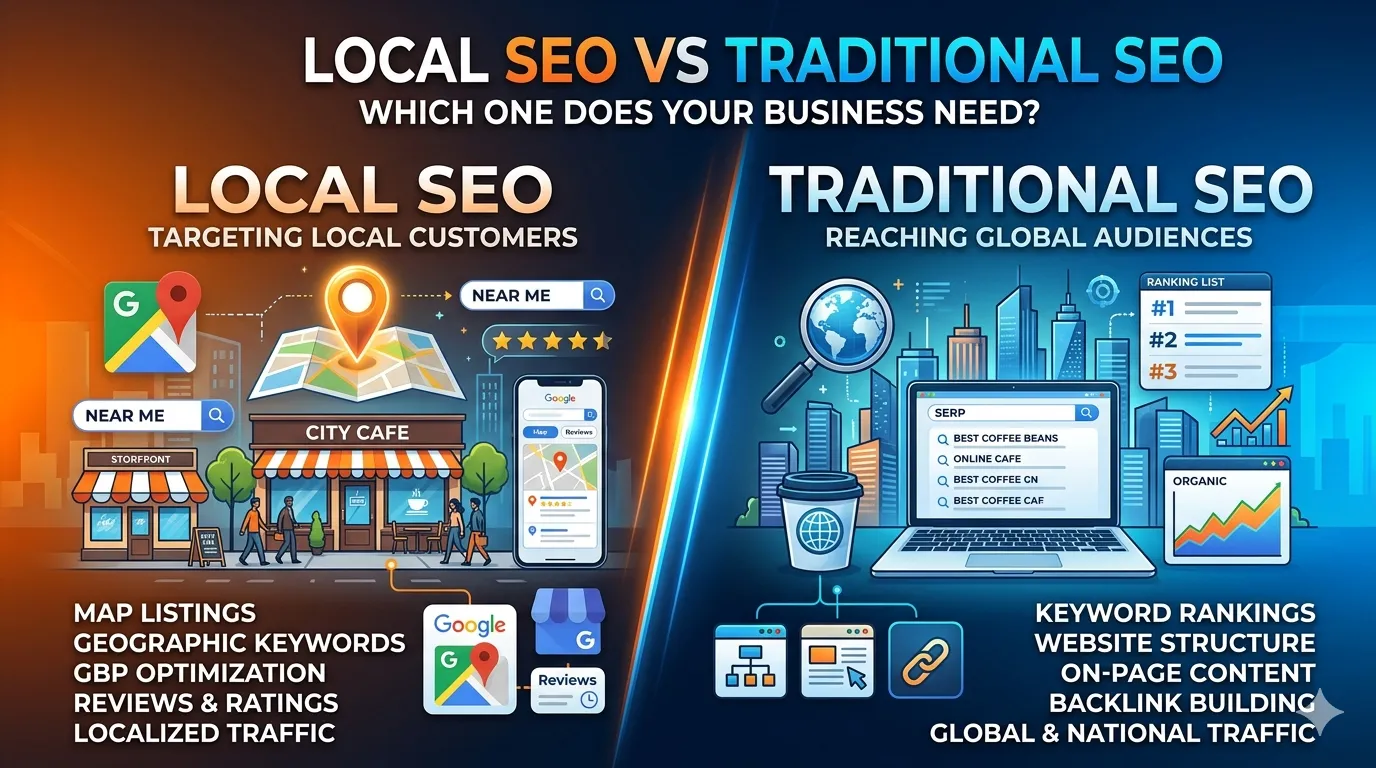
Traditional SEO (sometimes called organic SEO or global SEO) is the practice of optimising your website so it ranks higher in Google’s main organic search results for queries that are not tied to a specific location.
When someone searches “best project management tools” or “how to file GST returns” or “lightweight running shoes for women,” they are not looking for a nearby shop. They want the best information, the best product, or the best comparison, regardless of geography. Traditional SEO is how you show up for those searches.
What Drives Traditional SEO Rankings?
The ranking factors in traditional SEO fall into three broad categories:
On-page SEO: This covers everything on your website that you control directly. Content quality and depth. Keyword usage in title tags, meta descriptions, headers, and body text. Internal linking structure. How well each page satisfies the intent behind the query it targets.
Off-page SEO: Backlinks from other websites remain one of the strongest authority signals Google uses. The quality, relevance, and diversity of sites linking to yours tells Google how trustworthy and authoritative your content is. Digital PR, guest contributions, and organic mentions all feed into this.
Technical SEO: Site architecture, page speed, mobile-friendliness, crawlability, indexation, and structured data. These determine whether Google can efficiently find, understand, and rank your pages.
User experience signals, content freshness, and brand authority also play significant roles. The better your site is at satisfying what a searcher is looking for, the more consistently it will rank.
Where Does Traditional SEO Show Up in Search Results?
Traditional SEO targets the main organic listings: the ten blue links (though they are rarely just blue links anymore). It also targets featured snippets, knowledge panels, “People Also Ask” boxes, and rich results like product listings, review stars, and FAQ dropdowns.
What it does not target: the map pack. The local three-pack you see at the top of search results when Google detects local intent? That is local SEO territory.
When Is Traditional SEO the Primary Growth Engine?
Traditional SEO is the right lead strategy when your business:
- Sells products or services to customers regardless of where they are located (e-commerce, SaaS, digital products)
- Publishes content for a national or global audience (media, education, B2B thought leadership)
- Ships across India or internationally and does not depend on walk-in traffic
- Competes on category-level keywords rather than city-level ones
For these businesses, traditional SEO builds long-term visibility, authority, and a compounding stream of organic traffic that reduces dependency on paid ads over time.
What Is Local SEO and Why Does It Exist?
What is local SEO? In simple terms, it is the process of optimising your business’s online presence, so you show up when someone nearby searches for what you offer.
When a person in Bandra searches “dentist near me,” Google does not show a list of dental clinics from across India. It shows the three most relevant, nearby options in the local pack, with a map, reviews, hours, and a click-to-call button. Getting into that pack, and staying there, is the core goal of local SEO.
Local SEO applies to any search where Google detects location-based intent. That includes explicit queries like “AC repair in Andheri East” and implicit ones like “open pharmacies right now” (where Google uses the searcher’s GPS to return local results without the user mentioning a location at all).
How Google’s Local Algorithm Works Differently
This is where the difference between SEO and local SEO becomes concrete. When Google detects local intent, it activates a separate local algorithm that layers additional ranking factors on top of the standard organic signals.
The three pillars of local rankings:
- Proximity: How close the business is to the searcher at the time of the search. This is the one factor you genuinely cannot optimise. It is geography.
- Relevance: How well your business profile, categories, and content match what the searcher is looking for.
- Prominence: How well-known and trusted your business is, based on reviews, citations, backlinks, brand mentions, and overall online authority.
Traditional SEO signals (strong website, good content, quality backlinks) still matter in local rankings. But local SEO adds its own layer: Google Business Profile signals, review volume and quality, NAP (Name, Address, Phone) consistency across the web, and local citations.
What Goes into a Local SEO Strategy?
The core components of local SEO for small business include:
- Google Business Profile (GBP): Arguably the most important asset after your website. Accuracy, completeness, and regular engagement directly impact local pack visibility.
- NAP consistency: Your business name, address, and phone number must be identical across your website, GBP, social profiles, and every directory listing.
- Local citations: Listings on platforms like Justdial, Sulekha, Apple Maps, Bing Places, and industry-specific directories.
- Reviews: Volume, velocity, average rating, and how you respond all factor into both rankings and customer trust.
- Localised content: City-specific landing pages, local guides, area-relevant blog posts, and FAQ content.
- Geo-targeted keywords: Search terms that include city names, neighbourhoods, landmarks, and “near me” variations.
For most local businesses, the process starts with a local SEO audit (finding what is broken or missing), followed by GBP optimisation, citation cleanup, and content development.
Why Local SEO for Small Business Is Non-Negotiable
With 76% of smartphone users visiting a nearby business within a day of their online search, that is an extraordinary conversion rate compared to almost any other marketing channel.
A separate study by Google India found that “near me” searches in India have grown significantly in the past five years, with the sharpest rise in tier-2 and tier-3 cities where smartphone adoption has accelerated.
For clinics, salons, restaurants, repair services, coaching institutes, retail shops, and any business that relies on customers walking in or calling from nearby, local SEO for small business is not optional. It is the single most effective way to be found by people who are ready to act.
Local SEO vs Traditional SEO: What Is the Actual Difference?
Now that we have covered what each one is, let us put them side by side. The differences are real, and understanding them changes how you plan your strategy.
Target Audience
Traditional SEO targets a broad audience. Geography is not a primary filter. You are trying to reach anyone searching for your topic, product, or service, whether they are in Mumbai or Mangalore or Melbourne.
Local SEO narrows the focus to people in a specific city, neighbourhood, or service area. The audience is smaller, but the intent is sharper. Someone searching “plumber in Powai” is not researching plumbing as a concept. They need a plumber, probably today.
Keyword Strategy
This is where local SEO vs SEO becomes very tangible:
| Traditional SEO Keywords | Local SEO Keywords |
| “best accounting software” | “chartered accountant in Pune” |
| “how to improve website speed” | “web developer near me” |
| “running shoes for flat feet” | “sports shoe store in Koramangala” |
| “employee onboarding checklist” | “HR consultancy in Navi Mumbai” |
Traditional SEO keywords are topic-driven. Local SEO keywords are topic-plus-location-driven. Local campaigns incorporate city names, area names, landmarks, and “near me” variations throughout keyword research. The intent is different, and the content you build around these keywords needs to reflect that difference.
Ranking Factors and Signals
Both types of SEO share common foundations: content quality, backlinks, technical health. But each adds its own layer.
| Signal | Traditional SEO | Local SEO |
| Content quality and depth | Core factor | Important, but GBP matters more for map pack |
| Backlinks | Major authority signal | Valuable, especially from local sources |
| Technical health | Critical for crawling and indexation | Same, plus mobile experience is especially key |
| Google Business Profile | Not a factor | One of the most influential signals |
| Reviews | Indirect (trust, CTR) | Direct ranking and conversion factor |
| NAP consistency | Minimal impact | High impact on local trust and verification |
| Citations | Not a primary factor | Core signal for local authority |
| Proximity to searcher | Not applicable | Cannot be optimised, but influences all local results |
Where You Actually Show Up
Traditional SEO aims to rank in the main organic listings: the standard search results, featured snippets, knowledge panels, and rich results.
Local SEO targets the local three-pack (the map results that appear above organic listings for local queries), Google Maps, and localised organic results. These are often the first thing a searcher sees, and for mobile users, they may be the only thing they interact with before making a decision.
Content Strategy
Traditional SEO content tends to be broader: comprehensive guides, comparison articles, how-to resources, product pages, and thought leadership pieces that target informational and commercial queries.
Local SEO content is hyperlocal: city-specific service pages, neighbourhood guides, local case studies, community-focused blog posts, and location-specific FAQs. Both share E-E-A-T principles (demonstrating experience, expertise, authority, and trust), but local content needs to prove familiarity with the specific area and audience it targets.
A restaurant in Indiranagar and a restaurant in Koramangala can both be in Bangalore. But if their location pages read identically except for the area name, neither will perform well. Local content has to feel local.
Link-Building and Citations
Traditional SEO link-building focuses on earning backlinks from high-authority, niche-relevant publications. A link from an industry blog, a national news site, or a respected educational resource carries significant weight.
Local SEO link-building prioritises locally relevant sources: regional news outlets, city blogs, community organisations, local event pages, and area business directories. Citations (structured listings of your NAP on platforms like Justdial, Sulekha, and industry directories) are a core local SEO signal with no real equivalent in traditional SEO.
Which Is Better: Local SEO or SEO?
“Better” Depends on What You Need
Businesses ask this a lot: local SEO vs traditional SEO, which one should they invest in? And the honest answer is that “better” is not a useful word until you define what you need SEO to deliver.
If you need more phone calls from people within ten kilometres of your shop, traditional SEO alone will not get you there efficiently. If you sell software to businesses across India and have no physical storefront, obsessing over your map pack ranking is a misallocation of effort.
Let me break this down by scenario.
When Local SEO Is the Clear Priority
Local SEO for small business is the obvious first move when:
- You meet customers face-to-face (clinics, salons, repair services, gyms, coaching centres)
- Your revenue depends on a defined geographic area
- You want more calls, walk-ins, or appointment bookings from nearby customers
- A map pack appears when you search your core keywords (if it does, Google considers the query local, and you need to be there)
For these businesses, the local SEO vs SEO debate is straightforward. Start local. Get your Google Business Profile in order. Clean up your citations. Build your review profile. Create location-specific content. Then layer traditional SEO on top to strengthen your website’s overall authority.
When Traditional SEO Takes the Lead
Traditional SEO should be the primary investment when:
- You sell products or services online to a national or global audience
- Your business model does not depend on physical location (SaaS, e-commerce, publishing, D2C)
- You compete on category-level keywords that do not carry local intent
- Your growth depends on organic traffic volume and content-driven lead generation
Even in these cases, though, traditional SEO is rarely the entire picture. If you have a physical office, a regional support centre, or a local reputation to protect, some local SEO work is still worthwhile.
The Hybrid Reality
For a growing number of businesses, the answer is both. A multi-location retail brand needs local SEO for each store (GBP, reviews, citations, local content) and traditional SEO for its category pages, blog, and brand-level keywords. A professional services firm might rely on local SEO for city-specific client acquisition while using traditional SEO to build thought leadership and attract leads nationally.
Treating local SEO vs SEO as an either/or decision leads to gaps. The smarter approach is figuring out the right balance for your specific situation.
Local SEO for Small Business: Where to Start
If your business depends on local customers, here is a practical starting sequence. This is not the only way to do it, but it is a structure that works well for most small businesses getting serious about local SEO for the first time.
Step 1: Check Whether You Actually Need Local SEO
A quick test: search your main service keyword in Google. If a map pack (the three local results with a map) appears above the organic listings, Google considers that query local. You need to be competing in that space.
Also ask yourself: Do customers come to your location? Do you serve a specific area? Do you want more calls or walk-ins from people nearby? If yes to any of these, local SEO for small business is essential.
Step 2: Get Your Google Business Profile Right
Your GBP is the most influential asset in local search after your website. Treat it with the same seriousness.
A quick checklist:
- Business name matches your real signage (no keyword stuffing)
- Address is accurate and eligible (no virtual offices)
- Phone number connects to the right location
- Website URL points to the correct landing page
- Primary and secondary categories are accurate
- Services and products are filled in with descriptions
- Hours are current, including holidays and special hours
- Photos are recent and genuine (not stock images)
- Posts are published at least monthly
- Q&A section is monitored and answered proactively
- Reviews are being responded to (positive and negative)
Step 3: Fix NAP Consistency and Citations
Audit your listings across Google, Justdial, Sulekha, Apple Maps, Bing Places, Facebook, LinkedIn, and any industry directories. Fix every inconsistency. Even small differences (Road vs Rd., missing floor numbers, old phone numbers) weaken the trust signal search engines use to verify your location.
Step 4: Build Local Content
Create dedicated pages for each city or area you serve. Each page should have unique content, local references, an embedded map, accurate NAP, and clear calls to action. Thin pages that just swap city names do more harm than good.
Step 5: Track What Matters
Set up monthly tracking for:
- Map pack positions for target keywords
- GBP impressions, clicks, calls, and direction requests
- Review count and average rating
- Local organic traffic to your website
- Conversion actions (form fills, bookings, calls)
How Traditional SEO and Local SEO Support Each Other
Strong Traditional SEO Lifts Local Results
A technically sound website with fast load times, clean architecture, and quality content does not just help organic rankings. It helps local rankings too. Google considers your website’s authority when deciding how prominent your business is in local results. Strong backlinks, well-optimised pages, and a good user experience all feed into the “prominence” pillar of local search.
Local Signals Strengthen Broader SEO
Positive reviews generate brand searches. Brand searches signal to Google that people are actively looking for your business by name, which is a trust indicator. Local media mentions, community engagement, and active social profiles create brand signals that benefit your organic visibility beyond just local queries.
Why Treating Them as Silos Hurts
Businesses that run local SEO and traditional SEO as completely separate efforts often end up with duplicated work, inconsistent messaging, and missed opportunities. The smarter approach is to structure your strategy around business goals and customer journeys, then map which SEO tactics (local or traditional) serve each stage.
A customer might first discover your brand through a blog post (traditional SEO), then search your business name to check reviews (local SEO), then look up your location on Maps (local SEO again), and finally return to your site to book an appointment (traditional SEO conversion path). The two types of SEO are not competing. They are different parts of the same journey.
Cost, Timeframe, and ROI
Investment and Timeline Differences
Both local SEO and traditional SEO are long-term plays. Neither delivers overnight results. But there are differences in how quickly you might see traction.
Local SEO for small business can show measurable improvements relatively quickly once GBP is optimised, citations are cleaned up, and reviews start coming in. For a single-location business in a moderately competitive market, meaningful gains in map pack visibility can appear within two to four months.
Traditional SEO campaigns targeting competitive national keywords typically take longer. Six to twelve months before significant organic traffic growth is common, sometimes longer in highly competitive niches. The payoff, however, is higher-volume, compounding traffic that grows as your content library and authority expand.
What ROI Looks Like
For local SEO: Calls, walk-ins, appointment bookings, and direction requests from nearby customers. Strong local rankings can significantly reduce spending on local PPC ads over time. The ROI is direct, measurable, and tied to revenue-generating customer actions.
For traditional SEO: Growth in organic sessions, leads, online sales, and brand visibility across regions. The returns compound over time as content and backlinks accumulate. For businesses in competitive niches, the long-term cost-per-acquisition from organic search is often far lower than paid channels.
Budgeting Sensibly
For a small business that depends on local customers, allocating the majority of your SEO budget to local SEO makes sense. Layer in traditional SEO gradually as you build content and authority.
For larger or multi-location brands, the split looks different. Technical SEO, content development, and link-building might take a significant share, with local SEO implementation running in parallel for each location. The exact ratio depends on how many locations you manage, how competitive your market is, and what your growth priorities look like over the next twelve to eighteen months.
AEO, AI, and the Future of Local SEO vs SEO
AI Is Blending the Lines
Google’s AI Overviews, conversational search features, and tools like ChatGPT-powered search are increasingly blending local and traditional SEO signals. An AI answer about “the best way to fix a leaking tap” might include both general advice (traditional SEO content) and a suggestion to contact a local plumber (local SEO data). The walls between the two are thinning.
For businesses, this means clean NAP data, structured content, and credible brand signals are essential regardless of whether you think of yourself as a “local” or “national” brand.
What Is AEO and Where Does It Fit?
Answer Engine Optimisation is the practice of structuring your content, schema, and brand evidence so AI systems can confidently reference your business. It sits at the intersection of local and traditional SEO.
Practically, AEO means:
- Using question-style headings that match how people search (“what is local SEO,” “what is the difference between SEO and local SEO”)
- Opening each section with a clear, direct answer before expanding
- Implementing schema (LocalBusiness, FAQ, Product/Service, Review) so both traditional search and AI can parse your business data accurately
- Maintaining strong E-E-A-T signals: credentials, case studies, testimonials, and verifiable expertise
Whether you are optimising for local pack results or national organic rankings, AEO principles apply equally. The businesses that structure their content for both human readers and AI systems will have the strongest position over the next few years.
How to Decide: A Simple Framework
Here is a straightforward way to think about it.
Start with Your Business Model
Local-only (single location, defined service area): Local SEO first. Get GBP, citations, reviews, and local content right. Add traditional SEO to strengthen your website over time.
Hybrid (physical location plus online sales or national services): Both from the start. Local SEO for your physical presence. Traditional SEO for your product, content, and brand pages. Balance effort based on where your revenue actually comes from.
Online-only or national: Traditional SEO first. Content, technical health, and authority building. Add local SEO only if you have physical offices or want to rank for location-specific service keywords.
Check Your Current Visibility
Search your core keywords. Do you appear in the map pack? In organic results? In neither? The gaps you find tell you where to invest first.
If you are invisible in the map pack for queries that matter, local SEO needs immediate attention. If your website does not rank for important non-local terms, traditional SEO is the priority. If both are weak, start with whichever channel is closer to driving revenue for your business right now.
Know When to Bring In Help
A few signals that suggest it is time to partner with an experienced SEO agency rather than going it alone:
- You have been doing SEO for six months and are not seeing movement
- You manage multiple locations and cannot keep citations, reviews, and GBP profiles consistent
- Your technical SEO issues are beyond what your team can handle
- You need a structured audit and roadmap, not just piecemeal fixes
So, Which Is Better?
There is no universal winner in the local SEO vs traditional SEO debate. Traditional SEO builds long-term organic visibility for broader queries. Local SEO makes you visible to nearby customers in Maps, the local pack, and location-based results. The difference between SEO and local SEO comes down to audience, keywords, ranking signals, and where you show up in search results.
If your business relies on nearby customers, start with local SEO for small business and layer traditional SEO as you grow. If you sell nationally or globally, invest heavily in traditional SEO with targeted local SEO support where needed. For many growing businesses, the smartest strategy combines both.
How Savit Approaches SEO and Local SEO Together
Savit is a Mumbai-based SEO and digital marketing agency that has spent over 20+ years helping businesses navigate both sides of this equation. We do not treat local SEO and traditional SEO as separate departments. We build unified strategies where local SEO drives high-intent, location-based visibility (Maps, local pack, city-specific rankings) and traditional SEO builds authority, content depth, and organic reach across broader queries.
Our SEO services in India span local SEO, e-commerce SEO, B2B SEO, international SEO, and AI-driven AEO strategies that prepare your business for how search is evolving. Our local SEO services in India cover everything from Google Business Profile management and geo-specific keyword strategies to local link-building, citation management, and reputation development for small and medium businesses.
With 3,500+ clients served, a strong presence across major Indian cities including Mumbai, Pune, Bangalore, Chennai, Hyderabad, and Delhi, and recognition including India’s Best Marketing Firm and Best Use of SEO awards, we bring both depth and accountability to every engagement.
Ready to Find the Right Mix?
Whether you need local SEO for small business, a full-funnel SEO strategy for national growth, or an AI-ready AEO approach that covers both, we can help you figure out where to start and how to scale.
Get in touch with Savit for a tailored SEO and local SEO strategy: audit, roadmap, and execution.