Strengthen your rankings in an AI-first search world with this EEAT SEO guide for 2026. Learn what E-E-A-T is, align with Google’s EEAT guidelines, and follow a practical checklist to boost your trust signals.
There was a time when SEO was mostly about keywords and backlinks. You found the right phrases, built enough links, and Google rewarded you with rankings. That era is not entirely gone, but it has been overtaken by something harder to fake: trust.
Google has spent the last several years making it clear that the content it wants to rank is content created by people (or organisations) who actually know what they are talking about, have real experience with the topic, and can be verified as credible. The framework behind this shift is E-E-A-T: Experience, Expertise, Authoritativeness, and Trustworthiness.
If you have been in SEO for any length of time, you have probably heard the term. But understanding what is EEAT in SEO at a practical level, and knowing how to act on it, is a different matter entirely. A lot of businesses treat E-E-A-T as a vague quality signal they cannot control. In reality, it is one of the most actionable areas of modern SEO, and ignoring it in 2026 is increasingly risky.
Here’s how the stakes have increased. There are numerous articles being created using AI. There are even AI Overviews by Google standing between the user and the website, determining whether that source is worthy of citation. Answering engines and voice assistants only pull information from verified sources. In such an environment, EEAT SEO is no longer a nice-to-have; it’s a must-have. It is the mechanism that determines whether your content gets surfaced or gets buried under a pile of generic, unverifiable alternatives.
This EEAT SEO guide will break down each element of E-E-A-T, explain how Google’s algorithm updates have shaped EEAT requirements over time, and give you a practical EEAT SEO checklist you can apply to your own site. We will also cover how EEAT connects to AI visibility, Answer Engine Optimisation, and the evolving role of trust in both traditional search and AI-driven discovery.
Understanding EEAT: What Each Element Actually Means
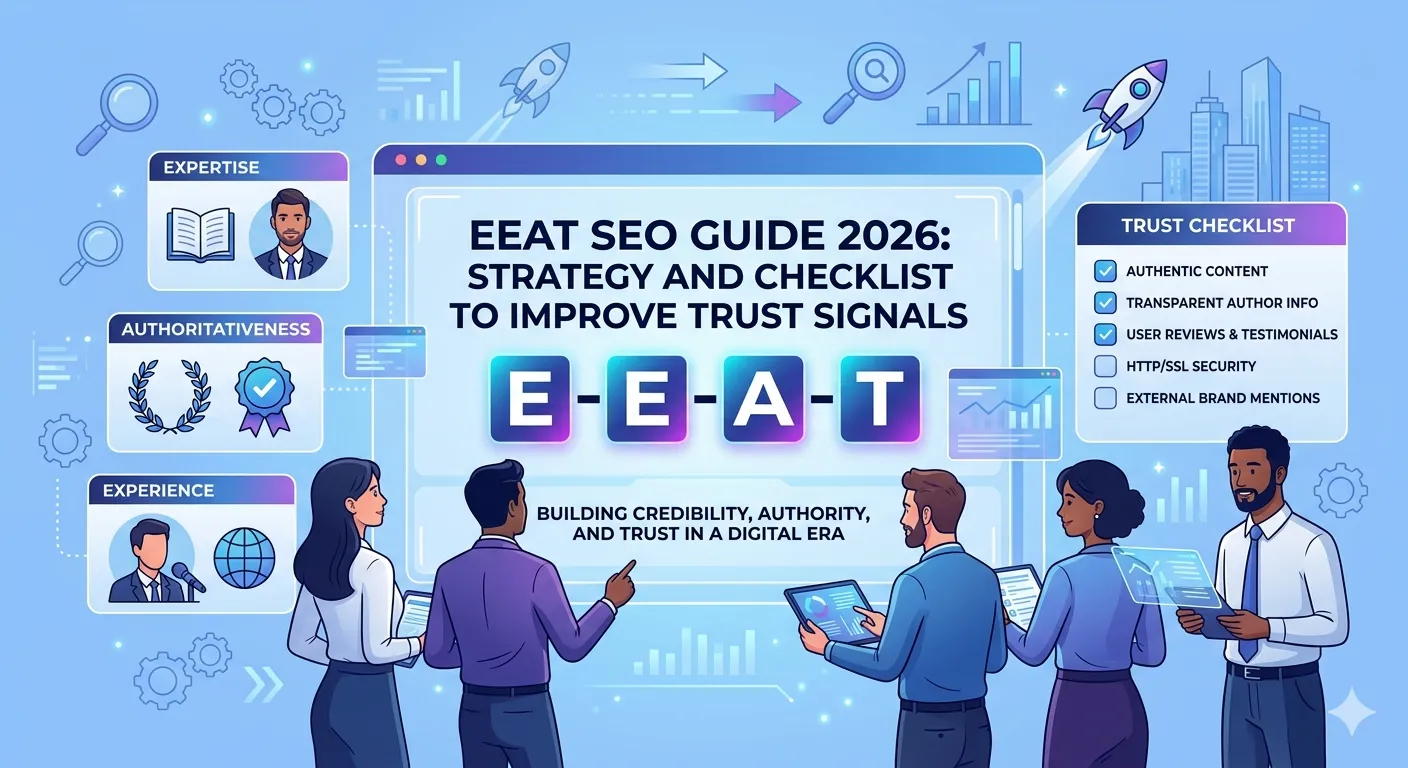
Before we get into strategy, let us make sure the foundation is solid. What is EEAT in SEO? It stands for Experience, Expertise, Authoritativeness, and Trustworthiness. These are the four dimensions Google’s human quality raters use to evaluate whether a piece of content is reliable, useful, and fit for the query it appears for.
They come from Google’s Search Quality Rater Guidelines, a document Google provides to thousands of human evaluators around the world. These raters do not directly change your rankings. But their feedback shapes how Google’s algorithms learn to distinguish high-quality content from low-quality content. Over time, what raters reward becomes what algorithms reward.
Let me walk through each element, because they are often confused or treated as interchangeable. They are not.
Experience
This is the newest addition. Google added the first “E” in December 2022 because they wanted a way to distinguish content written by someone who has actually done the thing from content written by someone who merely researched it.
A product review written by someone who bought the product, used it for three months, and photographed the wear and tear carries more weight than a review compiled from manufacturer specs and Amazon listings. A guide to recovering from knee surgery written by a physiotherapist who has treated hundreds of patients (or by a patient who went through it themselves) is more credible than one written by a content writer who googled the topic.
In 2026, experience matters more than ever because it is the one signal that AI-generated content struggles to replicate authentically. A language model can summarise what knee surgery recovery involves. It cannot tell you what the first week actually feels like.
How to demonstrate it: Case studies. Before-and-after examples. Original photos and screenshots. “Here is what we did” and “here is what we learned” narratives. Data from your own projects or clients. Anything that proves first-hand involvement.
Expertise
Expertise is about formal knowledge and qualifications. Does the person creating this content have the training, credentials, or professional background to speak with authority on this topic?
For some content, expertise is absolutely critical. If you are publishing medical advice, Google expects that content to be written or reviewed by a qualified medical professional. If you are publishing financial guidance, a chartered accountant or certified financial planner adds weight. These fall under what Google calls YMYL (Your Money or Your Life) topics, where bad information can cause real harm.
For other topics (restaurant reviews, travel guides, hobby tutorials), expertise requirements are lighter. Practical knowledge and demonstrated skill can be enough.
How to demonstrate it: Detailed author bios with relevant qualifications. Links to professional profiles (LinkedIn, institutional pages). Credentials listed alongside bylines. For YMYL content, visible expert review or sign-off.
Authoritativeness
Authoritativeness is about external recognition. It is not enough to say you are an expert. Other credible sources need to confirm it.
Think of it this way: if your website publishes a guide on tax planning for small businesses, and three respected financial publications link to it or cite it, Google has external evidence that your content is authoritative. If nobody outside your own site references your work, your authority claim is unverified.
How to demonstrate it: Earn backlinks from relevant, trusted publications. Get mentioned in industry media. Contribute guest content or expert commentary to recognised platforms. Build a body of work that other sites reference naturally. Maintain a consistent brand presence across the web.
Trustworthiness
Google clearly stated that trust is the main factor in E-E-A-T. A web page might exhibit experience, expertise, and authority, but if it gives the impression of being untrustworthy (through deceitful design, hiding contact information, unclear policies, or outdated facts), it will have a low E-E-A-T score overall.
Trust not only relates to how accurate the content is, but also to the kind of environment it is in. Even a well-researched piece of writing published on a site that has broken SSL, lacks a privacy policy, and does not provide a way to contact the business will still have a hard time.
How to demonstrate it: HTTPS across the entire site. Clear, accessible contact information. Transparent about-us and team pages with real names and photos. Privacy policy, terms of service, and refund/return policies where applicable. Content that is fact-checked, cited, and updated regularly. Honest handling of reviews and customer feedback.
How the Four Work Together
These elements are not meant to be optimised in isolation. A site with strong expertise signals but no trust infrastructure will underperform. A site with impressive backlinks (authority) but thin, generic content (weak experience and expertise) will eventually lose ground.
The businesses that perform exceptionally well in EEAT Google SEO are those that combine all four elements: experience as portrayed in the company’s content, expertise behind the information, external recognition for the content, and an atmosphere of trustworthiness on the website.
EEAT, Google’s Updates, and the Quality Rater Guidelines
How Quality Raters Shape What Google Rewards
Google employs thousands of quality raters worldwide. Their job is to evaluate search results against the guidelines Google provides, which include detailed instructions on assessing E-E-A-T. Raters look at the content, the author, the site, and the broader reputation of the brand, then score accordingly.
These scores do not change your ranking directly. But they feed into Google’s machine learning systems, helping algorithms learn to identify patterns associated with high-quality and low-quality content. Over time, what raters consistently flag as trustworthy and well-sourced becomes what Google’s algorithms favour.
Key EEAT Google Update Milestones
The evolution has been gradual but clear:
| Year | Update / Change | EEAT Impact |
| 2018 | “Medic” core update | Massive ranking shifts for health and finance sites lacking E-A-T signals |
| 2019-2021 | Multiple core updates | Continued emphasis on content quality, author expertise, and site trust |
| Dec 2022 | “Experience” added to E-A-T | Google formally recognises first-hand experience as a quality signal |
| 2023 | Helpful Content updates | Penalises content created primarily for search engines rather than people |
| 2024-2025 | Core updates + AI content guidance | Targets low-quality AI content; reinforces need for human oversight and genuine expertise |
| 2026 | Ongoing refinements | EEAT signals increasingly influence AI Overview citations and answer engine visibility |
Each EEAT Google update has pushed the same direction: reward content that demonstrates genuine quality, penalise content that tries to game the system. The pace of this shift has accelerated as AI-generated content has made it easier than ever to produce high volumes of mediocre, unverifiable material.
Is EEAT a Direct Ranking Factor?
This question comes up constantly, and the honest answer is: it is complicated. Google has said EEAT is not a single ranking factor with a score you can measure. There is no “EEAT metric” in Search Console. But the signals that make up EEAT (quality backlinks, author credentials, site security, content depth, user engagement) absolutely influence rankings through the various factors Google does measure.
Treating EEAT as “not a ranking factor, therefore not important” is a mistake I have seen businesses make repeatedly. The practical reality is that sites aligned with EEAT guidelines consistently outperform those that are not, especially after major core updates.
EEAT and YMYL: Where the Bar Is Highest
YMYL stands for “Your Money or Your Life.” It covers topics where inaccurate information could cause real harm: health, finance, legal advice, safety, and civic information.
For YMYL content, Google applies stricter EEAT SEO standards. A blog post about the best hiking trails in Kerala can get away with being written by an enthusiastic traveller. A blog post about managing diabetes needs a qualified medical professional involved in its creation or review. The consequences of getting this wrong, both for users and for your rankings, are significantly higher.
As per a 2025 study by NASSCOM-Deloitte on India’s digital content ecosystem, more than 40% of websites on health and finance topics lacked any visible signs of authorship or expertise. Websites that improved their visibility by taking care of these factors following Google updates performed well within six months. The data is clear: for YMYL topics in India, investing in EEAT Google SEO is not theoretical. It has direct business impact.
EEAT SEO in the Age of AI and Answer Engines
AI Has Changed Who Gets Cited
Google’s AI Overviews, ChatGPT-powered search tools, and voice assistants are now intermediate layers between your content and the person looking for answers. These systems do not just rank pages. They decide which sources are credible enough to reference, summarise, and attribute.
If your content lacks clear EEAT signals (no identifiable author, no credentials, no external validation, thin on original insight), AI systems have no reason to favour it over any other source. They will pick the content that is easiest to verify and most clearly authoritative.
This is where EEAT SEO and AI visibility become inseparable. The signals that make Google’s traditional algorithm trust your content are the same signals that AI systems use to decide whether to cite you.
What Are AI SEO Services and How Do They Connect to EEAT?
AI SEO services is a term that has gained traction in the last two years. It refers to SEO approaches that specifically optimise for AI-generated answers, conversational queries, and multi-platform visibility (AI Overviews, voice assistants, ChatGPT, Perplexity, and similar tools).
At the core of effective AI SEO is a simple principle: if AI systems cannot verify who you are, what you know, and why your content should be trusted, they will not surface it. Entity clarity (who is the author, who is the business, what is their track record), structured data (schema that communicates your details in machine-readable format), and evidence-backed content (citations, case studies, original data) are all EEAT signals that AI systems specifically look for.
Can AI-Generated Content Meet EEAT Guidelines?
Google has said clearly: AI-generated content is not automatically penalised. What matters is whether the content is helpful, accurate, and serves the user. But practically, meeting EEAT guidelines with purely AI-generated content is extremely difficult.
Why? Since EEAT means proficiency should be demonstrated (AI does not have any), expertise should be verifiable (AI is not able to hold credentials), and trustworthy authorship should be reputable (AI is not a person with a reputation). You may use AI tools for content creation assistance, drafting outlines, data research, and speeding up production. Nonetheless, the experience layer, expert review, author attribution, and fact-checking aspects must be done by real people.
Businesses that publish AI-only content at scale without human oversight are increasingly exposed to ranking drops during core updates. The guidance from Google’s own documentation and from every credible EEAT SEO guide is consistent: use AI as a tool, not as a replacement for genuine expertise and experience.
Answer Engine Optimisation and EEAT
AEO (Answer Engine Optimisation) is the practice of structuring content so AI tools and search features can easily extract, verify, and attribute answers from it. It sits at the intersection of EEAT and technical SEO.
Practically, AEO means:
- Using question-style headings that match how people search
- Leading each section with a clear, direct answer before expanding
- Implementing schema markup (FAQ, Organisation, Person, Product, Review) so machines can parse your content accurately
- Citing sources, linking to evidence, and making authorship transparent
All of the above AEO strategies can also enhance your EEAT metrics. When organising content for AI extraction, you will be optimising for transparency, verifiability, and credibility simultaneously. They are mutually beneficial approaches.
Core EEAT SEO Strategy: Turning Principles into Practice
Think of EEAT as Trust Architecture
The most useful way I have found to think about EEAT SEO is as trust architecture. It is not a single checklist item or a plugin you install. It is a set of design decisions that span content, technical infrastructure, branding, and external reputation.
Google itself suggests thinking in terms of Who, How, and Why:
- Who created this content? Is there a real, identifiable person or team with relevant credentials?
- How was it created? Was it researched, fact-checked, and based on genuine experience?
- Why does it exist? Was it created to help users, or primarily to attract search traffic?
If you can answer all three convincingly for every important page on your site, you are in strong shape.
The Main Pillars of an EEAT SEO Strategy
- Content quality: Depth, accuracy, originality, and evidence of real experience
- Author and brand signals: Visible credentials, bios, and a consistent identity across the web
- Technical trust: HTTPS, clean UX, accessible design, structured data
- External authority: Backlinks, mentions, PR coverage, and third-party validation
- User engagement: Time on page, repeat visits, low bounce rates (these improve naturally when the other four pillars are strong)
Each of these appears in the EEAT SEO checklist later in this guide.
Building EEAT into Daily Operations
EEAT should not be a one-off project. The businesses that sustain strong trust signals build EEAT practices into their standard workflows:
- Each piece of content has an identifiable author with an actual biography
- All facts are checked before publication, rather than after
- The expertise review is a standard procedure for all YMYL content
- Author pages and credentials are reviewed at least once a quarter
- Links to brands and backlinks are built constantly, rather than in campaigns
- Technical trust (SSL, site speed, accessibility) is monitored continuously
Content and On-Page Strategy: Proving Experience and Expertise
Writing Content That Shows (Not Just Tells)
The most common EEAT failure encountered is content that claims expertise without demonstrating it. A page titled “Complete Guide to Digital Marketing” that reads like a textbook definition copied from five other guides does not show experience or expertise. It shows that someone can summarise.
Content that scores well on EEAT looks different:
- “Here is how we increased organic traffic by 140% for a retail client in Pune over eight months” (experience)
- “Based on our work with 50+ e-commerce brands, the three most common technical SEO mistakes are…” (expertise)
- Original screenshots, proprietary data, or process documentation that could not come from anywhere else (evidence)
According to a 2025 SEMrush survey, websites that used original case studies, author bios featuring their qualifications, and at least one data point unique to their brand fared better for competitive keywords than those that did not use these elements. The correlation is hard to ignore.
Author Bios and Expert Attribution
All important pages on your website should be signed. Do not use “Admin” or “Team” as a sign. An actual author name, a portrait picture, an explanation of his qualifications to talk about the given topic, and a link to an author page are essential elements of such signing.
For any YMYL page, make even more effort. Prove that your page was reviewed by a professional. “Reviewed by [Name], [Qualifications]” with a link to his page gives extra credibility verified by both raters and automated systems.
Content Structure That Supports EEAT and AEO
Structure your content so that both humans and machines can quickly find and verify the information:
- Use descriptive H2 and H3 headings (question-style where natural)
- Open each section with a clear answer before adding detail
- Include FAQs for common queries, formatted with FAQ schema
- Link to credible external sources where you reference data or claims
- Keep paragraphs short and scannable
This structure serves two goals simultaneously. It makes your content more accessible to readers (improving engagement signals), and it makes it easier for AI systems to extract verified answers (improving AI visibility).
Keywords and EEAT: Finding the Balance
EEAT guidelines do not replace keyword strategy. They’re an additional layer on top of the keyword strategy. You will still have to choose the right keywords and include them in your website copy, but the age of quality-second, keywords-first content is finally over.
Assign the clear user intent to your pages and think does this content satisfy that intent better than anything else currently ranking? If the answer is no, the problem is not keywords. It is depth, experience, or trust.
Brand, Author, and Off-Page Signals: Building Authority
Backlinks as Authority Evidence
High-quality backlinks remain one of the clearest signals of authoritativeness in EEAT Google SEO. When a respected industry publication, a university, or a recognised media outlet links to your content, it is external validation that your work is worth referencing.
Focus on earning links through:
- Original research and data that others want to cite
- Expert commentary in industry publications
- Guest contributions on recognised platforms
- Digital PR and media outreach
- Community involvement and event participation
Strengthening Author Identity
If your authors publish across multiple platforms (your site, LinkedIn, industry blogs, podcast appearances), make sure their identity is consistent. Link your site’s author pages to their external profiles. The more coherent the “entity” of each author is across the web, the easier it is for Google to verify their expertise and associate it with your content.
Reviews, Testimonials, and Social Proof
Third-party reviews and testimonials, particularly those with positive outcomes, will provide social proof for EEAT. Place these on your website so people can see them, rather than hiding them in a separate section.
Monitor Your Brand Reputation
Stay vigilant about mentions and sentiment. Address any negative press quickly and courteously. Ensure your About Us, Contact Us, and policy pages are up to date. These are the first places that quality raters look when determining if your website can be trusted.
Technical and UX Foundations: Trust Beyond Content
Technical Basics That Influence EEAT
Content quality means nothing if the environment it sits in signals carelessness or risk. These technical fundamentals directly affect perceived trust:
- HTTPS: Non-negotiable. A site without SSL in 2026 is flagged as insecure by every major browser.
- Mobile responsiveness: The majority of searches happen on phones. A site that renders poorly on mobile undermines trust immediately.
- Site speed: Slow pages frustrate users and increase bounce rates. Both hurt engagement metrics that correlate with quality.
- Clean architecture: Logical navigation, clear menus, no dead ends. Users (and crawlers) should be able to find what they need within a few clicks.
- No broken links or intrusive elements: Broken pages, aggressive pop-ups, and auto-playing ads all erode trust.
Visible Trust Elements
Every site should have, at minimum:
- A contact page with a real address, phone number, and email
- An about page with real people, company history, and credentials
- A privacy policy and terms of service
- For e-commerce: refund/return policies and secure payment indicators
- For YMYL sites: accreditations, certifications, and regulatory compliance details
Schema and Structured Data
Schema markup is how you communicate trust-related information to search engines in a machine-readable format. For EEAT Google SEO, implement:
| Schema Type | What It Communicates |
| Organization | Company details, logo, founding date, social profiles |
| Person | Author name, credentials, job title, affiliated organisation |
| LocalBusiness | Address, phone, hours, service area (for local businesses) |
| Product / Service | What you offer, pricing, availability |
| Review / AggregateRating | Customer ratings and review data |
| FAQPage | Structured questions and answers for AI extraction |
Schema does not directly boost rankings. But it helps search engines and AI systems verify your EEAT signals, which increasingly matters for AI Overview citations and answer engine visibility.
The EEAT SEO Checklist 2026
Here is a practical EEAT SEO checklist you can apply to your site. Each item should be scored as “Done,” “In Progress,” or “Missing” for your priority pages.
Experience Signals
- Content includes first-hand case studies, examples, or original data
- Authors describe their direct involvement with the topic
- Original visuals (screenshots, photos, diagrams) support claims
- “How we did X” or “what we learned” formats are used where relevant
- Content cannot be replicated by someone who has never done the work
Expertise Signals
- Every important page has a named author with a visible bio
- Author bios include relevant qualifications and professional background
- YMYL content is reviewed or approved by a qualified expert
- Author pages link to external professional profiles
- Content demonstrates depth beyond surface-level summaries
Authoritativeness Signals
- The site earns backlinks from relevant, reputable publications
- The brand is mentioned in industry media or recognised directories
- Authors contribute expert content to third-party platforms
- The site is cited by other credible sources in its niche
- PR and digital outreach generate consistent external mentions
Trustworthiness Signals
- Site uses HTTPS with a valid SSL certificate
- Contact page has full details: address, phone, email
- About page features real people with photos and bios
- Privacy policy, terms, and relevant compliance pages are present and current
- Content is fact-checked, sourced, and updated regularly
- Reviews and feedback are handled transparently
- No deceptive design patterns (dark patterns, misleading ads, hidden terms)
How Often Should You Run an EEAT Audit?
- Annually: Full EEAT audit of the entire site, combined with technical and content audits
- Quarterly: Review critical pages (YMYL content, top landing pages, money pages)
- Monthly: Spot-check newly published content for author attribution, sourcing, and accuracy
Prioritising Improvements
Start with high-impact pages: the pages that drive the most organic traffic, the pages that generate revenue, and any YMYL content. Fix trust infrastructure first (SSL, contact details, policies), then move to content quality (author bios, case studies, expert review), then tackle external authority (link-building, PR, brand mentions).
EEAT SEO for Different Business Types
Local Businesses and Service Brands
For local businesses, the essence of EEAT is realised via the presentation of authentic customer experiences, reviews, mentions in the local media, and operational information. A plumbing company in Hyderabad builds EEAT by showcasing photos of its work, earning authentic local reviews, appearing in authoritative directories, and maintaining a website that describes itself, where it operates, and how to reach it.
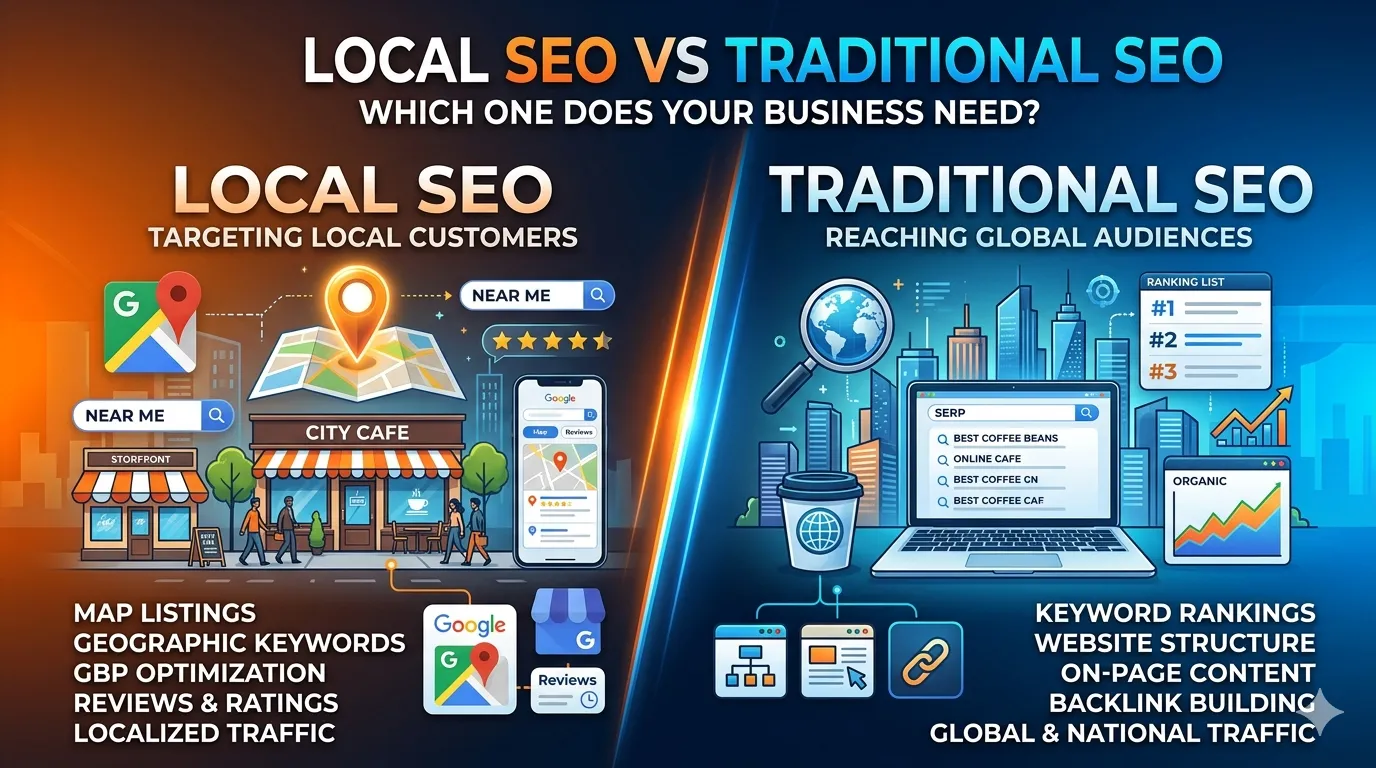
Local EEAT is directly related to Local SEO & AEO, where entity signals and reviews determine inclusion in the local pack and AI citation.
B2B, SaaS, and Tech Companies
These businesses build EEAT through case studies with measurable outcomes, whitepapers, expert-authored blog content, and links from industry-specific publications. Transparent pricing, detailed documentation, and visible security practices (SOC 2 compliance, data handling policies) all strengthen trust.
YMYL Businesses (Health, Finance, Legal)
The bar is highest here. Every piece of content needs identifiable expert involvement. Author credentials must be verifiable. Claims must be sourced. Content must be regularly reviewed and updated. Businesses in these sectors should treat EEAT not as an optimisation layer but as a compliance requirement.
Education and Training Brands
Showcase instructor credentials, student outcomes with real numbers, curriculum transparency, and third-party accreditation. Testimonials from actual students with specific results carry far more EEAT weight than generic praise.
Making EEAT SEO a Continuous, AI-Ready Practice
EEAT in SEO is Google’s framework for evaluating whether content is created by people with real experience and expertise, backed by external authority, and presented in a trustworthy environment. Every major EEAT Google update over the past several years has pushed this framework deeper into how rankings are determined.
In 2026, EEAT SEO is inseparable from AI visibility. The same signals that make Google’s traditional algorithm trust your content are the signals AI Overviews, answer engines, and voice assistants use to decide what to cite. Ignoring EEAT means becoming invisible in both traditional and AI-driven search.
This is not a one-time project. It is an ongoing commitment to quality, transparency, and genuine expertise. The businesses that build EEAT into their daily operations (content creation, publishing workflows, technical maintenance, and brand building) are the ones that sustain rankings through algorithm changes and competitive shifts.
Where to Start
Pick your five most important pages. Run them through the EEAT SEO checklist above. Score each one honestly. Fix the trust infrastructure gaps first (they are usually the quickest wins), then strengthen content quality, then build external authority. Document your actions and timelines so EEAT improvements become part of your standard SEO workflow, not an afterthought.
How We Think About EEAT at Savit
Everything this guide has laid out, we have had to figure out ourselves first. When Google added “Experience” to E-A-T in 2022, we did not just update our service page copy. We restructured how we plan content for clients: who writes it, what evidence supports it, how authorship is attributed, and whether the finished piece could have been written by someone who has never actually done the work. That distinction became the filter for every brief we produce.
Our AI SEO services grew out of the same principle. As AI Overviews and answer engines started deciding which sources to cite, we realised that EEAT signals were no longer just about ranking in ten blue links. They were determining whether a brand got referenced at all in the new discovery layer. So we built what we call the AI 360 Framework around that reality: mapping entities and intent first, designing content that AI systems can extract and attribute, building the external authority (PR, citations, backlinks) that makes attribution credible, and then tracking where and how a brand actually shows up across AI Overviews, ChatGPT, voice interfaces, and traditional search.
That last part, diagnosis, is where most agencies stop short. We do not. We monitor answer visibility and entity recognition across platforms and feed that data back into EEAT refinements. It is a loop, not a launch.
We have been working as the top SEO company in Mumbai for over 20 years, serving 3,500+ clients across industries and earning recognition such as India’s Best Marketing Firm and Best Use of SEO. That said, listing credentials alone is not what builds trust, and this guide makes that clear. What matters more is how that experience translates into solving real EEAT challenges. For businesses in India, this often means handling multilingual content without compromising authoritative sourcing, balancing local and national search signals, and ensuring that YMYL topics involve genuine expert input, even when it requires more time and rigour.
We do not skip it. That is the difference.
If This Guide Raised Questions About Your Own Site
Use the checklist. Score your critical pages. See where the gaps are. If you need a team that has already worked through these problems across hundreds of sites and can build EEAT into your SEO operations alongside an AI-ready AEO strategy, that is what we do.
Talk to Savit. We will start with an EEAT audit and go from there.