Your customers are in Mumbai, but their intent changes depending on the app they open. Here is how to match your business goals with the right feed.
Most Mumbai businesses are on the wrong platform, and they didn’t get there by accident.
If you walk into ten growing Mumbai businesses today and ask why they’re on Instagram, LinkedIn, or X, you’ll get ten variations of the same answer. The founder has a bias towards it. A competitor seems to be doing well there. An agency they hired pushed them onto it. Someone’s nephew runs the account. Everyone else is on it, so they should be too.
What you almost never hear is the answer that should be obvious. We’re here because this is where our customers spend their attention, and the content we make works on this platform.
That gap, between why a business chose a platform and why it should have, is the most expensive mistake in Indian digital marketing right now. It looks small from the outside. A few wasted posts. A bit of ad spend that didn’t convert. But across six months and a Mumbai-sized marketing team, it compounds. Lead quality drops. Sales cycles stretch. The founder starts blaming the product when the real issue is that the audience never showed up in the first place.
This blog post is our attempt at the “platform answer” for Mumbai businesses in 2026. We’re analysing the real impact that Instagram, LinkedIn, and X have on the Indian market today, company by company, who they serve and whom they don’t, and where the lines fall when you have to choose.
Before the platform comparison, there is a natural blind spot worth saying out loud. Often, the biggest hurdle to social media ROI isn’t bad creative or a weak agency. It’s our tendency to choose platforms based on personal habits. It is incredibly easy for a B2B leader to prioritise Instagram simply because that is where they personally unwind, even when their corporate clients are networking on LinkedIn. The opposite is just as common: a consumer brand posting earnest LinkedIn essays because the platform feels more “serious,” while their actual buyers are watching Reels.
The honest first step is auditing your own bias before you audit the platforms.
What Each Platform Represents in India in 2026
India does not consume the three platforms equally. Not even close.
Statcounter’s April 2026 figures put Instagram at 42.19% of India’s social media traffic, with Facebook at 25.31% and YouTube at 22.58%. X sits at 5.58%. LinkedIn is at 1.62%.
Read that ratio again. Instagram is roughly 26 times the size of LinkedIn in raw Indian attention share, and roughly seven times the size of X. That sounds like Instagram is the answer to everything, and for some businesses, it is. But raw attention share is the wrong number for any business that doesn’t sell to consumers in volume.
A better way to think about the three platforms:
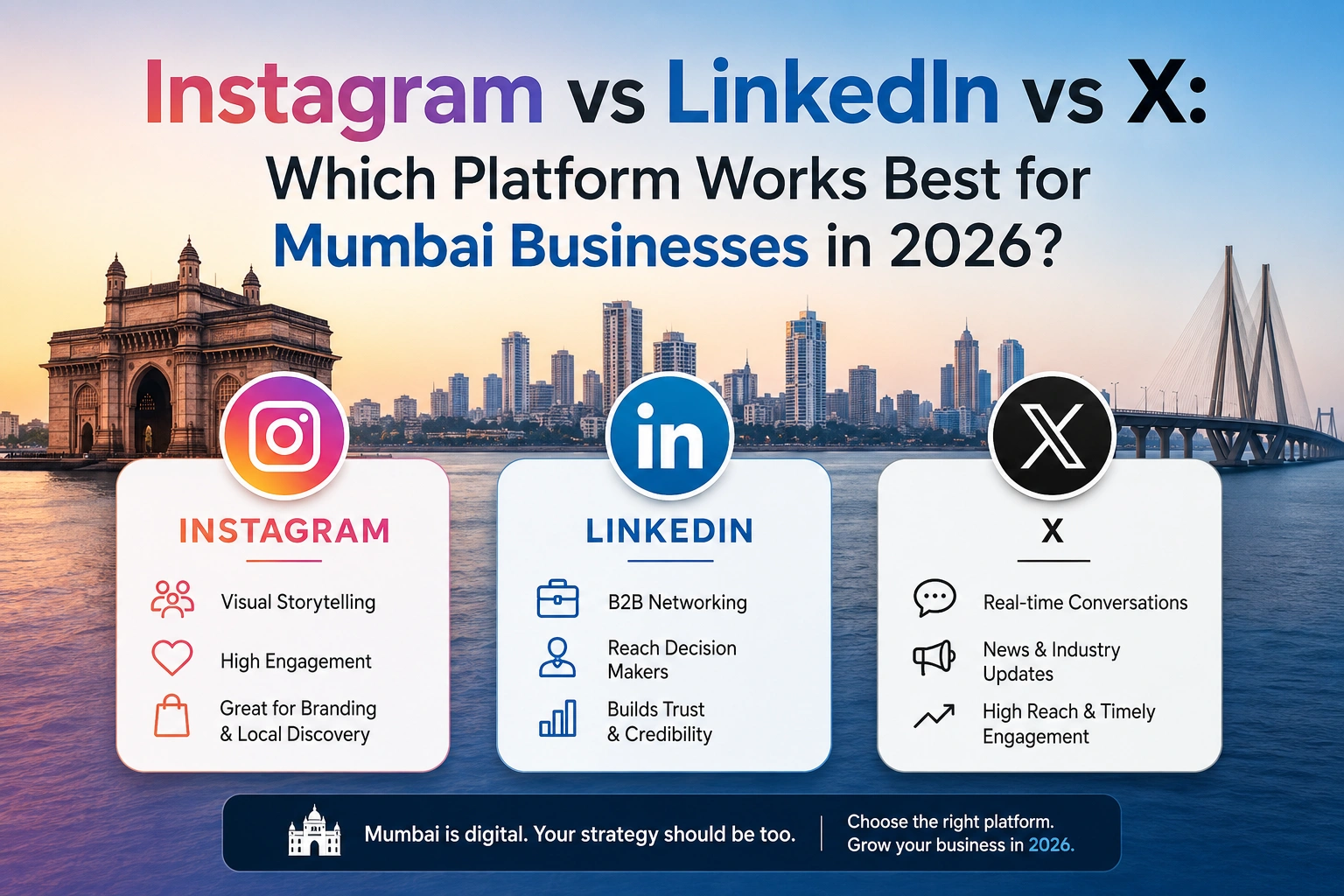
Instagram is where Mumbai’s consumers spend their leisure attention. It rewards visual content, frequency, and discovery through Reels. The audience is large but the intent at any given moment is low. A user is scrolling because they’re bored, not because they’re shopping. Conversion happens when the content is good enough to interrupt that drift.
LinkedIn is where Mumbai’s professional decisions get made. The audience is smaller, the cost per impression is higher, and the content needs to do real work. But the intent is qualitatively different. Someone reading a LinkedIn post about “content strategy in the age of AI” at eleven in the morning on a Tuesday is in a frame of mind that no Instagram user is ever in.
X is where conversations about news, markets, policy, and culture happen in something close to real time. It does not work as a primary lead source for most businesses. It works as a place to be present when something is happening, and to be findable when journalists, analysts, and decision-makers go looking.
These are not equally good platforms for everyone. They are different tools for different jobs. The mistake is treating the question of the best social media platforms for marketing as a single answer, when it is always a function of who you sell to.
Instagram: The Platform Where Mumbai’s Consumers Live
India crossed 522 million Instagram users by January 2026 and roughly 534 million by April, according to NapoleonCat’s regional tracking. Maharashtra leads every Indian state with 35 million users. Mumbai, as Maharashtra’s commercial capital, sits at the centre of that concentration.
That much you can read anywhere. What’s more useful is what Instagram does in 2026 for a Mumbai business that uses it well.
Instagram business marketing works when the product has a visual identity that benefits from being seen, when the customer is making a discretionary or aspirational purchase, and when the brand can post consistently without sounding like a brochure.
Asian Paints, headquartered in Mumbai, is the cleanest case study in the city. They don’t sell paint on Instagram. They sell colour, mood, and the idea of home. Their Colour of the Year campaigns, their interior-led visual content, and the way they treat each post as a small story about a space, all of it builds a slow accumulation of trust that no banner ad has ever produced. By the time a customer is choosing between paint brands, Asian Paints has already been part of the consideration for months.
Hunger Inc. Hospitality, the group behind Bombay Canteen, O Pedro, Bombay Sweet Shop, Papa’s, and Veronica’s, runs the same play in food. Each restaurant has its own voice on Instagram. The Bombay Canteen account doesn’t sound like O Pedro. O Pedro doesn’t sound like Papa’s. They understand that an Instagram feed is not a menu. It is the mood of the restaurant, served daily.
These businesses get something most Mumbai brands miss. Instagram is not a billboard. It is a slow medium dressed up as a fast one.
For Instagram lead generation in 2026, brands must move beyond generic content and focus on high-intent, conversion-driven formats. The most effective strategies for capturing qualified inquiries include:
- Publishing Reels tailored with hyper-local context, incorporating specific Mumbai neighborhoods, language, and cultural references.
- Creating short-form videos designed around a single, highly actionable takeaway.
- Running native lead form ads that integrate seamlessly with your CRM for immediate data capture.
- Implementing DM automation to quickly qualify messages and route serious inquiries to a human representative within minutes.
- Collaborating with niche influencers chosen for exact audience fit rather than sheer follower count.
Where Instagram fails is in two places. Organic reach has dropped sharply year on year. A business that posts well but spends nothing on amplification will struggle to be seen. The platform also rewards a particular kind of polish that can be expensive to produce consistently. And for B2B businesses, especially in services and software, Instagram lead generation produces a low yield relative to the effort it takes to do well.
Reels generate roughly 67% higher engagement than standard posts, which has turned short-form video into Instagram’s default format. A 2026 Instagram business marketing strategy that doesn’t lean into Reels is working with one arm tied.
LinkedIn: The Platform Mumbai Businesses Still Underuse
As of mid-2026, LinkedIn has approximately 167 million users in India, according to Moneycontrol.com. The country sits second globally, behind only the United States. And here is the figure that doesn’t get nearly enough attention. Of LinkedIn’s roughly 310 million monthly active users worldwide, only around 3 million post weekly.
Less than 1% of the global active audience is actively creating content. Translate that to the Mumbai context. The pool of decision-makers, founders, and senior professionals in this city is enormous. The pool of decision-makers actively posting and engaging is a fraction of it. The competition for visibility on LinkedIn is, by any rational measure, the lowest of any major platform.
This is the gap most Mumbai businesses have not yet tried to fill.
A successful LinkedIn content strategy in 2026 abandons the traditional corporate news feed in favour of authentic, human-led insights. To maximise reach and engagement, B2B brands should focus on the following key elements:
- Featuring founders or senior leaders who share professional perspectives in their own authentic voice.
- Publishing document carousels (PDF-style multi-slide posts), which have quietly become the platform’s highest-performing format.
- Writing long-form text posts that offer deep, actionable industry knowledge instead of standard company updates.
- Sharing short, high-impact videos kept strictly under 90 seconds.
Harsh Mariwala, founder of Marico, the Mumbai-headquartered FMCG company behind Parachute, Saffola, and Livon, is one of the cleanest local examples. His LinkedIn posts read like notes from an experienced operator, not press releases. He writes about leadership, succession, and the realities of running a business across decades. The content is not designed to sell. It is designed to earn the right to be considered.
Shantanu Deshpande of Bombay Shaving Company runs a more direct, sometimes controversial version of the same play. His LinkedIn content has built him a personal audience far larger than the company’s, and that personal audience has measurably helped Bombay Shaving Company on hiring, partnerships, and brand consideration.
For most Mumbai businesses, especially in B2B services, consulting, finance, technology, and professional services, LinkedIn is the platform with the highest unrealised return. Multiple industry studies place LinkedIn-generated B2B leads at roughly twice the conversion rate of leads from other social channels. Around 80% of all B2B social leads come through LinkedIn.
What goes wrong is predictable. Most companies treat LinkedIn like a corporate notice board. Quarterly results, employee awards, generic festival greetings. None of this content earns engagement, and the algorithm responds accordingly. A LinkedIn content strategy that doesn’t sound like a person, doesn’t share anything specific, and doesn’t show up consistently, is functionally invisible.
The other failure mode is treating LinkedIn as a place for pitch decks. The platform punishes selling and rewards teaching. Most Mumbai businesses still get this backwards.
X in 2026: Smaller Than People Think, More Useful Than People Admit
X has roughly 22 million Indian users and around 5.58% of Indian social media share. That is small. Roughly a thirtieth of Instagram’s footprint in this market.
X’s global ad revenue has dropped from around $5 billion in 2021 to about $2.5 billion in 2024, per QuantumRun analysis. Advertiser confidence has thinned. Organic reach is unpredictable in a way it wasn’t five years ago.
And yet, for a specific set of Mumbai businesses, X is still the most useful platform on the internet.
The clearest example is Anand Mahindra. The Mahindra Group is headquartered in Worli, Mumbai. His X account has built one of the largest founder-led followings in India by posting in a register no PR team would write for a chairman. Humour. Social commentary. Replies to ordinary users. Photographs of innovations he finds online. The occasional pointed observation about where the country is going. The result is a brand voice that no amount of paid advertising could produce, and a halo effect that runs across every Mahindra group company.
Mumbai Police’s X account is another counterintuitive case study. They use X for real-time public engagement, gentle wit, and crisis communication. The account has built credibility for an institution that, by default, would have struggled to be credible online.
What these examples have in common is that X works when there is a real person or a real institutional voice behind the account, and when that voice has something to say in real time. It does not work as a feed for marketing announcements.
The genuine use cases for X in 2026 are narrow but real:
- Customer service: Roughly two-thirds of users prefer X for customer service queries, and businesses that respond in minutes rather than hours measurably reduce churn.
- Real-time PR: Live commentary during budget announcements, RBI policy changes, market events, or industry news gives a brand visibility that no scheduled content can buy.
- Founder-led thought leadership in finance, technology, media, and policy.
- Industry conversations with journalists, analysts, and other founders.
For most Mumbai businesses, X is not a primary platform. It is a secondary or tertiary channel, often run personally by the founder or by a small in-house team rather than an agency.
Best Social Media Platform for Marketing: How to Decide
When Mumbai businesses ask which are the best social media platforms for marketing, the instinct is usually to be on all three. Just in case. This is the most expensive form of caution there is.
A genuinely useful platform decision starts with four questions.
- Who actually buys from you? Not who follows you. Who pays.
- What is the shape of your sales cycle? Impulse, considered, or long.
- What kind of content can your team realistically make every week for the next year?
- Where are your existing best customers already paying attention?
Once those four are answered honestly, the recommendation tends to land in one of a handful of patterns:
| If your business is… | Primary platform | Secondary platform |
| Mumbai D2C (fashion, beauty, food, lifestyle) | LinkedIn (for hiring and partnerships) | |
| Mumbai B2B services (consulting, IT, finance) | Instagram (for culture and employer brand) | |
| Mumbai professional services (legal, accounting, architecture) | Instagram (for founder personal brand) | |
| Mumbai real estate developer | LinkedIn (for investor and channel partner trust) | |
| Mumbai media, events, or fintech brand | Split across all three based on niche | Depends on commentary load |
| Local Mumbai service (salon, gym, clinic, cafe) | None. One platform done well is enough |
Two data points are worth keeping in mind while you read that table. India’s average social media user spends roughly two hours and 44 minutes on these platforms every day, per GrabOn’s 2025–26 estimates. Maharashtra alone accounts for 35 million Instagram users, the largest concentration in the country, according to Oye Creators’ regional analysis. Attention is concentrated, but it is also finite. A user who spends 2 hours 44 minutes a day on social media is not spreading that time equally across Instagram, LinkedIn, and X. They are spending the vast majority of it on one or two platforms, and they are doing so at predictable times of day.
This is why the conversation around social media marketing in Mumbai cannot be solved by being everywhere. Attention is not democratic. It is concentrated, and concentration is the entire point.
The Hidden Cost of Being on All Three
Most Mumbai businesses underestimate how expensive a multi-platform presence is when none of the platforms has a clear role.
Three things go wrong, usually all at once.
- Content quality drops, because the same team is now producing for three formats, three tones, and three rhythms. A Reel needs to be different from a LinkedIn carousel, which needs to be different from an X thread. When the same person is making all three, none of them is good.
- Messaging becomes inconsistent. A brand voice that works on Instagram (playful, visual, fast) is not the same as a brand voice that works on LinkedIn (measured, specific, slower). Trying to be both produces a third voice that sounds like neither, and that voice doesn’t build trust on either platform.
- Algorithms fail to understand the brand’s positioning because the signal is inconsistent. Instagram’s algorithm wants to know what you’re about. LinkedIn’s algorithm wants to know who you serve. X’s algorithm wants to know what you contribute to live conversation. Confused inputs produce confused outputs.
A focused Mumbai business with one strong platform almost always outperforms an unfocused one across three. This is the single most important point in any honest discussion of social media marketing in Mumbai for 2026.
How Savit Thinks About This
At Savit, we don’t start with platforms. We start with the business. What does the company sell, who buys it, what does the buyer’s day look like, and where does that buyer spend their attention. The platform recommendation follows from that read, not the other way round.
For Instagram business marketing, our work for Mumbai brands focuses on building visual identity over time, not chasing reach on individual posts. We design content systems, not one-off campaigns. Reels with genuine local relevance, lead form integrations that route enquiries straight into the client’s CRM, and ad targeting built around audiences that actually convert rather than audiences that simply engage. A clean Instagram lead generation programme, run with discipline, will outperform a noisier one every quarter of the year.
For LinkedIn content strategy, we work primarily with founders and senior leaders in Mumbai’s B2B sector. Document carousels that break down genuinely complex ideas. Founder-voice posts that share perspective without selling. Engagement strategies that put the brand in front of the right decision-makers, not in front of the largest possible audience. Most of the highest-performing LinkedIn work we do has audiences in the thousands, not the millions, and converts at a rate paid advertising rarely matches.
For X, we use it where it earns its place. Real-time PR. Customer service operations. Founder thought leadership. Conversations with journalists and industry voices.
What ties all of this together is a way of thinking about social media marketing in Mumbai that treats attention as expensive and treats relevance as the only metric worth chasing. We have spent more than two decades watching businesses grow online in this city, and the pattern is consistent. The brands that win are the ones with the discipline to be excellent on one platform before they are average on three.
If you are trying to decide where to focus, or trying to fix a presence that isn’t producing leads, we’d be happy to help you read the situation honestly.