Key Highlights
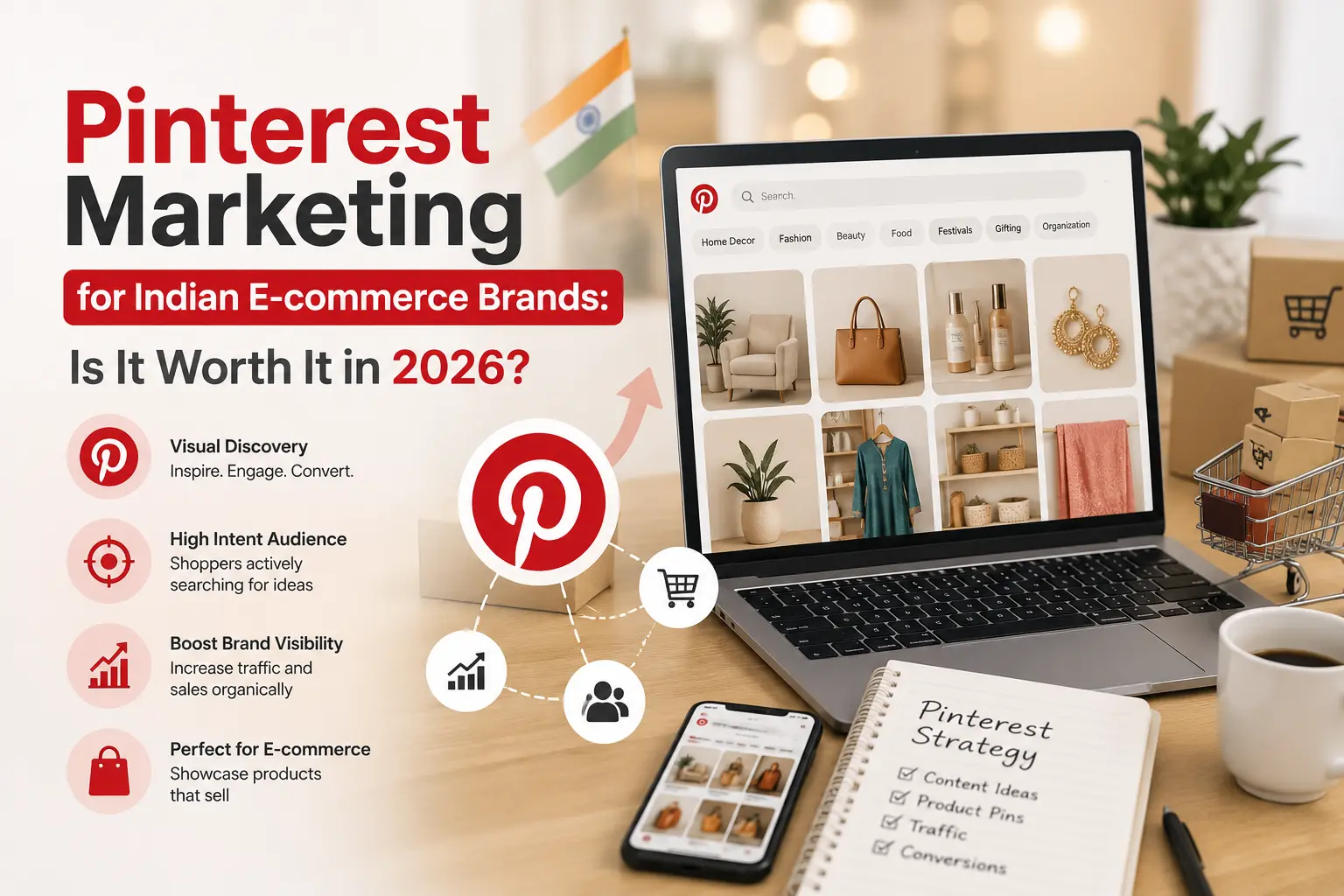
- Pinterest’s 2025 Annual Report confirms 619 million monthly active users worldwide, with India among its fastest-growing markets
- 85% of weekly Pinners have made a purchase based on a brand’s Pin, making it one of the highest-intent social platforms for e-commerce
- Around 96% of top Pinterest searches are unbranded, giving new Indian brands an equal shot at discovery against established players
- Pinterest content lives for months or years; Instagram and Facebook posts are typically dead within 48 hours
- Gen Z now represents over 50% of Pinterest’s monthly active user base, matching India’s young online shopper profile
- Indian brands in fashion, home decor, art, jewellery, and lifestyle face almost zero local competition on Pinterest right now
- A free Pinterest business account unlocks analytics, shoppable Pins, and advertising capabilities from day one
An Indian shopper is planning a bedroom makeover.
She does not open Instagram. She does not search on Amazon yet. She opens Pinterest, types “small bedroom decor India,” and over the next week saves 30 images, clicks through to product pages, and builds a clear mental shortlist of the brands she trusts.
By the time she buys, she already knows exactly what she wants. Most of the time, she already knows the brands that created the looks she saved.
The question for every Indian e-commerce business is not whether this kind of buyer exists. It is whether your brand appeared on that screen, or whether it was invisible during the entire decision.
Indian D2C and e-commerce brands pour significant budget into Instagram and Meta ads. The competition on those platforms is real, and costs keep climbing. Pinterest, by contrast, sits largely unused by Indian brands across most categories, including the ones where it consistently performs: fashion, home decor, jewellery, art, lifestyle, and beauty.
This is not a coincidence. It is an opportunity.
This guide gives you the full picture: how Pinterest works for business, how it differs from Instagram and Facebook, the traffic it drives for e-commerce, and why the platform represents a genuine early-mover advantage for Indian brands right now. It then covers the complete setup, a Pinterest marketing strategy built for 2026, what is working and what has stopped working, a clear advertising framework, and a 90-day action plan.
According to Pinterest’s 2025 Annual Report, the platform reached 619 million monthly active users worldwide. Not all of them are your buyers. The ones who are, however, are more ready to purchase than almost any audience on any other social platform.
How Do Businesses Work on Pinterest?
Pinterest is a visual search engine that also functions as a planning and discovery platform. That distinction matters for every business that uses it, and it shapes everything that follows in this guide.
When someone opens Pinterest, they are not checking what their friends had for lunch. They are searching for ideas. They type a query, explore visual results, save things they like to named boards, and follow links to find out more. The process looks like browsing but functions like shopping research.
Pinterest for brands means placing your products and content at the exact point of discovery. A Pin is an image or video linked back to a page on your website. When a user saves your Pin to their board, it gains additional reach because boards are public and other users find them through search. One well-optimised Pin can continue driving website visits for months or years after it was first published, unlike a social post that stops generating reach within days.
According to Pinterest Business research, 85% of weekly Pinners have made a purchase based on a Pin they saw from a brand. This figure reflects something specific: the majority of Pinterest users arrive on the platform in a planning and buying mindset, not to be passively entertained.
The core concept to understand: on Instagram and Facebook, you interrupt someone’s feed to show them your product. On Pinterest, you get discovered by someone who was already looking for something like it. That shift in the relationship between brand and buyer is what makes using Pinterest for business structurally different from every feed-based social platform.
How Is Pinterest Different from Instagram and Facebook for Business?
The fundamental difference is user intent. Instagram and Facebook are platforms for socialising and entertainment. Pinterest is a platform for searching and planning. Those distinct behaviours produce entirely different relationships with the brands that appear in each environment.
| Factor | |||
| Primary user mindset | Searching for ideas, planning purchases | Entertainment, socialising, self-expression | Social connection, news, community |
| How content is found | Keyword search, visual search, smart feed | Algorithmic feed, Explore page, Stories | Algorithmic feed, paid ads, groups |
| Content lifespan | Months to years | 24-48 hours | Days |
| Purchase intent | High (active buying and planning mode) | Medium (browsing and impulse) | Low to medium |
| Brand discovery | Unbranded searches dominate | Follows, paid reach, influencer content | Mostly paid or existing connections |
| Best-fit content | Products, lifestyle, inspiration, how-to | Lifestyle, personality, behind-the-scenes | Community, events, broad awareness |
The unbranded search point is particularly important for Indian brands. According to Pinterest’s own platform research, around 96% of top searches on Pinterest are unbranded, meaning terms like “modern bedroom ideas India” or “handmade silk kurta” rather than specific brand names. This means a new Indian D2C brand has an equal opportunity to be discovered alongside an established competitor.
On Google or Amazon, established brands dominate through domain authority, ad budget, and review volume built over years. On Pinterest, a new brand with well-crafted, keyword-optimised Pins can appear right next to a much larger player. That is a structural advantage that most Indian brands have not yet recognised or acted on.
For established brands, there is a trust dynamic worth noting: Pinterest users saving and revisiting Pins over several weeks have a very different quality of consideration compared to users clicking an Instagram ad on first exposure. Pinterest’s buyer is slower to arrive but further along the decision when they do.
How Much Traffic Does Pinterest Drive for E-commerce and D2C Brands?
Pinterest is not a fast traffic channel. It is a durable one, and that distinction matters for how you plan with it.
A well-optimised Pin published today can continue surfacing in search results and smart feeds twelve months from now. Pinterest’s algorithm prioritises relevance over recency in a way that Instagram and Facebook do not. When a user saves your Pin to their board, that board gets indexed and seen by other users searching similar terms. The compounding effect builds slowly and then accelerates over months.
For e-commerce brands in visual categories, Pinterest consistently ranks among the highest-intent referral traffic sources. Users who click through from Pinterest to a product page arrive already inspired, with a clearer sense of what they want than someone who clicked a cold ad on a social feed.
Social media advertising for ecommerce on Pinterest also benefits directly from this intent signal. Because Pinterest users are in active planning and buying mode, ad conversion rates on the platform can be competitive with or exceed those on Meta in the right categories, with lower cost-per-click in many cases due to lower advertiser competition, particularly in the Indian market.
Honest expectation: Pinterest does not suit every product category. For commodity products with no visual or aspirational dimension, or for B2B brands, the platform offers limited returns. For fashion, home decor, art, jewellery, beauty, food, and lifestyle products, the intent-to-traffic match is genuine and measurable.
Why Does Pinterest Matter Specifically for Indian E-commerce Brands in 2026?
The case for Indian brands is not just that Pinterest works for e-commerce. It is that Pinterest is growing fast in India while Indian brands are almost entirely absent from it.
Pinterest’s own disclosures, referenced in platform analytics research from 2026, identify India alongside Brazil and Germany as among the international markets driving the platform’s renewed growth. Pinterest’s 2025 Annual Report confirms that Gen Z now represents over 50% of Pinterest’s monthly active user base. India has one of the largest and fastest-growing young online shopping populations in the world. The audience alignment is direct and significant.
Yet if you search Pinterest today for “Indian fashion brands,” “home decor India,” or “handmade jewellery India,” the results are thin on verified Indian D2C brands. International brands, lifestyle bloggers, and large aggregators fill most of the search space. The keywords are open. Advertising costs are lower than Meta equivalents in these categories. Organic competition from Indian brands is negligible.
This combination creates an early-mover window of the kind that rarely stays open for long. Pinterest rewards account seniority and consistent publishing with algorithmic trust. Brands that build their presence in 2026 will be harder to displace in 2027 and 2028. The algorithm accumulates trust over time; a brand that starts later has to work against an established account, not into open space.
India’s D2C market is projected to reach $60 billion by 2030, according to Techeasify’s 2026 D2C trends research. Indian fashion, handicraft, home decor, jewellery, and handmade art are globally searched visual categories. Those searches happen on Pinterest daily, and most results do not point to Indian brands.
How Do You Set Up Your Brand on Pinterest? A Complete Guide
Getting a Pinterest business account set up correctly takes less time than most brands expect, and doing it right at the start prevents the most common strategic errors that undermine performance for months. The foundation of using Pinterest for business effectively is technical: without account verification, a connected catalogue, and a tag in place, none of the content or advertising strategy that follows works properly.
Step 1: Create a Pinterest Business Account
Go to business.pinterest.com and create a free business account, or convert an existing personal account. A business account unlocks Pinterest Analytics, access to Pinterest Ads, rich Pins and product Pins, and the ability to claim your website.
If you have an existing personal Pinterest account for your brand, convert it rather than starting fresh. Follower history, saved content, and any algorithmic trust the account has built carry over. Starting a new account means starting from zero.
Step 2: Claim Your Website and Install the Pinterest Tag
Claiming your website connects your domain to your Pinterest account and pulls analytics data about Pins originating from your site. The Pinterest tag, a small tracking script, enables conversion tracking, retargeting audiences, and Actalike audience creation for future ads.
Install both before publishing your first Pin. Setting these up afterwards means losing data you cannot recover retroactively, which compromises your ability to measure performance accurately or build targeted audiences.
Step 3: Connect Your Product Catalogue and Enable Product Pins
For an e-commerce brand, this step unlocks the most commercially valuable Pinterest features. Upload your product catalogue via Pinterest’s Data Source feature. Once connected, Pinterest automatically creates shoppable product Pins with live pricing, stock status, and direct buy links.
These Pins appear in Pinterest’s Shopping tab and in shopping search results, reaching buyers who are in active purchase mode. If your store runs on Shopify, WooCommerce, or similar platforms, there are direct integrations that automate catalogue syncing and keep product information current.
Step 4: Build Boards Around How Your Buyers Search
This is where most brands go wrong in a way that limits performance for months without an obvious explanation. The instinct is to create boards that mirror your product range (“Kurtas,” “Cushion Covers,” “Canvas Prints”). Boards that rank and attract followers are named around how buyers search.
Category-specific examples:
Fashion brands: boards by occasion (“Festive Season Looks 2026”), by aesthetic (“Sustainable Summer Fashion India”), by styling use case (“How to Style Straight Kurtas”), and by season.
Home decor brands: boards by room (“Bedroom Inspiration for Indian Homes”), by interior style (“Modern Indian Minimalism”), and by project size (“Small Apartment Decor India”).
Art brands: boards by the type of space the buyer is decorating (“Office Wall Art India”), by colour palette that coordinates with interiors, and by art medium.
Lifestyle brands: boards by aspiration, daily routine, and occasion rather than by product category. “Slow Morning Rituals” outperforms “Breakfast Products.”
Step 5: Optimise Every Pin for Pinterest SEO
Pinterest functions as a search engine, which means each Pin needs treating as a searchable content asset. This is the practical layer of social media content strategy that separates brands whose Pins get found from those that go nowhere.
Key optimisation points for each Pin:
- Use a keyword-rich title (not “Blue Kurta” but “Blue Cotton Kurta for Summer Weddings India”)
- Write a descriptive, searchable caption of 100-300 characters with relevant search terms
- Use vertical images at 2:3 aspect ratio (1000 x 1500 pixels is the Pinterest standard)
- Add a clear text overlay that communicates the Pin’s value at a quick glance
- Link each Pin directly to the most relevant product or category page, never the homepage
- Name image files with keywords before uploading
Setup Checklist
| Setup task | Status |
| Pinterest business account created or converted | |
| Website claimed and verified | |
| Pinterest tag installed on site | |
| Product catalogue connected and syncing (for e-commerce) | |
| Shoppable product Pins enabled | |
| 8-10 intent-based boards created with keyword descriptions | |
| Profile optimised: keywords in bio, logo, website link | |
| Analytics reviewed and baseline set |
What Is the Best Pinterest Marketing Strategy for 2026?
The short version: publish consistently, optimise every Pin for search, use video and Idea Pins alongside standard static content, and use Pinterest advertising to amplify organic content that is already performing. This is the social media content strategy that separates Pinterest accounts with lasting compound growth from those that plateau after a few weeks.
The longer version requires understanding what the platform’s algorithm is currently rewarding and what it has largely stopped responding to.
What’s Working on Pinterest in 2026
Fresh Pins with keyword-rich content. The algorithm rewards new content. Create new Pins for your existing product and content regularly rather than recycling old images. The same product shot with a different design, context, or seasonal angle qualifies as fresh content.
Idea Pins and short video. Multi-frame Idea Pins and video Pins generate significantly more saves and engagement than static images alone. The algorithm reads high saves as a quality signal and increases distribution accordingly.
Shoppable product Pins with live catalogue data. Pins connected to a live catalogue appear in Pinterest’s Shopping tab and convert better because the path from discovery to purchase is seamless. This format is especially useful for Pinterest for brands whose primary goal is direct product sales.
Trend-aligned content published ahead of the peak. Pinterest’s own Trends tool forecasts rising search terms 6 to 8 weeks before they peak. Brands that publish content around an emerging trend before it peaks earn a first-mover advantage in that search space.
Consistent publishing over months. The algorithm builds trust in accounts that publish regularly. Six months of consistent daily pinning outperforms any short-term burst.
What Has Stopped Working
Reposting square Instagram content. Square images underperform on Pinterest. The platform’s feed is built for vertical 2:3 content, and repurposed social content that has not been adapted for this format gets significantly less reach.
Publishing without keyword research. Pins without keyword-optimised titles and descriptions are invisible in search regardless of how strong the image is. Most of Pinterest’s traffic is search-driven.
Bulk pinning without consistency. Posting 50 Pins in one day and then nothing for two weeks tells the algorithm the account is not active. Steady and regular beats intensive and intermittent.
Boards organised around internal product names. If board names mirror your SKU categories rather than how buyers search, those boards do not rank for the terms your audience uses.
| What’s working in 2026 | What’s no longer effective |
| Keyword-optimised fresh Pins published daily | Reposting square Instagram content as-is |
| Video Pins and multi-frame Idea Pins | Bulk pinning followed by extended inactivity |
| Shoppable product Pins from a live catalogue | Boards structured around internal product names |
| Trend-led content timed to Pinterest Trends | Publishing without keyword research |
| Consistent publishing sustained over months | Treating the account as a low-priority channel |
| Paid amplification of proven organic performers | Running ads on untested creative |
How Often Should You Post?
Posting cadence recommendations for Pinterest vary more than for most platforms because the algorithm rewards both quality and sustained frequency. These are practical starting points, not rigid rules.
| Brand type | Starting daily cadence | Content mix |
| Fashion or home decor brand | 3-5 fresh Pins | Product Pins, lifestyle imagery, trend content |
| Art or handmade jewellery brand | 2-4 fresh Pins | Strong visual quality; process and inspiration Pins |
| Lifestyle or beauty brand | 3-5 fresh Pins | How-to Pins, ingredient or material spotlights, use-case content |
| Small D2C brand starting out | 1-2 fresh Pins | Prioritise quality and consistency over volume |
“Fresh Pin” means a new image or video, not a repin of existing content. The algorithm gives new content priority in distribution.
Scheduling tools help with this considerably. Batching a week’s content in one session and scheduling it to publish at optimal times is both more efficient and more effective than attempting to pin manually each day.
How Should Indian E-commerce Brands Use Pinterest Advertising?
Pinterest advertising works best as a paid layer on top of an organic foundation that has already produced performance signals. Running ads without any organic presence is possible but inefficient: you are spending money on creative and audiences before you know what resonates.
The Sequence That Works
First, publish organically and identify which Pins earn strong saves, outbound clicks, and repins. These engagement signals indicate which content your audience finds valuable.
Then, promote the Pins already performing well. This ensures your ad budget amplifies proven creative rather than testing unvalidated ideas at the cost of paid impressions.
Finally, build audience layers. Use the Pinterest tag data to retarget website visitors and create Actalike audiences from your existing customers for prospecting campaigns.
Ad Formats Relevant to Indian E-commerce
Shopping ads pull directly from your product catalogue and appear in shopping search results. For a buyer actively searching a product type, Shopping ads are the closest Pinterest equivalent to Google Shopping. These are high-intent placements.
Collection ads display a hero image or video with several product images beneath it. They suit lifestyle brands where brand context matters alongside product presentation: fashion, home decor, and beauty brands typically find this format effective.
Standard Promoted Pins (single image or video with a paid boost) are the simplest format and useful for driving traffic to landing pages, category pages, or content as part of a broader social media advertising for ecommerce strategy.
Targeting Options Worth Using
Pinterest’s targeting options relevant to Indian e-commerce brands include:
- Keyword targeting: ads appear when users search specific terms, functioning similarly to search advertising but in a visual discovery context
- Interest targeting: reach users categorised by their Pinterest engagement patterns in topics relevant to your category
- Actalike audiences: reach users who resemble your existing customers or website visitors, built automatically from tag data
- Retargeting: re-engage users who have visited your website or saved your Pins previously
For Indian brands starting with Pinterest ads, keyword targeting aligned to your strongest organic search terms provides the most direct, measurable starting point. Add interest layers once keyword performance data gives you a baseline to compare against.
Your Comprehensive Action Plan to Get Started on Pinterest
This plan is built for an Indian e-commerce brand starting from scratch or restarting a neglected account. The goal at 90 days is not viral success. It is a functioning, data- producing presence with early performance signals to act on.
Week 1: Technical Foundation
- Create or convert to a Pinterest business account
- Claim and verify your website
- Install the Pinterest tag
- Connect your product catalogue and enable product Pins
- Research 25-30 keywords your buyers use (use the Pinterest search bar suggestions, the Trends tool, and competitor board names as starting points)
- Set up 8-10 intent-based boards with keyword-rich names and descriptions
- Complete the profile: keyword-rich bio, website link, brand logo as profile image
Weeks 2-3: First Content Batch
- Create 30-50 fresh Pins: a mix of product Pins, lifestyle imagery, and inspirational content
- Ensure every Pin has a keyword-optimised title, descriptive caption, and direct website link
- Use vertical 2:3 format for all static images; create at least five Idea Pins or short video Pins in this first batch
- Start publishing consistently at 2-3 fresh Pins per day using a scheduling tool
Weeks 4-6: Early Momentum
- Review Pinterest Analytics: which Pins earn saves, which earn outbound clicks?
- Double down on the content topics and formats that are generating saves
- Introduce more video Pins if not already publishing them consistently
- Begin aligning content to Pinterest Trends for the next 4-6 weeks
- Hold off on paid advertising until you have organic performance data
Weeks 7-11: Paid Amplification
- Identify the top 5-10 organic Pins by saves and outbound clicks
- Promote these as Promoted Pins or Shopping ads with modest daily budgets
- Set up keyword targeting aligned to your strongest organic search terms
- Begin retargeting campaigns for website visitors using tag audience data
- Track cost per click, outbound clicks, and conversions from the Pinterest tag
Week 12: Evaluate and Plan
- Review full 90-day performance: organic saves, outbound clicks, Pinterest-referred sessions, and conversion data
- Identify top-performing boards, Pin formats, and content topics
- Plan the next 90-day content calendar around what the data shows is working
- Set a monthly content and paid budget that the performance data justifies
At 90 days, a brand publishing consistently with keyword-optimised content and initial paid amplification will have genuine performance data to guide the next phase. The compounding effect of Pinterest’s algorithm becomes more pronounced from month four onward, and the brands that build this foundation in 2026 are the ones positioned to dominate their category search results through 2027 and beyond.
So, Is Pinterest Worth It for Indian E-commerce Brands in 2026?
The direct answer is yes, for the right categories, with a sustained commitment to consistent execution.
The case is built on three conditions that currently align uniquely well for Indian brands.
- First, Pinterest users arrive in active buying mode: this audience has higher purchase intent than almost any social platform.
- Second, Pinterest advertising costs in Indian market categories are currently lower than Meta equivalents, because Indian brands are not competing on the platform yet in significant numbers.
- Third, organic search space in fashion, home decor, jewellery, art, and lifestyle is essentially unclaimed by Indian brands, which means early organic positioning is achievable right now in a way it will not be in two years.
These three conditions will not persist indefinitely. Pinterest’s international audience is growing fast, and Indian users are a meaningful part of that growth. As more Indian brands recognise this and invest, the organic and paid competition will rise, costs will increase, and the early-mover window will close.
Pinterest marketing strategy in 2026 is not about being on every platform. It is about being in the right place before your competitors arrive. For brands in visual, discovery-led categories, Pinterest in India is that place right now.
This is not a recommendation to abandon Meta or SEO. Pinterest works best as a complementary channel: it finds buyers earlier, builds brand trust through inspiration, and feeds warmer traffic into your other conversion channels. The brands that integrate it properly, with consistent organic publishing and targeted paid amplification, will build a compound asset that pays returns for years.
For fashion, home decor, art, jewellery, beauty, food, and lifestyle brands in India, the decision in 2026 should not be whether to build a Pinterest marketing strategy. It should be whether to start now, while the space is open, or later, when it is not.
How Savit Interactive Approaches Pinterest Marketing for E-commerce Brands
At Savit Interactive, we have been working with Indian e-commerce brands, D2C businesses, and global clients from our base in Mumbai since 2004. Pinterest sits within our broader social media and performance marketing practice, and we approach it with the same performance orientation we bring to SEO, PPC, and every other channel we manage.
When we develop a Pinterest strategy for an e-commerce client, we start with the question this article starts with: how do your buyers normally search on Pinterest? The answer shapes everything that follows. Board architecture, keyword strategy, content formats, and ad targeting all flow from a clear picture of what the brand’s best customer is typing into that search bar and what they expect to find.
Our process begins with audience research and keyword mapping, then moves into the technical foundation: business account setup, verified website, product catalogue integration, and tag installation. We build boards around buyer intent rather than internal product taxonomy. Every Pin is optimised for Pinterest SEO, formatted for visual impact at the 2:3 ratio, and connected directly to a product or landing page that can convert the traffic.
Pinterest for brands we manage is never treated as a set-and-forget activity. We publish consistently, monitor what earns saves and outbound clicks, and refine content direction based on real performance data. When sufficient organic signal exists, we move into paid amplification through Pinterest advertising that uses keyword targeting, Act alike audiences, and retargeting built from the Pinterest tag. We track saves, outbound clicks, website sessions from Pinterest, and actual conversions, not vanity engagement metrics.
This Pinterest work integrates into each client’s broader social media advertising for ecommerce strategy. Discovery on Pinterest connects with retargeting on Meta, email nurture sequences, and on-site conversion optimisation, so the inspirational intent that Pinterest captures does not leak before it converts.
We adapt this approach to each brand’s specific category and market, because a fashion brand in Mumbai, a home decor store targeting pan-India, and a handmade art brand selling globally each have different Pinterest audiences, different keywords, and different content formats that work for them.
If your brand is in fashion, home decor, jewellery, lifestyle, art, or beauty, and you want to reach Indian shoppers earlier in the buying journey at a lower cost than crowded feed platforms, we would be glad to talk through what a Pinterest strategy would look like specifically for your brand and goals.
Talk to our team at savit.in to get started.