Key Highlights
- Performance marketing pays only for measurable results: clicks, leads, and sales. No placements. No exposure fees. No guesswork.
- Three things must be in place before scaling: proven product-market fit, a converting landing page, and verified conversion tracking
- A 10-step framework takes you from getting the foundation right to optimising for lifetime value
- Creative fatigue is the most consistent ceiling on paid scaling; the fix is a creative system, not just better creative
- Step 9 (optimising for LTV) is what changes the CPA you can profitably afford and allows you to outbid competition while staying in the black
- Full-funnel tracking is what makes every other scaling decision trustworthy
You validated the product. The early sales came in. You doubled the ad budget.
Then the returns did not double.
If anything, they got worse.
The problem was not the product and it was not the platform. It was the order of operations. Scaling performance marketing is not a spend decision. It is a system decision.
This guide lays out that system, step by step.
As per SQ Magazine’s 2026 digital marketing report, global digital ad spend is projected to surpass $700 billion in 2026, with digital channels now driving the majority of all advertising worldwide. The shift is accelerating because the logic is compelling: you only pay when something happens. Every rupee is traceable to a specific action, which makes performance marketing the most measurable, controllable growth lever a business can use.
This guide covers how it works, the tools required, the prerequisites that must be in place first, and the ten-step scaling framework that takes a validated business from its first profitable campaign to a durable, compounding growth engine.
What Is Performance Marketing and How Does It Work?
Performance marketing is a results-only advertising model. You pay when a predefined action occurs: a click, an app install, a form fill, a sale. There is no fixed placement fee. If nobody converts, you do not pay for conversions.
The mechanics follow a continuous loop:
Target a defined audience
↓
Show an ad across a chosen channel (Google, Meta, YouTube, programmatic)
↓
User takes a specific action (click, purchase, sign-up)
↓
Platform records the conversion and charges accordingly
↓
You measure cost per acquisition and optimise toward your target
↓
Scale what works. Fix or stop what does not.
As per WordStream’s 2026 digital marketing data, PPC advertising returns roughly two rupees for every rupee spent, a consistent 200% return on investment, with Google and Meta ranking among the highest-ROI paid channels available. That return is not accidental. Performance marketing campaigns are built to be measured and improved continuously, which is why they compound when managed well and bleed when left unattended.
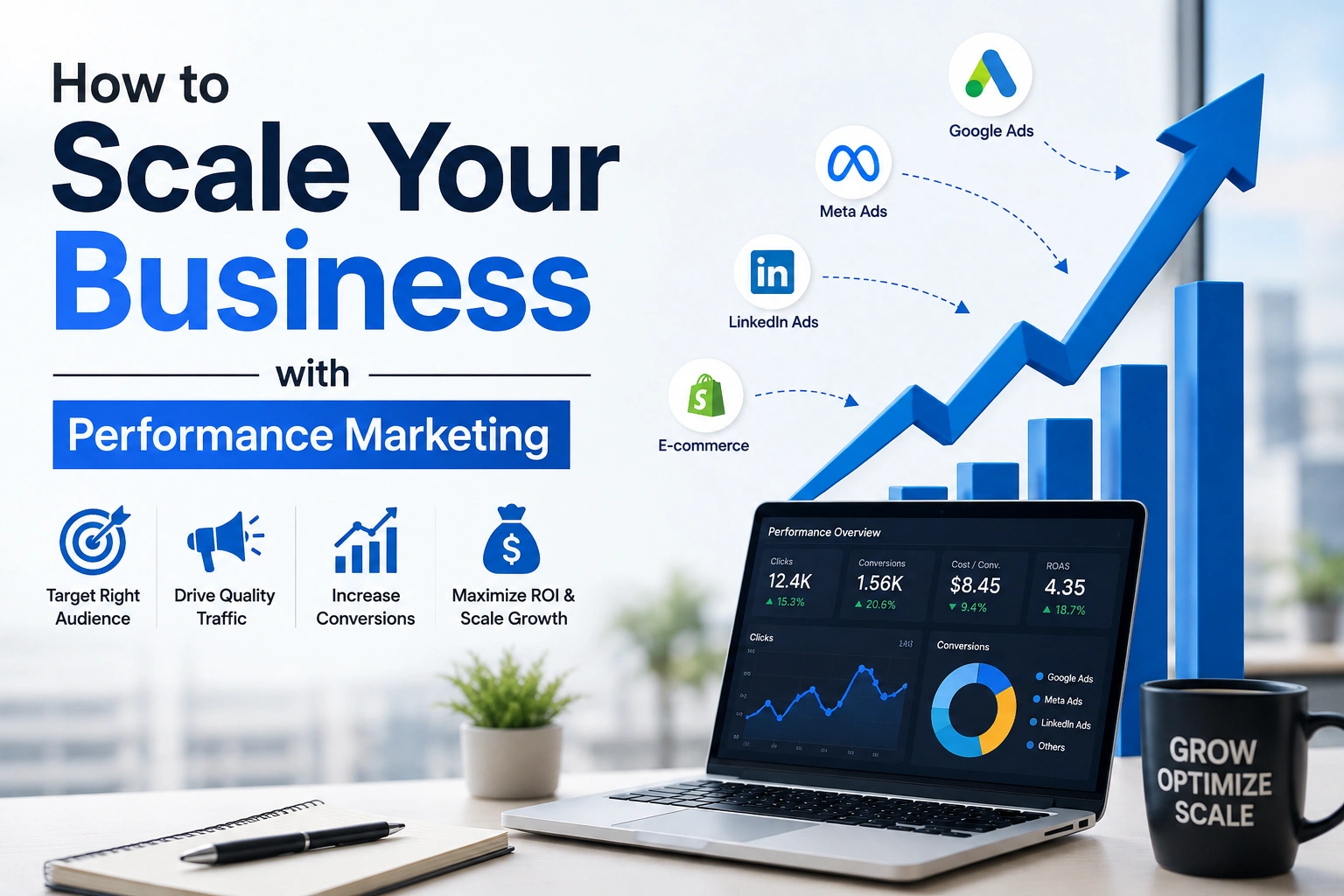
A set of performance marketing campaigns runs across whichever combination of channels best reaches the target audience: paid search (Google, Bing), paid social (Meta, YouTube, LinkedIn), shopping ads, programmatic display, and retargeting through email or SMS. The deciding factor is not which channels you use. It is whether you can measure precisely what each one produces.
This is the core difference between performance marketing and traditional advertising. Professional online marketing services built around performance principles include measurement and attribution as a standard part of the work, not an afterthought. Visibility into what each channel, campaign, and creative is producing is what makes optimisation possible at all.
What Tools Do You Need for Performance Marketing?
Running performance marketing without the right tools is driving without a dashboard. You may be moving, but you cannot tell how fast, where you are going, or when something breaks.
Here is the core tool stack by category:
| Category | What it does | Common tools |
| Analytics and reporting | Tracks visitors, events, conversions, and ROAS across the full journey | GA4, Looker Studio, Triple Whale |
| Audience and lead analysis | Segments buyers, identifies high-LTV cohorts, manages lead flow | CRM platforms, AI audience tools |
| Product feed and backend | Keeps listings current for shopping and search ads | Google Merchant Centre, Shopify |
| Competitor research | Shows what competitors are running and where they are spending | Meta Ads Library, Google Ads Transparency Centre |
| Automation | Runs rules-based bid adjustments, pauses underperforming ad sets, triggers flows | Google Ads scripts, Meta automated rules, email tools |
You do not need all of this from day one. Start with clean analytics and verified conversion tracking. Without a reliable measurement layer, every other tool is guesswork with a dashboard attached to it.
What Do You Need Before You Start Performance Marketing?
Before scaling a single campaign, the foundation must hold. A leaking funnel amplified by ad spend does not produce growth. It produces a bigger, more expensive leak.
Work through this checklist before increasing any budget:
- Proven product-market fit. Real customers bought without heavy discounting. Repeat buyers exist. Reviews reflect genuine satisfaction. If advertising is the only thing driving sales, the product or offer needs work first.
- A landing page that converts. A baseline conversion rate of 2 to 5 percent (depending on vertical) is the minimum standard before scaling traffic to a page. Below this, every click you pay for is largely wasted.
- A frictionless checkout or enquiry process. Slow load times, broken forms, and poor mobile UX can wipe out conversion rates regardless of how effective the ad was. Fix the destination before paying for the journey.
- Verified conversion tracking. Test every conversion event before spending. If the measurement is wrong, every optimisation decision you make from it will also be wrong.
- Margins that support a realistic CPA. Know the maximum you can pay to acquire a customer and remain profitable. That number governs every budget decision that follows.
A sound performance marketing strategy addresses each of these before a single rupee of paid budget is increased. Any performance marketing agency worth working with will run through this checklist at the start of an engagement. If they skip it and move straight to campaign setup, that is a meaningful warning sign.
How Do You Scale a Business with Performance Marketing? The 10-Step Framework
Scaling is a sequence. Each step builds on the one before it, and skipping any of them produces waste rather than growth. Here is the full framework, from foundation to full-funnel optimisation.
Step 1: Get the Foundation Right
Scaling amplifies what already exists. If your landing page converts at 0.5%, doubling your budget doubles your cost while your lead volume barely moves.
Before raising any spend, run a focused conversion rate optimisation pass. Improve mobile experience, reduce page load time, sharpen your headline and call to action, and simplify the checkout or enquiry form. A 1 percent improvement in landing page conversion rate can halve your effective CPA when applied at scale, which makes this the highest-return work you can do before increasing a single campaign budget.
Step 2: Set a Clear, Realistic ROAS Goal
Scaling without a target is acceleration without a steering wheel. The goal should be tied to return on ad spend (ROAS) or cost per acquisition (CPA), framed in concrete terms.
A well-defined performance marketing strategy sets goals like “3x ROAS at a ₹5 lakh monthly media budget” or “₹800 cost per lead with 500 leads per month.” The goal must be grounded in your actual margin structure. A ROAS target that ignores your cost of goods, logistics, and overheads is not a performance target. It is an aspiration without a plan. Realistic goals are motivating and actionable. Unrealistic ones produce poor decisions.
Step 3: Audit Your Current Campaign Data
Before spending more, understand what the existing data tells you. This is the moment for honest analysis, not optimistic spin.
Examine which creatives generated the highest conversion volume, which audience segments showed repeat-purchase behaviour, what the CPA was for customers who produced the most lifetime value, and where the largest funnel drop-offs occur. The campaigns worth scaling are in this data. The budget going to underperformers is also here. A performance audit is not about confirming what you hoped to see. It is about seeing what the numbers actually say.
Step 4: Strengthen the Offer
Good ads behind a weak offer produce mediocre results. Good ads behind a strong offer produce compounding results. The offer is the leverage point that most advertisers overlook.
Test bundled products at higher margins, time-limited discounts that create urgency without eroding brand value, post-purchase upsells that increase average order value, and guarantees or free trials that remove the buyer’s perceived risk. A stronger offer raises ROAS at the same media spend. That is a budget multiplier that requires zero additional ad spend to activate.
Step 5: Build a Creative Engine, Not Just Better Creative
Creative fatigue is one of the most consistent ceilings on scaling paid campaigns. As ad frequency rises, performance decays. A campaign delivering 4x ROAS at ₹50,000/month can drop to 1.5x at ₹2,00,000/month if the same creative is being seen too often by the same audience.
The answer is not finding one great piece of creative. It is building a systematic pipeline for producing and testing variations continuously. Design 5 to 10 variants of your best- performing hook. Repurpose user-generated content into ad formats, since it consistently outperforms polished production at scale. Run structured A/B tests across formats: short video, carousels, and static images each perform differently by audience and placement. Build a rotation schedule so fresh creative enters the system before existing creative fatigues. This is the work that keeps scaling possible beyond the first few weeks.
Step 6: Expand Winning Campaigns Strategically
When a campaign consistently shows low CPA and strong ROAS, it earns a larger budget. But the increase should be deliberate.
Scale proven ad sets by 20 to 30 percent every three to four days rather than doubling the budget in one move. Sudden, large budget increases push Meta and Google’s bidding algorithms back into learning mode, which temporarily degrades performance before stabilising. Alongside budget increases, launch lookalike audiences built from your highest-value purchasers, and gradually broaden demographic targeting to expand the addressable pool. Check ROAS at each increment. If it deteriorates as you scale, pause and diagnose before spending further.
Step 7: Optimise Your Media Buying
Scaling requires systematic control over where every rupee goes. Manual campaign management becomes a bottleneck when you are running multiple campaigns across multiple channels and audiences.
Set automated rules that pause ad sets exceeding a defined CPA threshold or spending past a limit without generating conversions. Use Google Ads scripts to adjust bids based on device, time of day, and geographic performance patterns. On Meta, monitor ad frequency and rotate creative when it exceeds three to four impressions per user per week. The goal of media buying optimisation is to remove human bottlenecks from routine, rules-based decisions so your attention and energy stay on strategy.
Step 8: Deepen Your Audience Segmentation
Broad audiences are appropriate for early testing. At scale, precision drives efficiency. Broad targeting that worked at ₹30,000/month becomes expensive and diluted at ₹3,00,000/month if the audience architecture has not been refined.
Build segmented cohorts from your existing customer base: high-LTV buyers (target with upsells and loyalty), cart abandoners (retarget within 24 hours with a specific offer), first-purchase buyers (cross-sell into a complementary product), and lapsed customers (reactivate with a win- back sequence). Tailor creative, copy, and landing pages to each segment rather than running a single message to everyone. Incremys, in its 2026 digital marketing research, found that personalisation can lift conversion rates by approximately 17%. At scale, that lift represents meaningful additional revenue for no additional media spend.
Performance marketing services at this level require both a data infrastructure and a creative production capability capable of serving multiple audience segments with distinct messages simultaneously. This is where campaigns become genuinely sophisticated.
Step 9: Optimise for Lifetime Value
Acquisition campaigns fill the top of the funnel. Lifetime value determines whether those campaigns are actually profitable.
A business spending ₹1,500 to acquire a customer who purchases once at ₹2,000 is operating with thin margins. The same acquisition cost becomes highly profitable if that customer purchases four times over two years. Build the retention layer alongside the acquisition layer: subscription models, loyalty programmes, post-purchase email and SMS sequences, and personalised product recommendations based on purchase history. The higher the LTV, the higher the CPA you can afford to pay, which means you can outbid competitors for the same clicks and still stay profitable.
LTV optimisation does not require a large budget to start. A post-purchase email sequence triggered 48 hours after a first order costs very little to build and can recover a meaningful fraction of customers who would otherwise have remained one-time buyers. Build this layer early, because it changes the economics of every acquisition campaign you run.
This is the compounding layer of performance marketing. Most advertisers focus entirely on acquisition; the ones who build strong retention mechanics can consistently outspend everyone else in the same auction.
Step 10: Implement Full-Funnel Tracking
Every decision in the previous nine steps is only as good as the data informing it. Full- funnel tracking is what makes every earlier step measurable, attributable, and genuinely improvable.
Install analytics that show the complete customer journey: which channel generated the first touchpoint, which ad drove the conversion, how long the consideration window was, and which campaigns produce the highest-LTV buyers, not just the most buyers. GA4 with clean UTM parameters, or dedicated attribution tools, provides this visibility. Without it, you are scaling based on incomplete information.
One attribution point that every advertiser should understand: most platforms attribute more conversions to themselves than they actually caused. Last-click attribution inflates the apparent return of the final touchpoint and understates the contribution of earlier channels. This means your Meta or Google dashboard may show ROAS figures significantly above what the campaign is truly generating in incremental revenue.
Multi-touch attribution gives a more accurate picture of what is genuinely driving growth and should be the basis for serious budget decisions. It is not a perfect system, but it is far more actionable than trusting any single channel’s self-reported numbers. Build the attribution model before you scale, because reversing attribution mistakes after two million rupees of spend is far more painful than setting it up correctly from the start.
Scaling Is a System. Treat It Like One.
Performance marketing does not reward impulse. It rewards discipline applied consistently over weeks and months.
The businesses that scale successfully are not necessarily the ones with the largest budgets. They are the ones that validated their funnel before scaling, set targets grounded in real unit economics, found their winners through honest data analysis, expanded those winners with deliberate budget control, and built the retention layer before their acquisition costs started rising with competition. They also built their attribution infrastructure early, so every scaling decision rested on data they could trust.
This is week-by-week work. Platforms change. Audiences shift. A campaign delivering 4x ROAS this month may deliver 2x next month when creative fatigues or a competitor enters the auction. The brands that compound over time are the ones that read the data, adapt the strategy, and make the next decision based on evidence.
Start where you are. Build the system. Scale what works. Repeat.
The ten steps in this guide are not a one-time project. They are the ongoing discipline that separates businesses that grow predictably from ones that spend heavily and plateau.
How Savit Interactive Helps You Scale Your Performance Marketing
At Savit Interactive, we have been building and managing performance marketing systems for businesses across India from our base in Mumbai for over two decades. In 2026, we hold Google Premier Partner status, placing us among the certified top tier of Google Ads management in India. Choosing the right digital advertising company for performance work matters because the difference between a team managing for impressions and one managing for leads is the difference between cost and investment.
Our view of performance marketing is straightforward: the metric we are accountable to is leads and conversions at a cost the business can sustain. A campaign generating traffic but no qualified enquiries is not performing, regardless of what the dashboard reports. We manage every account around this principle.
We approach every engagement the way this guide describes: foundation first. Before we scale anything, we audit the existing data, verify conversion tracking, review the landing page, and confirm the offer is strong enough to convert the traffic we are about to send it. We have seen too many businesses spend aggressively into a funnel that was not ready.
Our performance marketing campaigns cover the full channel stack: Google Search, Performance Max, Meta, YouTube, Shopping, and retargeting. The channel mix is chosen based on where a specific client’s audience converts, not on which platform is currently promoted most heavily. We run audience segmentation at depth, build creative rotation schedules to prevent fatigue, use automated rules and scripts to keep media buying efficient at scale, and focus retention work on LTV from the moment acquisition starts producing customers.
As a digital marketing agency with over twenty years of experience serving clients from Mumbai across India and internationally, we bring the same rigour to a ₹30,000/month campaign as to a large enterprise account. We provide performance marketing services that span strategy, campaign execution, creative guidance, tracking infrastructure, and transparent reporting tied to business outcomes.
We are a digital advertising company focused on one objective: scaling businesses in ways that are measurable, repeatable, and profitable. Our online marketing services are built around that same standard.
If you want to scale with performance marketing and want a team that treats every rupee as accountable, we would welcome the conversation.
Get in touch with our team at savit.in to start the conversation.
Footnotes and References
- SQ Magazine, Digital Marketing Statistics 2026 (April 2026): Global digital ad spend projected to surpass $700 billion in 2026; digital channels driving the majority of all advertising worldwide. Source: sqmagazine.co.uk/digital-marketing-statistics/
- WordStream, 180+ Powerful Digital Marketing Statistics for 2026: PPC advertising returns approximately $2 for every $1 spent (200% ROI); Google Ads and Facebook Ads among the highest-ROI paid channels. Source: wordstream.com/blog/ws/2022/04/19/digital-marketing-statistics
- Incremys, Digital Marketing 2026 Statistics: Key Figures to Know (April 2026): Personalisation lifts conversion rates by approximately 17%; behavioural segmentation is more effective than demographic segmentation alone. Source: incremys.com/en/resources/blog/digital-marketing-statistics
- Structure and scaling framework cross-referenced from: eComConversion, How to Scale Your Business with Performance Marketing (Step-by-Step Guide) (June 2026); Unbundl, Performance Marketing for Businesses: A Complete Guide (January 2026).