The 2023 playbook is dead, and most Indian businesses haven’t noticed.
Most social media strategies you’ll see in India right now are still running on logic that was true in 2023. Post consistently. Use trending audio. Drive followers. Chase reach.
None of these were wrong then. Most of them are wrong now.
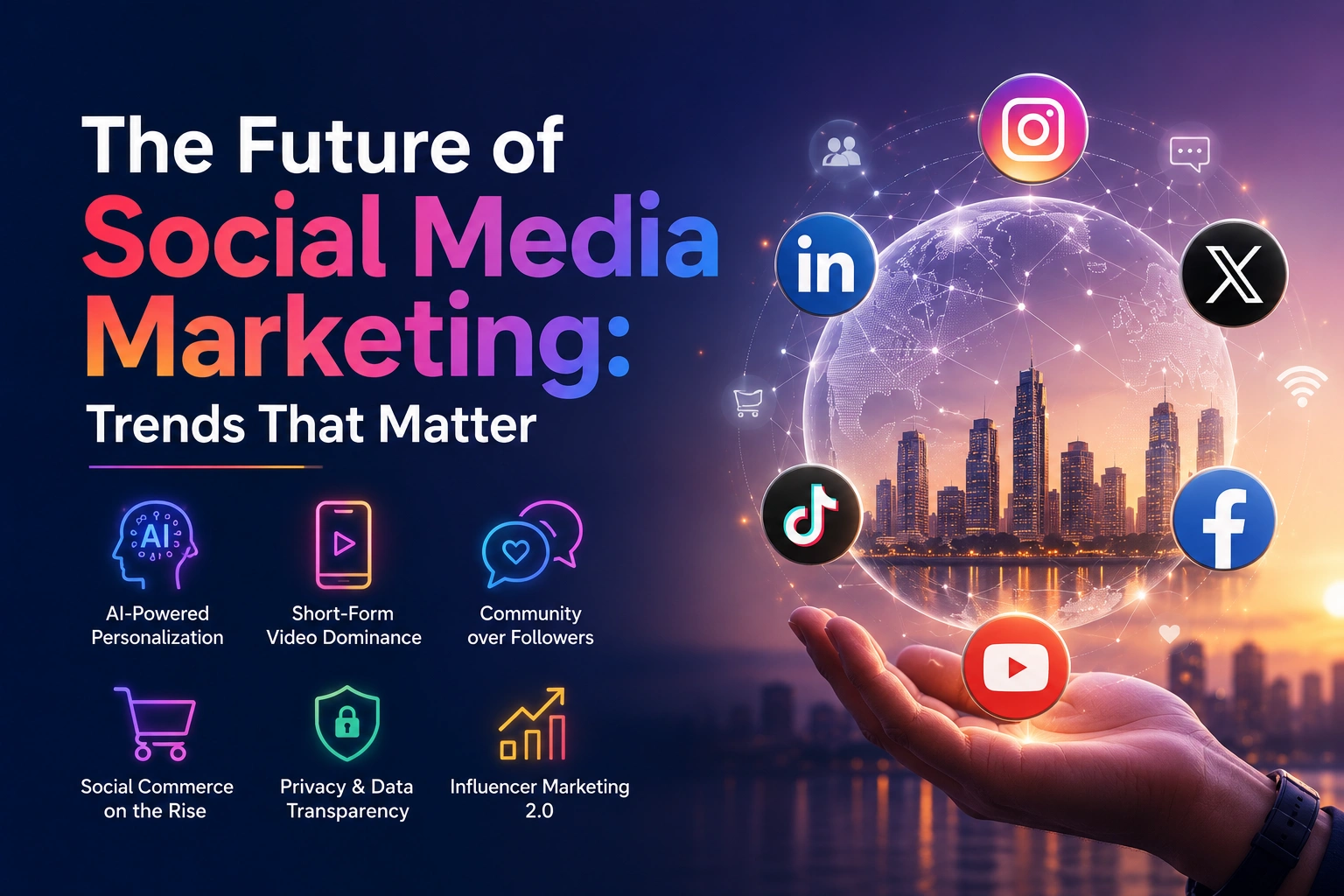
A handful of shifts have rewired the landscape:
- Organic reach has collapsed across every platform that matters here.
- AI now sits inside every step of content creation, ad placement, and audience targeting.
- The way people discover products has split between two camps: those who still use Google for high-intent search, and a fast-growing other group that starts the search directly inside Instagram or YouTube.
- Social Commerce has begun to exist as a real revenue stream, no longer simply an experiment.
- Actual business outcomes have become more valuable than followers and likes.
For brand and marketing leaders, the danger is not a lack of social media trends to follow. It’s the opposite.
The market is generating so much noise that it has become hard to separate which trends actually move business outcomes from which ones are just fashionable. A useful 2026 social media marketing strategy is built on the smaller set of trends that show up in the numbers, not the larger set that show up in marketing newsletters.
This blog is an evolving read on those trends. 8 moves that are actually shaping behaviour on Indian social platforms, and the business impact this has, pulled from a body of data that’s survived scrutiny and grounded to brands you can research.
Most of the digital marketing trends this year worth attention fall under one umbrella idea: the platforms have started rewarding useful behaviour over performative ones, and brands that build for the former are steadily beating those who still go after the latter.
Trend 1: Social search is becoming the default for product discovery
About one in three consumers globally now skips Google entirely when starting a product search, going straight to Instagram or YouTube. Among Gen Z, that share crosses 50% (Sprout Social’s 2025 Pulse Survey).
On Instagram specifically, around 60% of users now rely on the platform for product research, up roughly 16% year on year (Power Digital’s 2026 State of Social).
This is the most important structural shift on this list, because it changes what social content has to do. For years, social was about reach and engagement: how many people saw the post, how many liked or commented on it.
In 2026, social content increasingly has to be findable, not just visible.
Someone searching “best face wash for oily skin Indian summer” inside Instagram’s search bar wants an answer. The brand that shows up at the top of those results gets considered before the brand that just runs influencer collaborations.
What this changes for a social media content strategy is concrete:
- Captions now matter the way blog meta descriptions used to. Long-tail, natural-language phrases that real people type into search bars belong in the first two lines.
- Alt text on images, location tags on posts, and topic-relevant hashtags on Stories all act as discovery metadata.
- Episodic content built around clear, specific questions (“how to fix dry hair in monsoon,” “best cafe in Bandra to work from”) performs better than topical posts chasing a single moment of attention.
Indian beauty brands have moved on this faster than most. Mamaearth, Plum Goodness, and Sugar Cosmetics all structure a significant share of their Instagram content around the actual questions their customers type into search. The posts read less like brand campaigns and more like answers, and they show up when potential buyers search for solutions rather than brands.
The wider shift is that social platforms have started acting like search engines while Google has started acting like a social platform with AI Overviews. A social media content strategy that doesn’t account for both is leaving a meaningful share of new customer discovery on the table.
Trend 2: Short-form video is still dominant, but the way it’s used is evolving
Short-form video remains the single most relevant content format for 2026. About 38.8% of marketers identify it as the most important format of the year (Sendible), and 91% report planning to use it.
The format isn’t going anywhere. What’s changing is how it’s being used by brands actually getting returns from it.
Three shifts inside the format are worth knowing.
First, episodic series are starting to outperform standalone clips. A weekly “behind the build” series from a furniture brand, a recurring “ingredients explained” series from a food brand, or a “what we shipped this week” series from a software company all build familiarity and anticipation in ways one-off Reels cannot.
The Whole Truth Foods, the Mumbai-founded clean-label brand, has built much of its brand recognition through founder Shashank Mehta’s serialised Reels content unpacking what’s actually inside competitor products. The format isn’t novel. The consistency is.
Second, the production-quality hierarchy has inverted. Smartphone-shot, lo-fi content consistently outperforms polished studio output on Reels in 2026.
Wakefit has built a substantial Reels audience using office-shot content and customer-led day-in-the-life formats that no agency would have signed off on five years ago. Mokobara, the luggage brand, films most of its product-led Reels in environments that look closer to a friend showing you a new bag than a brand campaign. Both are growing.
Third, the technical details of how short-form video gets watched have shifted enough to change how it should be made. More than half of social video views happen on mute, which makes captions and visual storytelling load-bearing rather than optional.
The first one to three seconds of a Reel now decides whether the viewer stays or scrolls, which means the hook has to do the work an entire setup used to do. “Creative replaces targeting” is how Strike Social framed this shift in 2026, and the framing holds. Smart targeting can put a poor video in front of the right person; it cannot make them watch it.
A serious social media content strategy now treats Reels as a serialised content engine, not a series of one-off posts. The episodic approach also feeds the algorithm signals that simple consistency does not, because the platform learns the audience returns specifically for this brand’s recurring content.
Trend 3: AI in social, what it actually changes and what it doesn’t
About 81.6% of companies report prioritising AI and personalisation in their 2026 marketing strategies (TechBehemoths).
On the spending side, 85% of companies increased AI investment in 2025, with 91% planning to expand further in 2026 (Deloitte). Whatever else is true about AI in marketing, the budget is showing up.
What’s worth understanding is where AI is genuinely changing the social media marketing strategy and where it’s being oversold.
Where AI is helping
- Research and ideation. AI tools can identify trending topics, content gaps, and recurring audience questions faster than manual research can. For a brand running across multiple platforms, this collapses a week of trend tracking into an afternoon.
- Creative production at scale. Caption variants, ad copy iterations, content calendar drafts, and image generation for low-stakes content can all be produced faster with AI assistance. Brands running A/B tests on creative now generate ten variants in the time it used to take to make two.
- Performance optimisation. Meta’s and LinkedIn’s ad platforms now use AI for real-time placement, bidding, and creative allocation. The brands getting the best returns have learned to feed the algorithm clean, well-tagged creative and clear audience signals, and then get out of its way.
- Personalisation. Around 81% of Gen Z and 57% of millennials say they prefer personalised ads, and roughly 63% of marketers are increasing personalisation budgets in 2026. AI-driven dynamic creative makes personalisation possible at a scale manual segmentation cannot match.
Where AI is being oversold
The honest answer is: on the content itself. Fully AI-generated content without human editing still underperforms human-led work on engagement and platform ranking.
The pattern across multiple 2025 studies is consistent. AI-augmented content (AI assists, human finalises) shows no meaningful penalty. AI-replaced content (AI generates, human ships) shows measurable engagement drops.
The principle worth holding onto is simple: use AI to move faster, use humans to move in the right direction.
For a serious social media marketing strategy, the AI question in 2026 is not whether to use it. It’s how to use it without giving up the brand voice and judgement that make social content actually work.
Trend 4: Social commerce, when the post is also the point of sale
About 46% of consumers bought a product directly through social media in 2025 (Sendible). The global social commerce market is projected at roughly $1.2 trillion in 2025.
This is not a future trend. It is already a primary revenue line for an entire category of D2C brands.
The Indian picture is sharper than most marketers realise.
Bain & Company and Sequoia Capital India, in their joint analysis of the sector, projected that India’s social commerce market would grow from around $1.5-2 billion in 2020 to between $16 billion and $20 billion by 2025, with the potential to reach $60 to $70 billion by 2030. The trajectory has held.
A few Indian examples make the trend concrete:
- Meesho built an entire business on the reseller model this trend enables.
- Nykaa’s “Drops” model uses Instagram to launch limited-edition product runs with previews, reminders, and in-app purchase.
- Myntra has built a live commerce capability that runs alongside its primary marketplace.
Each of these is operating on the assumption that the social platform is not a discovery channel that leads to the website. It is the website.
What changes inside the brand when this assumption is taken seriously is significant. Product content and commerce content stop being separate workstreams. A single Reel can introduce a product, demonstrate it, take questions in the comments, and convert in the same window. Lead Gen Forms on Instagram and LinkedIn capture customer data without forcing the user to a landing page. WhatsApp Business catalogues let a small business take orders inside a chat without a website at all.
For most Indian businesses, the practical implication is that a social media marketing strategy now has to include commerce capability, not just brand and content capability.
Catalogue integration, shopping tags, lead forms, and WhatsApp Business setup are not optional add-ons. They are the infrastructure that lets social content actually convert.
The brands that miss this lose to ones that build it.
Trend 5: Community over broadcast
For most of the last decade, social media success was measured in audience size. In 2026, that measurement is breaking down.
Organic reach has become so unpredictable that a large follower count no longer guarantees posts will be seen. At the same time, closed communities (the WhatsApp Channels, Discord servers, Instagram Broadcast Channels, and LinkedIn Groups that operate outside the public feed) are quietly outperforming public content on engagement and conversion.
The framing that’s started circulating among smart B2B marketers is that 1,000 engaged community members can outperform 100,000 passive followers.
The maths bears this out. A 1,000-member WhatsApp Channel where the brand sends one update per week and 40% of readers open it produces 400 real touchpoints. A 100,000-follower Instagram account where the algorithm shows posts to 3% produces 3,000 impressions of varying quality, of which maybe 30 convert into anything meaningful.
In India, the platforms enabling this shift are specific:
- WhatsApp Channels and Communities have unusual depth here because WhatsApp is the dominant messaging platform across every demographic.
- Instagram Broadcast Channels are increasingly used by creators and brands as direct-to-audience newsletters that bypass the feed.
- Discord and Geneva serve niche audiences in gaming, crypto, and design.
- LinkedIn Groups and newsletters remain the primary B2B community vehicle.
Zerodha’s approach is the clearest Indian case study. The brokerage has built a quiet community machine through Varsity (its educational platform) and TradingQnA (its community forum), both producing ongoing engagement no Instagram campaign could match. CRED runs a gated, in-app community around financial behaviour. Atomberg, the Mumbai-founded appliance brand, runs WhatsApp groups for product owners that drive both retention and word-of-mouth referral.
The larger point is that public content drives discovery, and community drives depth. A 2026 strategy that includes both, the public layer for reach and the community layer for retention, consistently outperforms one that relies on either alone.
Among the social media trends genuinely affecting business outcomes, this one is the most undervalued.
Trend 6: Influencer marketing has moved from gigs to long-term partnerships
About 60% of marketers plan to increase influencer investment in 2026 (HubSpot), and the format of that investment is changing.
The one-off sponsored post is being replaced by longer-term creator partnerships where the same creators show up across multiple campaigns and become recognisable brand ambassadors rather than rented endorsers.
Two data points are reshaping how brands choose creators.
First, mid-tier creators (100,000 to 499,000 followers) consistently deliver the highest engagement-to-spend ratio.
Second, micro-influencers in the 1,000 to 10,000 follower range achieve engagement rates around 10.3%, multiples of what top-tier celebrities deliver.
The hierarchy of “bigger is better” has flipped, and brands paying attention have moved spend down the follower count.
The Indian context is particularly relevant here.
According to EY’s 2025 creator economy report, India’s creator economy was valued at roughly INR 125 billion in 2024 and is projected to reach nearly INR 500 billion by 2030, growing at a 25% CAGR. The same report places India’s influencer base at over 4 million creators, up from approximately 962,000 in 2020, a 322% increase over four years. Nearly 2 million of those creators are nano-influencers with fewer than 1,000 followers, indicating that the depth of India’s creator base now significantly exceeds the marketing budgets allocated to it.
Practically, this changes how an Indian brand should build its influencer programme. Sugar Cosmetics, Plum Goodness, and Mamaearth all run programmes anchored on dozens of mid-tier and micro creators rather than a handful of celebrities. The economics work better, the engagement is higher, and the content feels more like genuine recommendation than paid placement.
Regional and vernacular creators (Tamil, Marathi, Bengali, Telugu, Punjabi) are particularly underpriced relative to the audience attention they command, and brands that have moved early on regional partnerships have gained category share national creators alone could not have produced.
The strongest pattern across high-performing 2026 influencer programmes: the relationships are longer, the creators are smaller, and the content is more co-created than dictated.
Trend 7: First-party data and privacy-led targeting
Third-party tracking is shrinking, both because of platform restrictions and because of regulation.
India’s Digital Personal Data Protection Act (DPDPA), passed in 2023 and being progressively operationalised, joins GDPR and Apple’s tracking limitations in a wider global movement reducing the data brands can collect passively. About 75% of marketers report declining returns from traditional, tracking-heavy tactics.
The brands that win the next 24 months are the ones that build first-party data assets through social, rather than relying on signals that are about to disappear.
What this looks like in practice:
- Interactive content (polls, quizzes, surveys on Stories) that gathers insight while engaging users.
- Gated value (early access, exclusive drops, discounts) in exchange for an email or phone number.
- Lead form ads on Instagram and LinkedIn that capture data natively.
- Community membership where joining a WhatsApp Channel or Discord requires a contact handover.
Zomato has built much of its app retention through gamified rewards and tiering that incentivise users to share data. CRED’s entire model is essentially a permission-led data exchange, where the user trades behavioural data for rewards.
Both are extreme cases. Most brands won’t need to go that far.
But the underlying principle, that valuable customer data has to be earned through value rather than collected through tracking, is the direction every Indian brand will be moving in over the next two years.
For social media specifically, this means content that incentivises sharing, contact handover, and direct engagement now matters more than content optimised purely for consumption. The brand with the cleanest first-party data asset at the end of 2027 will have the strongest targeting position when third-party signals continue to weaken.
Trend 8: Metrics that actually connect to business outcomes
The most consistent failure in Indian social media marketing in 2026 is still the metrics layer.
Brands are tracking likes, follower growth, and reach because those numbers are easy and visible. They are not, by themselves, predictive of business outcomes.
A useful 2026 measurement framework moves toward metrics that connect social activity to revenue, audience quality, and brand asset building.
| Metric | What it measures | Why it matters |
| Content-assisted conversion | Conversions influenced by social content even when the final sale happens elsewhere | Connects social activity to actual revenue |
| Engagement quality (saves, shares, DMs) | Depth of interaction beyond surface likes | Better predictor of purchase intent than likes |
| Social search impressions | How often content surfaces in on-platform searches | Measures discoverability, not feed reach |
| Influencer engagement quality | Depth of creator-audience interaction (replies, product questions) | Separates effective partnerships from vanity reach |
| Sentiment trajectory | How perception evolves across a campaign | Catches issues early; validates messaging |
| First-party data capture | New contacts (email, phone, community joins) generated by social | Measures long-term marketing asset growth |
| Response time | How quickly the brand replies to comments and DMs | Brands replying within 24 hours see 47% higher engagement on future posts |
The last one is worth pulling out.
Brands that respond to comments and DMs within 24 hours see roughly 47% higher engagement on future posts. The algorithm interprets responsiveness as a signal the account is genuinely active and reciprocal, and rewards it accordingly.
For Indian brands relying on small teams, this is one of the highest-leverage changes available. It requires no additional ad spend, no new platform, no agency.
It only requires someone is actually answering.
What Savit thinks about all of this
At Savit, the way we read these social media trends is straightforward. A few of them genuinely change how a business should approach social. The rest is noise.
The brands that win the next 24 months are the ones that:
- Take social search seriously
- Build serialised short-form video instead of one-off posts
- Use AI as a speed multiplier rather than a quality replacement
- Build commerce capability into their social presence
- Invest in community alongside public content
- Work with mid-tier and regional creators on longer arcs
- Measure what actually connects to revenue
What we don’t do, and what we’d advise against, is chasing every new feature launch, treating every algorithm update as an emergency, or measuring social media success in followers when followers haven’t predicted business outcomes for at least two years.
Our social media marketing services are built around this thinking. We work with Indian brands across consumer, B2B, and professional services on social media marketing strategy that starts with the business question (who buys, why, and how they discover) and works back into the right platform mix, content architecture, and measurement framework.
The social media content strategy work we do covers organic content development, paid amplification, influencer programmes, community building, and the performance reporting that ties everything back to revenue. Every piece of the system is supervised by people who have done this for two decades, with AI used for speed and scale, never as a substitute for the strategic judgement that makes the work matter.
What stays constant across two decades of digital marketing trends is the underlying logic:
- Understand the audience.
- Make content worth engaging with.
- Measure what matters.
- Adapt based on what the data shows, not what the trend reports say.
The platforms change, the formats change, the tools change. The discipline doesn’t.
If you’re trying to update a presence still running on a 2023 playbook, or building one designed for how 2026 works, our social media marketing services team would be glad to help you read the situation honestly.
Let’s connect.