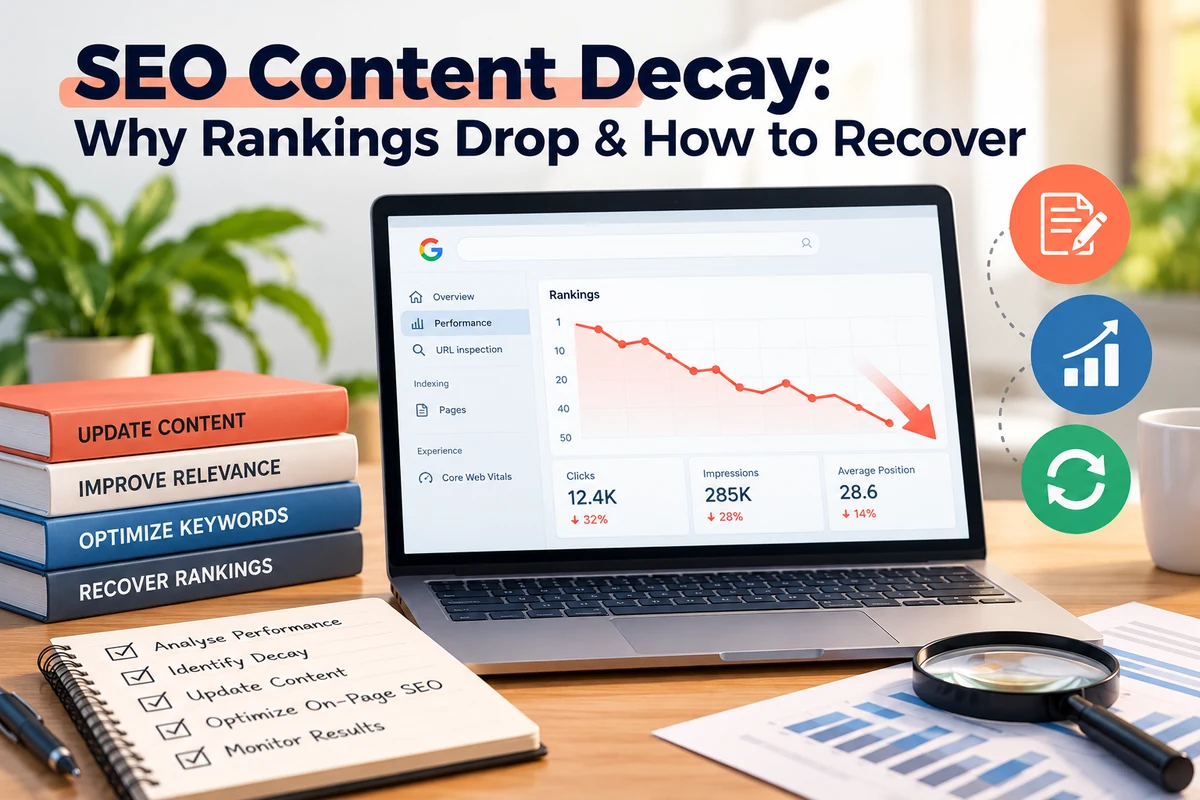
“Content does not always lose value overnight. Sometimes, it simply stops keeping up with what people search for.”
Key Highlights
- SEO content decay is the gradual loss of organic traffic, rankings, or relevance from content that once performed well.
- A ranking drop does not always mean the content is outdated. Search demand, competitors, search intent, technical issues, and Google updates can also be responsible.
- Google recommends using Search Console and Google Trends to identify the reason behind a traffic decline before making major changes.
- Updating content is useful when the page still matches the topic and search intent but needs fresher or more complete information.
- Some pages should be consolidated, redirected or removed instead of being repeatedly refreshed.
- Regular content audits can identify declining pages before the loss becomes significant.
- A strong search engine optimization strategy treats content maintenance as an ongoing process, not a one-time task.
What is SEO content decay?
SEO content decay refers to the gradual decline of a webpage’s organic performance over time. A page that once attracted steady search traffic may start losing clicks, impressions and rankings.
This does not necessarily mean the content was poor. The search landscape changes constantly. Competitors publish better resources, information becomes outdated, user expectations shift, and search results may begin favouring different content formats.
Search Engine Land describes content decay as a decline in organic traffic, rankings and relevance. Its recent guidance also stresses that different causes require different solutions.
What can content decay look like?
- Organic clicks gradually decline.
- Important keywords move down the search results.
- Impressions decrease over time.
- Competitors begin ranking above the page.
- The information becomes outdated.
- Traffic remains stable while clicks decline because search features answer queries directly.
The important point is that SEO content decay is a symptom, not a diagnosis. First, identify the reason behind the decline.
Why do SEO rankings drop over time?
A ranking drop SEO problem can have several causes. Assuming every decline requires a content, refresh can waste effort.
1. The content has become outdated
Facts, statistics, product details, industry trends and recommendations can become old.
A page published several years ago may still be useful, but some sections may no longer reflect the current market.
2. Competitors have improved
Search results are competitive. A page can lose rankings even when nothing has changed on the page.
A competitor may publish:
- More complete information
- Original research
- Better examples
- Stronger first-hand experience
- A clearer structure
- More relevant content
3. Search intent has changed
Users may want something different from what they wanted when the page was first published.
For example, a search that once returned informational guides may now show comparison pages, videos, product pages or forums.
Search Engine Land identifies intent changes as a key cause of content decline.
4. Search demand has fallen
Some topics naturally become less popular.
Seasonality, changing trends, discontinued products or fading events can reduce search interest.
5. Technical problems affect visibility
A content page can lose traffic because of technical issues rather than content quality.
Check for:
- Accidental no index tags
- Crawl or indexing problems
- Broken redirects
- Canonical issues
- Website migrations
- Internal linking problems
Google specifically recommends checking indexing and technical reports when investigating search traffic declines.
How can businesses identify SEO content decay?
Before changing a declining page, businesses need to understand what happened.
Start with google search console
Search Console can show changes in:
- Clicks
- Impressions
- Average position
- Queries
- Pages
- Search types
Google recommends comparing affected pages and looking for patterns across the website. It also suggests reviewing a longer period, such as 16 months, to account for seasonality and recurring trends.
Compare search demand
Google Trends can show whether interest in a topic has changed. If searches for the entire topic have declined, updating the page may not restore previous traffic.
Check the current SERP
Search the main keywords and compare the current results with the page.
Look for changes in:
- Content format
- Search intent
- Topics covered
- Level of detail
- Competitor quality
- SERP features
Check the page’s history
Look at how the page performed before the decline.
| Pattern | Possible reason |
| Clicks and impressions both decline | Ranking or demand issue |
| Clicks fall but impressions remain stable | CTR or SERP feature issue |
| Position drops sharply | Competition, relevance or technical issue |
| Traffic falls at the same time every year | Seasonality |
| Several pages decline together | Sitewide or algorithm-related issue |
This diagnosis is essential to effective search engine optimisation because the wrong fix can make an already declining page weaker.
When should old content be updated?
Updating is often the right option when the page still has value, and the topic still has demand.
Update a page when:
- The topic remains relevant.
- Search intent has not changed significantly.
- Important information is outdated.
- Competitors cover useful points that the page misses.
- The page has existing backlinks or organic authority.
- The content can be improved without changing its core purpose.
A proper refresh should go beyond changing the publication date.
A useful content refresh can include:
- Updating statistics and examples
- Removing outdated information
- Adding missing subtopics
- Improving explanations
- Revising titles and headings
- Strengthening internal links
- Improving the introduction
- Matching the current search intent
- Adding original insights or information
Search Engine Land notes that meaningful updates should add value, not just change dates, or add a few lines.
When should content be consolidated, redirected or removed?
Not every declining page deserves an update. Sometimes the best ranking drop SEO solution is to change the page’s role.
- Consolidate content
If several pages cover almost the same topic and compete, combining them may create one stronger resource.
- Redirect the page
A redirect can make sense when an outdated page has useful authority, but its topic is better covered by another relevant page.
- Remove the page
If a page has no meaningful traffic, backlinks, business value or current search demand, keeping it may not be worthwhile.
- Use this decision guide
| Situation | Recommended action |
| Useful topic, outdated information | Update |
| Strong page, missing important information | Expand |
| Multiple similar pages | Consolidate |
| Old page replaced by a better relevant URL | Redirect |
| Topic has permanently lost demand | Consider pruning |
| Technical issue | Fix the technical problem first |
| Search intent has changed | Restructure or create a better-fit page |
The goal is not to update every old URL. The goal is to make every important page useful for its current audience.
How can search intent recovery improve rankings?
Search intent deserves special attention because a page can remain accurate and still lose rankings.
Imagine an article targeting “best accounting software”. If the current search results are dominated by comparison pages, pricing information, and product features, a long educational article may no longer fit what users expect.
To realign the page:
- Review the current top-ranking results.
- Identify the dominant content format.
- Study the questions users appear to want answered.
- Compare your page with competing results.
- Add useful information that the audience expects.
- Restructure the page around the current intent.
- Keep the content natural rather than copying competitors.
This is an important part of modern search engine optimization because rankings depend on more than simply including the right keywords.
How can businesses recover from a ranking drop?
Recovery starts with diagnosis and then moves into targeted improvements.
Step 1: Confirm the decline
Check Search Console data rather than relying only on an analytics dashboard.
Step 2: Identify affected pages
Determine whether the decline affects one page, a content group, or the entire website.
Step 3: Check technical health
Make sure the page is indexed and accessible.
Step 4: Review the SERP
Compare the page with current competitors and identify changes in intent or format.
Step 5: Improve the content
Add missing information, update outdated sections, and strengthen the page’s usefulness.
Step 6: Improve internal linking
Connect the page with relevant supporting content and important commercial pages.
Step 7: Monitor results
Do not expect immediate recovery after making changes. Search systems need time to recrawl and reassess updated content.
Google notes that SEO changes can take place anywhere from days to months to take effect, depending on the situation.
How can businesses prevent SEO content decay?
Prevention is easier when you monitor content performance regularly.
Build a content maintenance process
- Review important pages every few months.
- Track organic clicks and impressions.
- Monitor important keyword groups.
- Check pages that show a sustained decline.
- Review competitors regularly.
- Update statistics and time-sensitive information.
- Check internal links.
- Monitor indexing and technical issues.
- Remove genuinely outdated content where appropriate.
Search Engine Land recommends building content monitoring into an ongoing process rather than waiting until a page has lost most of its traffic.
Prioritise pages strategically
Not every page deserves the same level of attention.
Focus first on pages that:
- Generate valuable organic traffic
- Target important commercial topics
- Have strong backlinks
- Support conversions
- Previously ranked well
- Show a clear opportunity for recovery
This makes content maintenance a practical part of search engine optimization rather than another routine task with no clear business outcome.
Does more content prevent content decay?
Not necessarily.
Publishing more articles does not automatically protect existing content from decline. In fact, creating too many similar pages can create overlap, dilute focus and make content management harder.
A better approach is to balance new content with maintenance of existing assets.
A stronger content programme includes:
- New content for genuine topic gaps
- Updates for valuable ageing pages
- Consolidation of overlapping content
- Removal of low-value pages
- Internal linking between related topics
- Regular performance reviews
This approach allows businesses to get more value from content they have already invested in.
How can an SEO agency support content recovery?
An experienced SEO agency in India can support the process by combining content analysis with technical and competitive research.
A professional review can examine:
- Search Console performance
- Keyword movements
- Search intent
- Competitor content
- Internal links
- Indexing
- Technical SEO
- Backlink changes
- Content quality
- Conversion opportunities
The value isn’t simply identifying that rankings have dropped. It is in finding out why and deciding what action is most likely to improve the page.
For businesses managing large websites, a SEO agency in India can also create a repeatable content audit process so that important pages are monitored before their decline becomes severe.
Turning content decay into SEO growth
SEO content decay is not something businesses can eliminate completely. Search behaviour, competitors, content standards and search systems will continue to change.
At Savit Interactive, we treat content as an ongoing business asset rather than something published once and forgotten. We look at the reason behind a decline before recommending an update, consolidation, redirect or other action.
Our approach to search engine optimization also considers the wider website. Content, technical SEO, internal linking, search intent and business goals need to work together.
For businesses facing a ranking drop SEO issue, the priority should be diagnosis before action. A page does not always need more words. Sometimes it needs better information, a different structure, stronger internal links or a completely different approach.
With regular monitoring and the right recovery plan, businesses can protect valuable content, regain lost visibility where possible and build a stronger organic search presence over time.
FAQs
- What is SEO content decay?
SEO content decay is the gradual decline of a webpage’s organic traffic, rankings or relevance. It can happen because content becomes outdated, competitors improve, search intent changes, demand falls, or technical problems affect visibility.
- How can I identify a ranking drop?
You can identify a ranking drop SEO issue by comparing historical and current Search Console data. Look at clicks, impressions, average position and affected queries and pages. Then check technical issues, search demand and current search results.
- Should every old blog post be updated?
No. Some pages should be updated, while others may be better consolidated, redirected or removed. The right decision depends on the topic’s current demand, search intent, performance and business value.
- How often should SEO content be reviewed?
There is no universal schedule for every page. Review high-value, time-sensitive content more often, while evergreen pages can be assessed periodically. Regular monitoring helps businesses spot SEO content decay before a major traffic loss occurs.
- Can an SEO agency in India help recover lost rankings?
Yes. A SEO agency in India can analyse Search Console data, technical issues, competitors, search intent and content quality to identify possible reasons for a ranking decline and recommend an appropriate recovery plan.