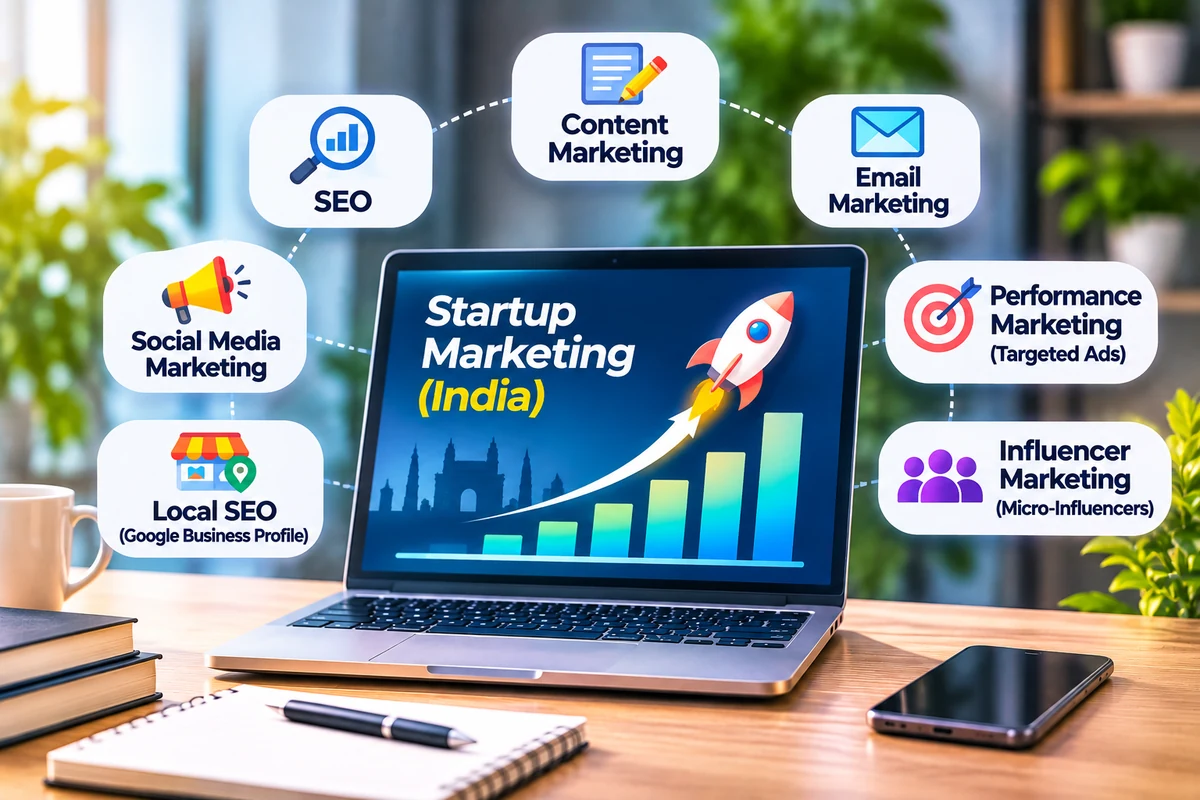
There is no single cheapest channel, and anyone who names one without asking what you sell is guessing. There is, however, a reliable order of operations, because channels differ enormously in what they cost per qualified conversation rather than per impression. Get the order right and a small budget behaves like a larger one. Get it wrong and the money buys reach you cannot convert, which is the most common way digital marketing for startups in India fails.
Key Highlights
- India now has 1,367.93 million telephone subscribers and 1,107.68 million broadband subscribers including machine-to-machine connections, on TRAI figures for September 2026.
- Rural tele-density is 61.30% against urban 155.85%, so a national campaign and a metro campaign are different products with different costs.
- WhatsApp got more expensive on 1 October 2026: service and utility messages inside an open customer service window are now charged, with 1,000 free service messages per business number each month.
- A hard deadline is approaching: Meta states that eligible India customers must migrate all Messaging accounts to INR billing by 31 December 2026, or message delivery stops on 1 January 2027.
- Click to WhatsApp ads open a free window of up to seven days, which is the cheapest paid-to-owned bridge available in the Indian market.
What Does “Cost-Effective” Actually Mean Here?
It means cost per qualified conversation, not cost per click. A founder comparing a ₹40 click against a ₹4 click is comparing the wrong things if one arrives ready to buy and the other arrived because a video autoplayed. The denominator that matters is the number of people who end up in a conversation your sales process can close.
This rephrasing alters the ranking of channels right away. Owned channels have virtually zero cost per conversation after setup. Intent channels have high cost per click but conversion rates that make that click very cheap. Interruption channels are low-cost per impression but high cost per conversation; this is why they go last for a business without a conversion track record.
The practical test for any cost-effective digital marketing decision is a single question: if this channel delivered a hundred responses tomorrow, could you tell which ones were worth having? A startup that cannot answer that should fix measurement before it buys traffic, because unmeasured spend is not cheap at any price.
The Cheapest Channel Is the One You Own
The only type of resources for which marginal cost drops to close to zero are owned resources. An interactive website that answers the genuine concerns of the consumer, a complete Business Profile, an email list, and a WhatsApp opt-in group continue to function even when budgeting stops. The rented attention ends the day the budget stops.
That is not an argument against paid media. It is an argument about sequence. Build the owned layer first so that paid traffic has somewhere to land and a way to be followed up, because sending paid clicks to a thin page is the fastest way to spend a seed round on nothing. A startup marketing strategy that puts paid before owned is paying twice: once for the click, once for the lost conversation.
The scale of the opportunity in India is unusual. TRAI reported 1,367.93 million telephone subscribers at the end of September 2026, with 1,319.19 million on wireless and 1,107.68 million broadband connections counting machine-to-machine. Almost everyone you want to reach can be reached cheaply through a channel they already have on their phone.
Why Search Intent Beats Reach for a Startup
The fact that someone has typed “GST software for small business” tells you more in five words than the demographic profile tells in five slides. Intent channels help the startup invest only in those moments that really count, which is the reason why intent channels perform better than reach channels, despite the expensive clicks on intent channels.
Search also builds upon itself in a way that paid reach does not. Buying questions continue to get answered by more and more pages in the search results, and, in many cases, in the AI answers themselves. It is well-documented in Google’s help files that for a page to be qualified for any AI features, it needs to be indexed and able to receive a snippet, period.
The caution is to resist head terms early. Bidding against funded competitors on the broadest phrase in your category is the most expensive mistake available in digital marketing for startups in India, and the long specific queries beneath it are cheaper, closer to purchase and usually ignored by the incumbents.
Is Google Business Profile Still Worth the Hour?
For any business with a location or a service area, it is the highest return per hour available anywhere in the mix, and it costs nothing. Google names three local ranking factors: relevance, how well a profile matches the search; distance, how far the business is from the searcher; and prominence, how well-known it is, which depends partly on links, review count and ratings.
Best-practice guidelines set out by Google itself are no less obvious and nothing requires money. Verification will indicate that you are authorised to speak on behalf of your company and increase the chances of getting listed at all. The completeness of the information is important because if any part is missing, the profile may fail to qualify for searches which would be otherwise relevant, and thus the address, schedule, categories and attributes should be filled in.
Two warnings belong with that advice. Google’s guidelines state your name should reflect the real-world name, and adding taglines, locations or service descriptions can lead to suspension, so the stuffed listing some agencies still build is a liability. And Google’s review policy prohibits incentivised reviews, selectively soliciting positive ones and setting staff review quotas, which rules out the usual shortcut for a new business with no ratings.
How Much Does WhatsApp Actually Cost Now?
Less than most channels and more than it did last month, and the change is recent enough that many budgets have not caught up. Meta moved to per-message pricing on 1 July 2025, charging for each delivered business-to-user message by category and recipient country, with user-to-business messages and undelivered messages not charged.
| Category | What it is for | Cost position |
| Marketing template | Promotional outreach, sendable any time | Charged; India’s marketing rate rose on 1 January 2026 |
| Utility template | Transactional and informational updates | Charged, including inside an open window since 1 October 2026 |
| Authentication template | Identity verification and one-time codes | Charged, with volume tiers by market |
| Service message | Replies to a user inside the 24-hour window | 1,000 free per business number per month, charged above that |
| Free entry point | Replies after a Click to WhatsApp ad | Free for up to seven days, except Meta’s agent messages |
Three planning points follow, and each one changes a cost-effective digital marketing budget rather than merely informing it. The 1,000 free service messages do not roll over, so a support-heavy month costs more than a quiet one. Utility messages inside an open window used to be free and are not any more, which quietly raised the running cost of order and delivery notifications. And Meta states it changes pricing only on the first day of a quarter, which at least makes the next revision predictable.
The genuinely cheap tactic sits in the last row. A Click to WhatsApp ad that earns a reply opens a window of up to seven days in which marketing, utility, authentication and service messages are free, so the ad spend buys a week of conversation rather than a single click. For an Indian startup with a considered purchase, that is the best value in the paid mix.
A Deadline Indian Startups Keep Missing
Meta’s pricing documentation states that eligible India customers could move to INR billing from 1 January 2026 and must migrate all Messaging accounts by 31 December 2026, and that message delivery stops on 1 January 2027 for accounts that have not migrated. The window for doing something about it closes at the end of December 2026.
The exposure is easy to state: an entrepreneurial company using the WhatsApp Business API for order confirmation, delivery updates, one-time passcodes, and even customer responses may find their messages not being delivered at all during the first week of January. The exposure with one-time passcodes is especially troublesome because it disrupts the product, not the marketing.
Your messaging business account manager must make sure that you have been migrated to the new bill this month, in writing. It only takes ten minutes, and it ensures that your channel, which all startups in India now rely on for money and not marketing, is secure.
Which Channels Should Wait?
While some channels aren’t necessarily expensive; they are early, in that they require something which a fledgling firm simply lacks – namely a proven value proposition, a conversion rate and even recognition.
- Display and programmatic: Cheap impressions, costly conversations, and almost impossible to attribute honestly at small volumes.
- Broad awareness video: Useful once you know who converts, wasteful while you are still finding out.
- Influencer campaigns at scale: One well-matched creator is a test; twenty is a budget with no control group.
- Head-term search bidding: The most contested inventory in your category, bought against companies with more patience and more cash.
- High-volume content production: Google’s spam policies treat scaled content abuse as pages made mainly to manipulate rankings rather than help users, applying whether automation, humans or a combination produced them, with no published page-count threshold.
- Multi-language expansion: Worth doing properly later rather than badly now, since machine-translated Hindi or Tamil reads as carelessness to the customer you were trying to respect.
None of those is wrong forever, and none of them is banned from digital marketing for startups in India. They are wrong first, and a startup marketing strategy that reaches for them before the owned layer exists is buying reach it cannot yet convert.
Content That Earns Instead of Buys
This is now much easier due to increased information about how content is made noticeable. A research study done at KDD 2024 examined nine different content modifications, and it found that the greatest increase in visibility for AI was through the use of quotes from authoritative sources, about 41% according to its main measurement, followed by the use of statistics with about 31%, fluency improvement with about 28% and source citation with about 27%. Keyword stuffing lowered visibility with about 8%.
Forget about the magnitude because the experiments were conducted in a stripped down engine on the top five Google search results instead of running on commercial websites. The ranking itself is what matters and that is the definition of an inexpensive science: make a statement, source it, and edit it for clarity.
For the startup, this would mean that fewer but actually useful pages are more beneficial than the blog calendar. Ten pages answering the queries repeated during the sales calls would beat sixty pages written following the keyword list, since they can be written with lesser costs since the content is already there in the inbox.
Sequencing the First Three Months
- Month one, build the owned layer: A site that states plainly what you sell, to whom and at what price, with the five pages your sales conversations actually need. Verify the Business Profile and complete every field. Set up the WhatsApp Business account and confirm the INR billing migration.
- Month two, capture existing intent: A tightly scoped search campaign on specific, low-competition queries, pointed at pages built for those queries rather than the homepage, with conversion tracking working before the first rupee is spent.
- Month three, build the bridge and measure: Add Click to WhatsApp ads to use the free seven-day window, write the follow-up sequence that window makes possible, and review cost per qualified conversation by channel. Then scale only what cleared the bar.
The reason why the above strategy is cost-effective compared to that of traditional launch strategy is due to the fact that none of the steps outlined in the first month cost any money as far as paid media is concerned.
Can You Measure This on a Free Stack?
For the most part, yes, and the free tools beat what startups do when it comes to reporting. Search Console gives you the queries bringing in the visitors, but with a caveat that it’s good to know: appearances in the AI Overviews and AI Mode are combined with the rest of your search traffic under Web searches, not separated, so interpret those numbers as directional. The Business Profile tool gives calls, directions, and messages, all more actionable than impressions.
The number that no tool can ever calculate for you is the number that counts. Count qualified conversations by source per month, divide cost by this number, and sort your channels on this figure. Four lines in an Excel spreadsheet beat forty boxes on any dashboard, because the four lines are the decision.
Resist attribution perfectionism, which is where a startup marketing strategy most often buys software instead of answers. At early volumes the honest instrument is asking people how they found you and writing the answer down, and it is more reliable than a model fitted to two hundred sessions. Cost-effective digital marketing at this stage is mostly about making decisions from small, clean numbers rather than large, noisy ones.
Where Startups Waste the Most
- Paid traffic to an unready site: The most common and most expensive error, and it looks like a channel problem rather than a page problem.
- Agency retainers before product-market fit: Paying for execution while the message is still moving means paying for work that gets redone.
- Vanity rankings: A head term that brings researchers rather than buyers, bought at the price funded competitors set.
- Broadcast WhatsApp sends: Marketing templates to an unsegmented list now carry a real per-message cost and a genuine risk of blocks.
- Tooling before traffic: A marketing automation subscription serving two hundred monthly visitors is a cost centre with a login.
- Ignoring the free things: An unverified Business Profile, missing attributes and unanswered reviews cost nothing to fix and quietly cost customers every week.
Every item on that list is a sequencing failure rather than a channel failure, which is why a startup marketing strategy is better judged on what it defers than on what it includes.
Savit’s View on Early-Stage Budgets
At Savit Interactive, we advise founders of early-stage businesses to dedicate the first month to the elements that can’t be turned off: the site, the profile, the opt-in list, and the tracking system. It’s better for us to return a paid media brief than to send traffic to a web page that won’t turn conversions because the whole campaign will be considered as a failure, and the page itself will remain broken. After running numerous search campaigns in Mumbai since 2004 in ecommerce, healthcare, education, logistics and manufacturing industries, we noticed that the companies that grew without spending too much money were the ones that had a clear understanding of the cost per qualified conversation by month three. When assessing the different options, founders need to ask agencies what they wouldn’t pay money for.