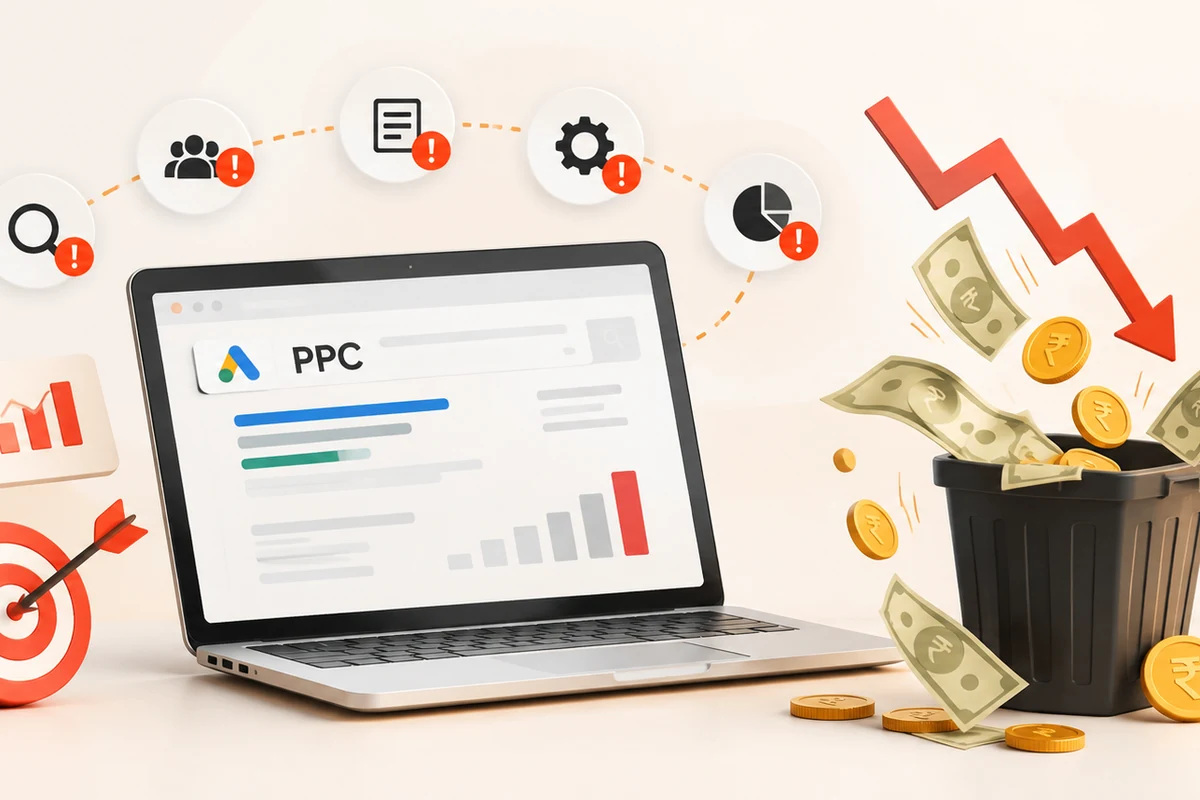
“Every click has a cost. The real question is whether that click has a reason to become a customer.”
Key Highlights
- PPC advertising can generate targeted traffic quickly, but poor campaign decisions can turn clicks into wasted spend.
- Broad targeting, weak keyword control and poor conversion tracking are common sources of budget leakage.
- A high click-through rate does not always mean a campaign is profitable.
- Effective Google Ads optimization requires regular reviews of search terms, keywords, ads, bidding and landing pages.
- Sending paid traffic to an irrelevant or poorly designed landing page can reduce the value of otherwise good clicks.
- Google Ads management should focus on business outcomes such as qualified leads, sales and return on ad spend.
- Regular monitoring is essential because search behaviour, competition and campaign performance can change over time.
Why does PPC spend get wasted?
PPC campaigns can look successful on the surface. They may generate impressions, clicks and even a healthy click-through rate. Yet, the business may still struggle to generate enough leads or sales.
This usually happens when you measure campaign activity without considering traffic quality.
For example, 1,000 clicks may sound impressive. But if most visitors have no intention of buying, the campaign is simply paying for activity rather than business results.
Recent PPC industry research continues to point to issues such as poor keyword targeting, missing negative keywords, weak landing pages and inaccurate conversion tracking as common sources of wasted spend.
The good news is that regular account reviews can identify many of these problems. Here are five mistakes’ businesses should watch closely.
What Are the Most Common Google Ads Mistakes That Waste Marketing Budget?
The most common mistakes are:
Note : Add all the below points in bullet.
Broad keywords with no negatives, which bring irrelevant clicks.
Weak conversion tracking, so campaigns optimise for the wrong actions.
Leaving campaigns unmonitored, so wasted spend goes unnoticed.
Chasing clicks instead of leads and revenue.
Other costly mistakes include poor ad relevance, unsuitable bidding strategies and unclear campaign goals. The sections below explain the five biggest ones and how to fix them.
Mistake 1: Targeting broad or irrelevant keywords without control
Keywords determine which searches can trigger ads. If they are too broad, a business may pay for clicks from people who are not looking for its product or service.
For example, a company selling professional accounting software may target a broad term such as “accounting software”. It could then attract searches from users looking for:
- Free accounting software
- Accounting courses
- Accounting jobs
- Accounting tutorials
- Accounting software reviews
- Software for a completely different use case
Not every search is commercially relevant.
How to reduce wasted keyword spend
- Review the Search Terms Report regularly.
- Identify irrelevant searches.
- Add suitable negative keywords.
- Group keywords according to search intent.
- Use more specific keyword themes where appropriate.
- Review match types based on campaign goals and available conversion data.
Google recommends using negative keywords to exclude searches that aren’t relevant to the business.
Negative keywords are especially important because they help prevent ads from appearing for searches that may look like the target keyword but have a different intent.
A strong PPC marketing campaign is not about reaching as many searches as possible. It is about reaching searches that are likely to create business value.
How Do I Use Negative Keywords to Stop Wasting Google Ads Budget on Irrelevant Clicks?
Negative keywords tell Google which searches should not trigger your ads. They stop spend on searches that look similar to your keywords but come from people with no buying intent.
- Open the Search Terms Report. Find the actual searches that triggered your ads.
- Spot irrelevant terms. Look for words such as “free”, “jobs”, “course”, “tutorial” or “DIY” if they don’t match your offer.
- Add them as negatives. Use campaign level for terms that are never relevant to your business, and ad group level for terms that only matter to one service.
- Choose the right match type. Broad, phrase and exact match work differently for negatives, so pick the one that blocks only the searches you want to exclude.
- Use shared negative lists. Apply a common list across several campaigns to save time.
- Avoid blocking good traffic. Don’t add a term that could exclude relevant searches.
- Review regularly. New irrelevant searches appear over time, so check the report every week or two on active accounts.
Mistake 2: Sending every click to the homepage
A relevant ad can attract the right person, but the post-click experience matters just as much. One common mistake is sending every paid visitor to the homepage regardless of what they searched for.
Imagine someone searches for “B2B SEO services” and clicks an ad promoting those services. If the visitor lands on a generic homepage and must search for the right service, that creates unnecessary friction.
A better approach
The landing page should match the user’s intent and the promise made in the advertisement.
| Search intent | Better landing page |
| Specific service | Dedicated service page |
| Product search | Relevant product page |
| Promotional offer | Offer-specific landing page |
| Local service | Location-specific page |
| Lead generation | Focused enquiry page |
The landing page needs to clearly guide the user to the next step.
Check these elements
- Is the headline relevant to the ad?
- Does the page explain the offer quickly?
- Is the call to action easy to find?
- Does the page work well on mobile?
- Are forms simple to complete?
- Does the page load properly?
- Does the content answer the user’s main concern?
Good PPC advertising does not end when someone clicks the ad. The landing experience determines whether that click can become a lead or sale.
Mistake 3: Running campaigns without reliable conversion tracking
One of the most damaging mistakes is not knowing which clicks produce results.
Without accurate conversion tracking, marketers may optimise campaigns around clicks, impressions or other surface-level metrics while missing the actions that matter.
What should be tracked?
Depending on the business, meaningful conversions could include:
- Completed purchases
- Qualified enquiry forms
- Phone calls
- Appointment bookings
- Demo requests
- Sign-ups
- Quote requests
The key is to distinguish valuable conversions from actions that don’t reflect real business outcomes.
For example, tracking a page view as a primary conversion could make a campaign appear more successful than it really is.
Why does this matter?
Google Ads uses conversion data to inform optimisation and bidding decisions. If that data is incomplete or inaccurate, campaign decisions can also become less reliable.
A recent industry analysis similarly identifies broken or weak conversion tracking as a major source of wasted PPC spend.
Before making major changes to bids or budgets, businesses should first make sure the data they are using is trustworthy.
Mistake 4: Setting up campaigns and then leaving them alone
PPC is not a “set it and forget it” channel.
Search behaviour changes. Competitors change their offers. New search terms appear. Costs can move. Some ads perform better than others. A campaign that worked well three months ago may not perform the same way today.
This is the reason continuous Google Ads management is important.
A regular account review should cover:
- Search terms
- Negative keywords
- Keyword performance
- Ad performance
- Conversion rates
- Cost per conversion
- Budget allocation
- Landing page performance
- Location targeting
- Device performance
- Audience data
- Bidding performance
Review frequency depends on account size and spends, but important campaigns shouldn’t go unmonitored for long.
Look for budget leakage
Suppose one campaign receives a large share of the monthly budget but produces few qualified leads, while another generates consistent conversions at a lower cost.
The answer is not always to increase the total budget.
It may be more useful to understand why the stronger campaign performs better and whether you can allocate the budget more effectively.
This is where ongoing Google Ads optimization becomes valuable.
Mistake 5: Optimising for clicks instead of business results
Clicks are easy to measure. Revenue is more meaningful. A campaign can generate thousands of clicks and still fail to produce enough customers. This happens when businesses treat traffic volume as the main measure of success.
Compare the right metrics
| Metric | What it tells you |
| Clicks | How many users visited |
| CTR | How often people clicked after seeing an ad |
| CPC | Average cost of a click |
| Conversion rate | How often clicks produced conversions |
| Cost per conversion | What each conversion costs |
| Lead quality | Whether conversions have business value |
| ROAS | Revenue generated compared with ad spend |
The right metric depends on the campaign objective.
For an ecommerce business, revenue and ROAS may be central. For a B2B company, qualified leads and cost per qualified lead may matter more.
Ask better questions
Instead of asking:
“Which keyword gets the most clicks?”
Ask:
“Which keyword produces the most valuable customers?”
Instead of:
“Which ad has the highest CTR?”
Ask:
“Which ad attracts visitors who actually convert?”
This shift can make PPC marketing more focused and profitable.
How can businesses improve google ads performance?
Avoiding these five mistakes is only the starting point. Strong campaign performance comes from a structured optimisation process.
1. Review search terms
Identify irrelevant searches and add suitable negative keywords.
2. Group campaigns logically
Keep related products, services, and search intents organised so ads and landing pages stay relevant.
3. Improve ad relevance
Make sure the ad clearly reflects what the user is searching for and what the landing page offers.
4. Test landing pages
Review whether visitors can quickly understand the offer and take the desired action.
5. Check conversion tracking
Make sure important conversions are being recorded correctly.
6. Review budget allocation
Look at which campaigns generate meaningful results rather than distributing budget purely by traffic volume.
7. Monitor performance regularly
Use performance data to identify changes before they become expensive problems.
These actions form the foundation of effective Google Ads optimization.
How Do I Reduce My Google Ads Cost Per Lead Without Reducing Campaign Reach?
You can lower cost per lead by improving the quality of clicks and the conversion rate, not by cutting budget or targeting. The aim is to pay less for each lead while still reaching the same relevant audience.
Add negative keywords. Remove irrelevant searches so spend goes to people who may become leads.
Improve landing pages. A clearer headline, faster load time and a simpler form raise conversion rate, which lowers cost per lead.
Improve ad relevance. Match ad copy to search intent so you attract better visitors and improve Quality Score.
Fix conversion tracking. Track qualified leads, not page views, so Google Ads learns from the right data.
Move budget to what converts. Shift spend from campaigns with high cost per conversion to those that produce leads at a lower cost.
Check device, location and time data. Reduce bids where results are weak instead of excluding those audiences.
Test ads regularly. Try different headlines and offers to find versions that convert better.
Cost per lead usually falls when conversion rate improves and wasted clicks are removed, so reach can stay the same while efficiency rises.
What should businesses look for in google ads management?
Managing PPC campaigns requires more than launching ads and adjusting bids.
Whether handled internally or through Google Ads management services, the process should include strategy, monitoring, testing and reporting.
A strong management process should include:
- Clear campaign objectives
- Relevant keyword research
- Negative keyword management
- Ad testing
- Landing page reviews
- Conversion tracking
- Budget monitoring
- Search term analysis
- Performance reporting
- Ongoing optimisation
Businesses should also look beyond vanity metrics.
A campaign with fewer clicks but more qualified enquiries may be far more valuable than a campaign generating large volumes of inexpensive traffic.
Turning PPC spend into measurable growth
PPC can be one of the fastest ways to put a business in front of people who are actively searching for its products or services. But speed does not guarantee efficiency.
At Savit Interactive, we believe PPC advertising should be managed around meaningful business outcomes, not clicks alone. We view targeting, search intent, ad relevance, landing pages, conversion tracking, and budget allocation as connected parts of the campaign.
Our approach to Google Ads management focuses on identifying where spend creates value and where it may be leaking. Regular analysis allows campaigns to adapt as search behaviour, competition and performance change.
For businesses considering Google Ads management services, the goal should not simply be to spend more or generate more traffic. The focus should be on attracting the right users, giving them a relevant experience and measuring what happens after the click.
With consistent Google Ads optimization, businesses can use their existing advertising budget better and build PPC campaigns around results that matter.