According to Google’s internal reports and multiple industry studies, over 60% of all global searches in 2025 now include an AI-generated element—from short summaries to full conversational results. This marks the biggest transformation in search since PageRank itself.
You must have noticed by now that when you search on Google, you often get an instant answer in a box that summarizes what you need before the usual list of links. That is Google’s AI in action – summarizing, interpreting, and presenting results using generative models like Gemini. This new style of search is changing how people discover brands, products, and services.
For marketers, this shift has given rise to a new approach known as AI SEO. Marketers across the world are learning how to make their content understandable not just for people but also for artificial intelligence. The goal is simple: to be recognized and quoted by AI systems when they generate answers.
Let us understand how this works and why it is transforming digital marketing in 2026.
What Is AI SEO?
AI SEO stands for Artificial Intelligence Search Engine Optimization. It means optimizing your website and content so that AI-driven search systems like Google Gemini, ChatGPT Search, Perplexity AI, and Bing Copilot can easily understand, summarize, and recommend your information. Unlike traditional SEO, which focuses on ranking web pages, AI SEO focuses on being included in AI answers.
To put it simply, regular SEO helps you appear in blue links. AI SEO helps you appear in AI-generated summaries or conversational responses.
Here is an example:
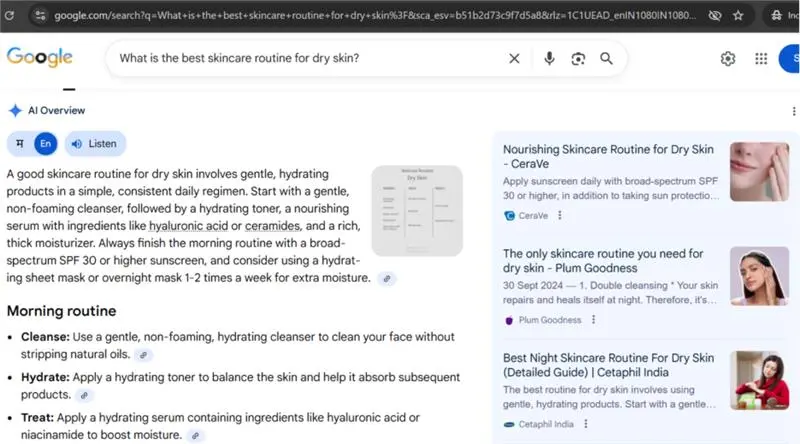
When a user asks, “What is the best skincare routine for dry skin?” Google’s AI may generate a short overview using several trusted sources. If your website provides clear, structured, and helpful information, it can become one of the sources quoted or linked in that overview.
AI SEO brings together many disciplines like Answer Engine Optimization (AEO), Generative Engine Optimization (GEO), Natural Language Processing (NLP), and structured data. Together, they help businesses stay visible in this changing search landscape.
How Search Evolved: From Keywords to Conversations
Search used to be simple. People typed keywords, and Google matched them to web pages. Over the years, as users started asking full questions and using voice search, Google’s systems learned to understand meaning instead of just words.
The biggest leap came with Generative AI. With the rollout of Search Generative Experience (SGE) in 2023, Google began using large language models to generate instant answers. By 2024 and 2025, this evolved into AI Overviews and later AI Mode, which appeared in many countries, including India.
Now In 2026, search is conversational. These AI features are going to be deeply integrated into search results. Users can read an answer, explore cited links, or even ask follow-up questions. The result is a more natural and interactive search experience. For marketers, however, it means adapting fast. The pages that used to win through backlinks and keywords now need to earn trust through structure, authority, and relevance.
The Core of AI SEO: How It Works
To understand AI SEO, we first need to see how AI search systems work behind the scenes.
1. Understanding Language:
AI-powered systems employ Natural Language Processing to interpret the underlying meaning of a user’s query. They analyze entities, relationships, and context, rather than simply looking at words.
2. Finding Reliable Sources:
AI looks through the internet for the most accurate and truthful pieces of content that would answer the question. It selects the information that is well-organized, comes from trusted sources, and is supported by consistent data.
3. Generating the Answer:
Artificial intelligence drafts a brief write-up that combines the best of the chosen sources once the sources are approved. Besides, the AI can also present the links of the online resources that it has used.
4. Updating Continuously:
AI technologies are always evolving and improving. If your content is stale or not user-friendly, you may quickly lose the traffic to your site.
This is why AI SEO is more dynamic than traditional optimization. You are not just trying to please an algorithm. You are training an intelligent system to recognize your brand as an authority.
The Building Blocks of AI SEO
There are four key pillars that make up a strong AI SEO foundation.
- Answer Engine Optimization (AEO):
Answer Engine Optimization focuses on structuring content around questions. Each article should answer “what,” “why,” “how,” or “when” queries clearly. Simple summaries, short paragraphs, and FAQ sections make it easy for AI to pull accurate snippets.
- Generative Engine Optimization (GEO):
GEO is about improving how AI systems select and use your content when generating new answers. It involves creating content that is context-rich, verified, and written in a way that aligns with how people naturally ask questions.
- Structured Data and Schema:
Schema markup helps AI systems understand what your page contains. Tags like FAQPage, HowTo, Organization and Speakable describe your content in machine-readable form. It tells AI, “this page explains a process” or “this section answers a question.”
Schema Example:
{

"@context":"https://schema.org",

"@type":"FAQPage",

"mainEntity":[{"@type":"Question","name":"What is AI SEO?","acceptedAnswer":{"@type":"Answer","text":"AI SEO helps content appear inside AI-generated answers such as Google AI Overviews."}}]

} - Topical Authority:
AI models value expertise. Building clusters of content around a single theme, such as “AI SEO optimization” or “local SEO,” helps show consistency and trust. When several related pages connect to each other, the AI identifies your website as a go-to source.
These building blocks work together to increase your visibility inside AI Overviews, voice results, and conversational search experiences.
Why 2026 Is a Turning Point for Marketers
By 2026, most search engines are using AI in some form. Google’s AI Overviews have expanded across regions and languages, and other platforms like Google Gemini AI, Bing Copilot, Perplexity AI, ChatGPT Search, You.com, and Claude Search are following similar models.
For digital marketers, this means the SEO game has new rules. Ranking on the first page is no longer enough. You now need to appear in the answers themselves. Visibility has moved from “position” to “presence.”
AI SEO is not just another update. It represents a complete change in how we create and measure content success. Brands that adapt early are already seeing better organic reach and higher trust scores, even when clicks are fewer.
How AI SEO Works in Practice
Now that we know what AI SEO means, let’s look at how it plays out in real life. The goal is to make your website and content easy for both humans and machines to understand.
- Research intent: Study real queries and match the underlying goal—learn, compare, or buy, before drafting.
- Write clear answers: Tackle one core question per page with a crisp upfront summary, then add examples, details, and links.
- Add structured data: Use schema to label page type, so systems interpret and display it correctly in AI features.
- Stay consistent: Keep stats, claims, and steps aligned across pages to strengthen reliability and trust.
- Build authority: Create interlinked clusters of blogs, case studies, and FAQs around your core topics to grow topical depth.
These simple, strategic moves form the backbone of effective AI SEO in 2026.
How AI SEO Benefits Businesses and Marketers
The impact of AI SEO goes far beyond rankings.
For businesses:
- Greater visibility in conversational and voice searches.
- Stronger brand credibility when cited in AI results.
- More meaningful traffic from users who already understand your expertise.
For marketers and SEO professionals:
- A shift from keyword research to intent mapping.
- New ways to measure success through impressions, mentions, and brand recall.
- The ability to align content, ads, and data for holistic growth.
In short, AI SEO is not only reshaping how content is found but also how digital marketing strategies are built.
The Role of Local SEO in the AI Era
AI has not replaced the local SEO. In fact, it has made it even more important. When people search for services nearby, Google’s AI still relies heavily on local data to provide accurate answers.
For example, if someone searches “best SEO agency in Pune,” the AI Overview will combine your Google Business Profile, website information, and customer reviews to decide whether your business deserves to appear in the summary.
To make the most of this, every local business should:
- Keep its Name, Address, and Phone number (NAP) consistent across all platforms.
- Update its Google Business Profile with recent photos, posts, and FAQs.
- Encourage reviews that naturally include service-related keywords.
- Add LocalBusiness schema and GeoCoordinates to the website.
AI also considers signals like proximity, relevance, and reputation. A local business with complete and regularly updated information is more likely to be featured in an AI answer or map snippet.
This is why many small businesses now look for an AI SEO agency or a local SEO services provider that understands both traditional and AI-based visibility methods.
How AI SEO Is Measured in 2026
In the world of AI search, success looks a little different. Ranking number one is no longer the only measure of achievement.
Here’s what you should track instead:
1. Impressions instead of clicks
AI Overviews often display your information without requiring a click. So even if traffic numbers do not rise, impressions can tell you that your content is being seen and trusted.
2. Appearance in AI-generated answers
Check whether your pages are appearing in AI Overviews or similar features. Tools and reports in Google Search Console are slowly expanding to include these metrics.
3. Query patterns
Notice if you start receiving traffic from longer, conversational queries. This means your content is being recognized for voice or AI-driven searches.
4. Engagement quality
AI search often drives more informed visitors. Track dwell time, scroll depth, and interaction with calls to action.
5. Brand mentions and citations
When AI systems quote or refer to your business name, even without a link, it builds brand authority.
The key idea is to focus on visibility over vanity metrics. AI SEO success is about being found in meaningful contexts, not just in rank lists.
Challenges and How to Overcome Them
AI SEO brings many advantages, but it also has its challenges.
1. Frequent algorithm updates
AI-driven systems are evolving quickly. What works today might not work a few months later. The best solution is to keep content updated and relevant. Refresh important pages regularly.
2. Over-optimization
Adding too many keywords or forcing “AI-related” phrases can make your writing sound unnatural. Always write for people first. The AI will follow the same logic.
3. Accuracy and source trust
If your content contains outdated or conflicting information, the AI might skip it. Use reliable data and include citations where necessary.
4. Lack of clear reporting tools
Not all platforms have detailed analytics for AI visibility yet. Until they do, combine qualitative observations (such as brand mentions) with traditional SEO data.
AI SEO is still new, but the learning curve is worth it. The businesses that adapt early will build strong trust and visibility in this new environment.
Real-World Impact: How AI Is Reshaping Marketing in 2026
Across industries, AI SEO is changing how marketing teams plan, write, and measure content.
1. Strategy and planning
Marketing strategies now begin with intent mapping instead of keyword density. Teams study how people ask questions online and design their content around those patterns.
2. Content creation
Writers use AI tools to structure articles, check tone, and identify missing topics. The focus is on clarity, credibility, and completeness.
3. Paid and organic synergy
Paid ads are being shaped by insights from AI Overviews. If an overview highlights specific benefits or trends, marketers use the same points in their ad copy to align with user expectations.
4. Data and analytics
Marketing dashboards are shifting from simple keyword tracking to semantic performance metrics. These show how well a brand is performing for entire topic clusters rather than individual keywords.
5. Personalization
With AI understanding user context better, marketers can serve dynamic content based on behavior, location, and interest without compromising privacy.
The result is a smarter, leaner marketing model where creativity and data science go hand in hand.
Governance, Trust, and the Human Touch
AI-generated summaries are only as reliable as the information they pull. This makes trust the most valuable currency in digital marketing.
Brands must ensure that all published content is accurate, transparent, and verifiable. Author profiles, credentials, and fact-checking processes help reinforce credibility. For sensitive sectors such as healthcare or finance, including disclaimers and expert reviews can prevent misinterpretation.
Regular audits are also essential. If an AI-generated summary misrepresents your business, take steps to update your content and notify the platform. A proactive approach builds long-term reliability and reduces misinformation risks.
In 2026, the businesses that combine authentic human insight with machine understanding will stand out. AI can process data faster, but only people can add empathy, context, and experience to the message.
The Future of AI SEO and Generative Search
AI SEO is the direction in which digital marketing is heading. In 2026, the biggest search platforms are powered by generative models that can understand meaning, context, and tone. The next phase is not about adding more keywords but about building semantic ecosystems where your website becomes a trusted source of truth.
In the future, search will feel more like a conversation than a query. People will talk to their devices naturally and expect clear, accurate answers. Brands that prepare now will not only appear in those answers but will also build deeper connections with their audience.
To stay ready, focus on three things:
- Keep your content simple, credible, and regularly updated.
- Add structure and context using schema markup and linked data.
- Build a reputation through expertise, reviews, and transparent communication.
How AI SEO Will Continue to Transform Marketing
The coming years will bring even more changes. Here are a few trends already visible in 2026:
1. Voice-first content: As voice assistants become smarter, AI SEO will merge with voice optimization. Businesses will need to make their answers sound conversational and natural.
2. Visual and multimodal search: AI systems will use images, charts, and even videos to create summaries. Optimizing visuals with clear descriptions will become standard practice.
3. Real-time personalization: AI will tailor results to individual preferences. Localized and behavior-based content will hold greater value.
4. Blended reporting: Traditional analytics will merge with semantic visibility metrics, giving marketers a complete view of how users engage with their brand through AI.
The future will belong to marketers who adapt quickly, experiment often, and treat AI as a creative partner rather than a threat.
Building the Future of SEO, Together
We have reached a moment where search is becoming intelligent and intuitive. At Savit Interactive, we have seen how AI SEO is reshaping digital marketing across India and beyond. Our focus is on helping businesses stay discoverable through AI-driven optimization, Answer Engine Optimization, and Local SEO strategies that reflect how users actually search today.
As a leading SEO services company in India, we believe that the future of digital visibility lies in aligning technology with trust. The search landscape will keep evolving, but our goal remains the same: to help brands stay relevant, findable, and future-ready in the age of AI.
FAQs
1. What is AI SEO in simple terms?
It is the process of optimizing your website so that AI-powered search systems can understand, summarize, and feature your content in their answers.
2. What makes AI SEO different from traditional SEO?
Traditional SEO focuses on ranking links, while AI SEO focuses on being included in AI-generated answers and conversational results.
3. What is Generative Engine Optimization (GEO)?
It is a newer branch of SEO that ensures your content performs well inside AI-driven search engines that generate responses instead of lists.
4. How long does AI SEO take to show results?
Like traditional SEO, it takes consistent effort over months. However, high-quality, structured content can start showing AI visibility within a few weeks.
5. Can small businesses benefit from AI SEO?
Absolutely. Local businesses that maintain accurate data, consistent profiles, and user-focused content can easily appear in AI Overviews and voice searches.