Generative engine optimisation and answer engine optimisation both suffer from the same measurement problem: the win often happens without a click. A borrower, buyer or patient reads a synthesised answer, absorbs a recommendation, and arrives weeks later through a branded search that no analytics package will attribute to the citation that caused it. Measuring the return therefore means accepting partial evidence from four sources and refusing the single tidy percentage that tools are happy to invent.
Key Highlights
- There is no separate report: Google states that AI Overviews and AI Mode activity appears in Search Console within the Web search type, so the trend is directional rather than attributable to one surface.
- Referral data undercounts badly, because most generative answers are read without a click, which makes self-reported attribution the most useful instrument a marketing team has.
- A fixed prompt panel is the only direct measure of citation share, and its value comes entirely from keeping the prompts and the schedule unchanged.
- Google reports that clicks from pages with AI Overviews are higher quality, with users spending more time on the site, which affects how the sessions you do get should be valued.
- Expect an 8 to 12 week lag, since Google notes recrawling can take from several days to several months.
Why Is AEO and GEO ROI Harder to Measure?
Three structural reasons, and none of them is a tooling gap that a purchase will close, which is why AEO marketing budgets are easier to spend than to justify. The first is the zero-click answer, which is why AEO services are judged on influence rather than on sessions alone. When a generative engine resolves a question in its own words, the citation delivers awareness and credibility without a session, so the value lands outside the measurement system entirely.
The second is reporting granularity, and it is the reason generative engine optimisation resists clean attribution. Google’s documentation is explicit that AI Overviews and AI Mode performance sits inside the Web search type in Search Console rather than as a separate breakdown, so an improvement there cannot be cleanly isolated from classic search movement. Anyone promising a dedicated AI Overviews optimisation dashboard sourced from Google data is either inferring it or inventing it.
The third one is query fan-out. According to Google, their artificial intelligence technology creates multiple searches based on one prompt, and this way a brand is credited with being mentioned in response to a question that was never asked. This is commercially good but analytically messy, since the keyword for which credit was given might not be used anywhere in the plans. LLM SEO reporting built around a tracked keyword list will therefore miss much of what is actually working.
What Can You Actually Measure Today?
Four sources, each partial, and the discipline is to read them together rather than to pick the flattering one.
| Source | What it tells you | What it cannot tell you | Cadence |
| Search Console | Impression and click trends for pages cited by AI surfaces, inside the Web search type | Which surface drove the change | Weekly, reviewed monthly |
| Assistant referrals in analytics | Sessions and conversions from people who clicked through from an assistant | Anything about readers who did not click | Continuous |
| Prompt panel | Whether the brand appears for a fixed set of prompts, and which page was cited | Volume, or how many real users asked that prompt | Monthly, same prompts |
| Server logs | Which AI crawlers fetched which pages, and the response they received | Whether the content was then used in an answer | Weekly during changes |
| Self-reported attribution | How buyers say they found you, including named assistants | Precision, since recall is imperfect | On every enquiry form |
Row five is also where most companies tend to overlook, and where the majority of the time a discussion on a board is altered. Asking one simple open-ended question about how the customer learned about the company via the enquiry form is enough to determine the impact of zero-click, which will never be documented in any log files. Without this, GEO service is handicapped.
How Do You Build a Citation Baseline?
Answer engine optimisation is measured here or it is not measured at all, so start with a prompt list drawn from real buying questions rather than from keyword tools. AI SEO optimisation work should be measured against a panel of this kind, and thirty to fifty prompts is enough for a mid-sized business, spread across the stages a buyer moves through: what a service is, how to choose a provider, what it costs, who the providers are in a given city, and the comparison questions a shortlist generates.
Fix anything that might change between checks, because if the way you measure AEO services changes, you cannot reliably measure them. Write down the exact prompt, engine used, date, whether or not the brand appeared, what page was referenced, and what competitors appeared on the page. Run the same checks on a regular schedule (ideally monthly) and keep the prompt list unchanged between runs. Otherwise, you lose the consistency you need to compare results over time. If you can afford it, run each prompt several times in the same session. AI answers can vary from run to run. So a single check is not very informative on its own.
The output of the panel is citation share, which is the percentage of your prompts where the brand makes an appearance at all, and the percentage where it makes its first appearance in the top two or three cited sources. Measured over the course of several months, this is the most precise measure we have of AI search performance.
Which Metrics Map to Business Value?
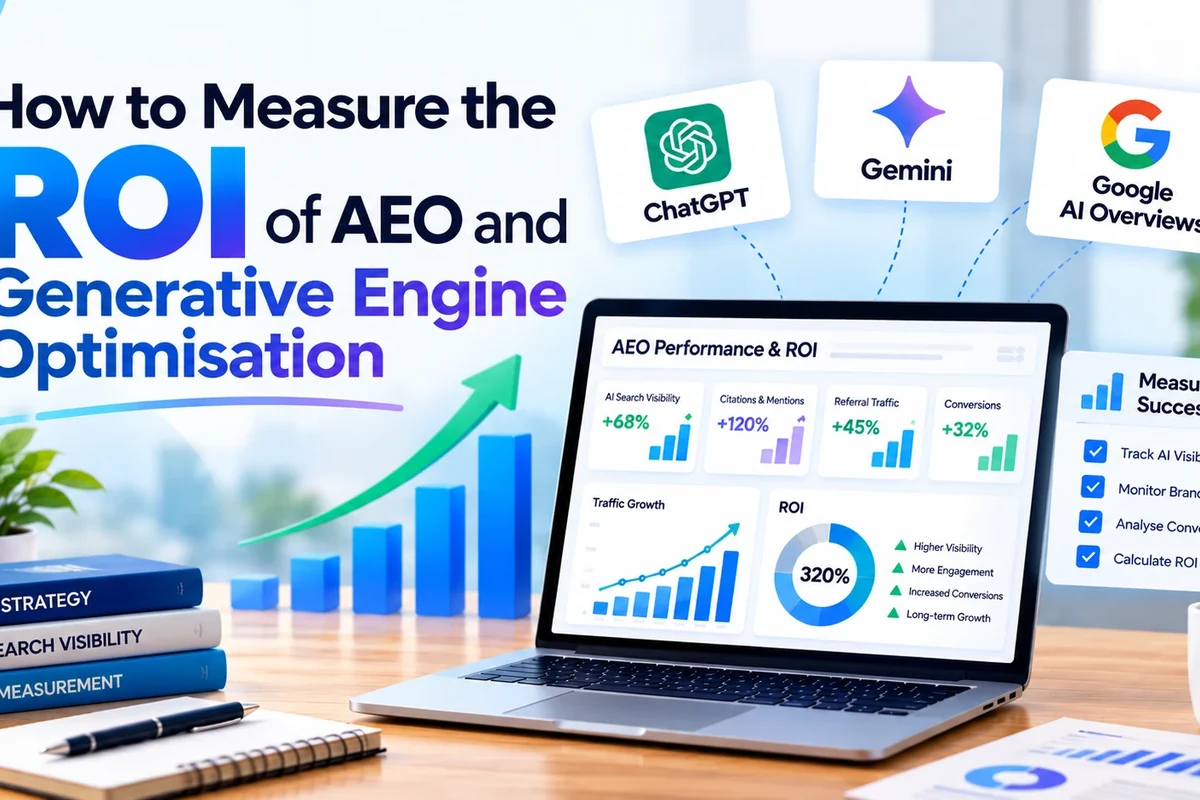
The chain from presence to revenue runs in four steps, and answer engine optimisation has an honest measure at each one. Citation share measures presence. Assistant referral sessions measure the fraction who clicked. Conversion rate on those sessions measures quality, and Google’s own observation that clicks from pages with AI Overviews are higher quality, with users spending longer on the site, is worth testing against your own numbers rather than assumed.
It fills the hole for everything in between and is the one and only tool that makes GEO services responsible. Whenever the buyer states that they sought advice from ChatGPT, it is all the proof you can find for an influence that has not resulted in any sessions. Measured monthly as a percentage of all enquiries, it turns zero-click influences into something that finance departments can consider directional evidence.
There are two secondary metrics worth tracking carefully. The branded searches and direct traffic increase whenever the brand is being recommended within answers, but they have a dozen other reasons for that too, so consider them just as corroborating and never as definitive. AEO marketing measured just by branded searches and direct traffic is just the correlation dressed as attribution.
How Do You Calculate the ROI?
Write the return on generative engine optimisation as a net benefit expression with every term sourced. Value equals attributable sessions multiplied by conversion rate multiplied by value per conversion, plus influenced enquiries captured through self-reported attribution multiplied by the same conversion value, minus the cost of the programme including content, technical work and internal time. Divide by cost for a return, and divide annual cost by monthly net benefit for a payback period.
The importance of the second term is shown in a figure. For example, a firm may have 120 assistant referral sessions per month at a 3 per cent conversion rate, or roughly four enquiries. Separately, they find that 11 enquiries per month mention an AI assistant in the attribution field. On those assumed numbers, the influenced volume is almost three times the clicked volume. A programme judged on referral sessions alone would be reported at a third of its actual contribution. These figures are illustrative and not definitive; it is the ratio that matters and not the numbers.
And then test the negative side properly, because when AEO marketing reporting comes to its best case, the one that gets attacked is the best case. Split the influenced number in half for the possibility of recall error and see if it holds up. Strip away all branded search lift, because this is the most difficult to attribute of the terms. An attribution model that only works under the most favourable assumptions is not really measured.
GEO vs SEO: Do the Same Metrics Work?
Mostly, with two differences that matter once generative engine optimisation is being reported alongside classic search. The GEO vs SEO measurement gap is not about which metrics exist but about which ones carry the weight: classic search reporting leans on rank and click-through, while generative measurement leans on citation share and self-reported influence, because position has no clean analogue inside a synthesised answer.
The second point is the unit. Classic reporting is done by keywords, while generative reporting works better when done on question clusters since fan out ensures that the one page receives citations from a family of prompts. The citation share becomes higher, while teams reporting using tracked keywords receive straight lines.
What carries over is the foundation. Google’s guidance of May 2026 treats optimising for generative AI features as part of SEO, since its AI features run on core Search ranking and quality systems, which means the technical and content work behind AI SEO optimisation is the same work, measured differently.
What Does a 90-Day Measurement Plan Look Like?
- Weeks 1-3, Instrument: Include the attribution question on every enquiry form, include assistant referrals in the metrics for analysis, confirm access to Search Console and Web search only caveat, and begin gathering AI crawler behaviour data from the logs.
- Weeks 4-6, establish the benchmark: Create and lock down the prompt panel and run it once for the engines that matter to your clients, noting presence, cited page, and competitors on the day of the run.
- Weeks 7-10, remain constant and publish: Do not change anything about the metrics mid-period because the comparison will be meaningless if you do.Weeks 11 to 13, read and report: Re-run the panel, compare citation share, assistant sessions and attributed enquiries against the baseline, and report the three together with the lag caveat stated.
The sequence matters more than the speed. A baseline set after the content work has begun cannot show the change the work produced, which is the most common reason AEO programmes end up argued about rather than evidenced.
Which Numbers Should You Refuse to Report?
There are three types that do far more harm than good. First, proprietary scores for visibility from tools, where a complicated methodology gets boiled down to a number that simply cannot be compared to anything on which the client has data. Then there’s share-of-voice percentages from a vendor prompt sample, measuring the sample and not the market. Finally, any ROI percentage without the underlying assumptions is the number most likely to come back to haunt you.
Two others are open to scepticism. Impressions from the surface of AI, which Google does not disaggregate, making the figure cited an inference. And citation counts between engines as if ranking them, when each has its own search algorithm and its own update cycle.
The honest approach has more strength than meets the eye. The report citing the proportion of citations, the number of assistant calls, the attributed queries and the delay between the effort and the result, naming the gaps, survives questioning. The confident number does not.
How Does Savit Measure AI Search Performance?
At Savit Interactive, we instrument before we publish, because a programme without a baseline cannot be defended at the end of the quarter. Our AEO services and GEO services run inside the same organic search programme rather than beside it, so the measurement pack carries citation share from a frozen prompt panel, assistant referral sessions, self-reported attribution from enquiry forms and the crawler evidence from server logs, each with its own caveat written in. Working from Mumbai since 2004 across apparel, B2B, healthcare and pharma, education, ecommerce, logistics, manufacturing and AI and LLM businesses, we publish the method in our AI SEO Playbook, and brands evaluating an AEO agency, an AI SEO agency or a GEO company should ask each of them for the measurement plan before the content calendar, since that is the document that will decide whether anyone can tell what worked.
Frequently Asked Questions
How do you measure the ROI of answer engine optimisation?
Through the amalgamation of four different partial measures: Search Console trend analysis for the cited URLs, referral sessions from the assistant in the analytics, citation share of the fixed prompt panel, and attribution by means of enquiry forms. It is the latter that is more important, since generative responses are generally read without clicks.
Can Search Console show AI Overviews performance separately?
No. As per Google’s documentation, AI Overviews and AI Mode are part of the Web search category without a specific breakdown; therefore, an AI impressions statistic displayed by any other service is necessarily estimated. The Change in Search Console can still be valuable as an indicator of direction for known citations.
What is a realistic timeline before results show?
Since Google specifies that recrawling could take anywhere between several days and several months, 8 to 12 weeks would be a fair starting point for conducting the initial check. Fixes related to technical eligibility have a quicker registration than those related to content depth.
How is AI SEO optimisation measured once AEO services are running?
Through citation share from the frozen prompt panel, assistant referral sessions and their conversion rate, and the share of enquiries naming an assistant. Read the three together, since each one on its own is misleading.
How many prompts should a citation panel contain?
Thirty to fifty for a mid-sized business, covering definition, selection, cost, local provider and comparison questions. The exact number matters far less than keeping the list and the schedule unchanged between runs, since a changed instrument cannot produce a trend.
Does AI search traffic convert better than classic search traffic?
Google reports that clicks from pages with AI Overviews are higher quality and that users spend more time on the site, which is consistent with a reader arriving after an answer rather than while still exploring. Test it against your own conversion data rather than adopting it as an assumption, since it varies by category.
What should an AEO or GEO proposal be asked to include?
Whether it is sold as answer engine optimisation or as GEO services, ask for a measurement plan with the baseline set before any content work begins, a named prompt panel, the attribution instrument it will rely on, and an explicit statement of what it cannot measure. AEO marketing that promises a visibility score and no baseline is proposing a report rather than a result.
What Should You Report to the Board?
Four numbers and one caveat. Citation share against the baseline, assistant referral sessions and their conversion rate, enquiries where a buyer named an AI assistant, and the cost of the programme. The caveat worth stating is that generative engine optimisation produces answers frequently read without a click, so the reported figures understate influence rather than overstate it, which is an unusual and useful position to be in.
Our experience at Savit Interactive is that the firms getting value from AI-powered SEO are the ones that added one question to an enquiry form before they changed a single page. Doing SEO with AI tools can make the work faster, and AI SEO services can make a site eligible and quotable, but neither answers the question a board actually asks, which is what changed and how you know. Instrument first, publish second, and report the gaps alongside the gains.