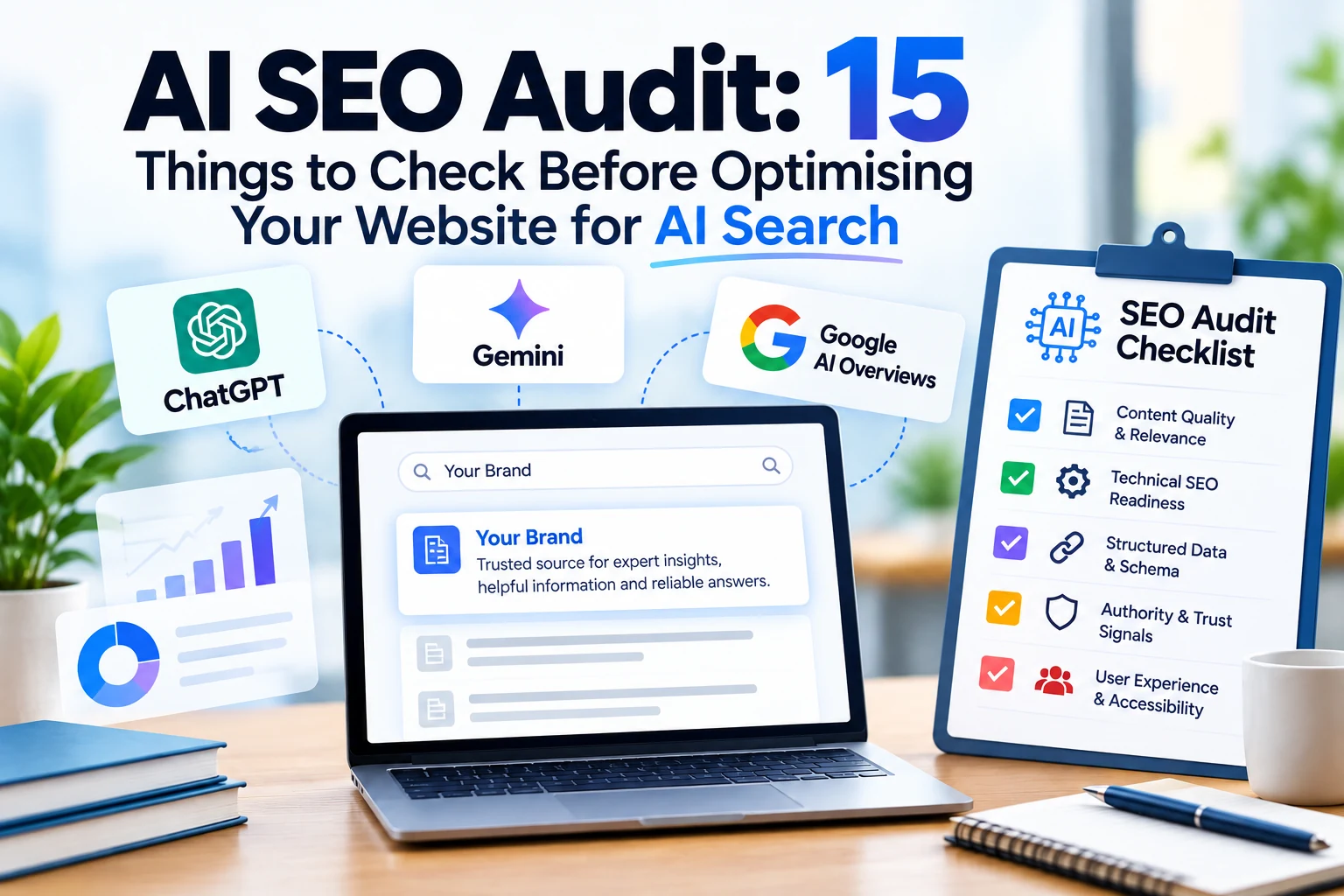
AI SEO optimisation usually fails for reasons that have nothing to do with content. A page that no AI crawler can reach, an inherited snippet restriction, a content delivery network quietly challenging requests, or two different founding years on two different pages will each cost a brand citations while the content calendar carries on regardless. An audit answers a narrower question than a strategy does: is this site even in a position to be cited, and if not, which of the fifteen usual culprits is responsible.
Key Highlights
- Access is checked per crawler, not once: Googlebot, OAI-SearchBot and GPTBot are three separate permissions, and server logs are the only proof that any of them arrived.
- Your CDN may be deciding for you: Cloudflare introduced separate controls for search, AI training and AI agents, with new defaults taking effect on 15 September 2026, so a setting nobody in the marketing team chose can suppress AI access.
- One setting can remove you from search entirely: blocking AI training at the edge also stops multi-purpose crawlers such as Googlebot, Bingbot and Applebot, because the same crawler serves both purposes.
- Snippet eligibility and rendering decide extractability long before wording does.
- Trust signals are part of the audit: named authors, dated figures, reachable contact details and consistent entity facts all affect whether an engine will summarise a brand confidently.
What Is an AI SEO Audit, and Why Run One First?
An AI SEO audit is a diagnostic pass over access, indexing, rendering, content structure and trust signals, carried out before any AI SEO optimisation work is commissioned. It produces a list of defects with evidence rather than a list of recommendations, which is what separates it from a proposal.
The phrase AI SEO is used for two different jobs, and conflating them wastes money. The first is optimising a site so AI search surfaces can find, quote and attribute it, which is what the fifteen checks below address. The second is doing SEO with AI, meaning using language models to speed up research, clustering, drafting and reporting. AI-powered SEO in that second sense changes how a team works, not whether a page is eligible to be cited, and a brand that invests only there will produce more content on a site that still cannot be read.
Google’s position is that its AI features run on core Search ranking and quality systems, so the groundwork overlaps almost entirely with classic technical SEO. That is good news for anyone with a maintained site and bad news for anyone hoping a new tactic will compensate for neglected infrastructure.
Which Access and Crawl Checks Come First?
Check 1, robots.txt read agent by agent. Treat Googlebot, OAI-SearchBot, GPTBot and ChatGPT-User as four separate decisions rather than one AI question. OpenAI’s documentation states that a site opted out of OAI-SearchBot will not be shown in ChatGPT search answers, and that blocking GPTBot to prevent training use does not affect search eligibility, so a blanket disallow copied from a template is usually the costliest line in the file.
Check 2, the content delivery network and firewall. Edge configuration can override intention. Cloudflare replaced its single block switch with separate controls for search, AI training and AI agents, announced in July 2026 with new defaults applying from 15 September 2026, and reporting on the change notes that choosing to block training also stops Googlebot, Bingbot and Applebot, since those crawlers serve more than one purpose. Any audit should open the dashboard rather than assume, and confirm the result in logs.
Check 3, server log evidence. Filter the last 30 days of logs by user agent and record which AI crawlers arrived, how often, and which status codes they received. Absence is a finding. A pattern of challenges or 403 responses to a named agent is a stronger finding, because it means the site is refusing a crawler the marketing team believes is welcome.
Check 4, rate limiting and bot management rules. Aggressive rules intended for scrapers frequently catch legitimate search and AI agents. Check whether limits apply by user agent, by network or by request volume, and whether any rule was added during an incident and never reviewed.
Which Indexing and Rendering Checks Matter?
Check 5, index coverage on pages that matter. Run the page indexing report and then verify the twenty commercially important URLs individually in URL Inspection. A page excluded as a duplicate or marked crawled but not indexed cannot be cited, whatever its content says.
Check 6, canonicalisation and near-duplication. Parameter URLs, printer versions, location pages built from one template and syndicated copy all split signals and give an engine several candidates for the same answer. Google lists reducing duplicate content among its foundational recommendations.
Check 7, rendering of load-bearing passages. Compare the rendered HTML with the source for the pages that carry key claims. Anything injected by script, hidden inside a click-to-open element or delivered as an image is at the mercy of how each crawler renders, which makes it unreliable as the sentence you want quoted.
Check 8, snippet controls at template level. Look for nosnippet, data-nosnippet and restrictive max-snippet values, since Google ties AI feature appearance to pages that can be shown with a snippet. These settings are almost always inherited from a template decision rather than chosen per page, so audit the template and not the URL.
Which Content and Trust Checks Belong in the Audit?
Check 9, answer structure per section. Read the first two sentences under each heading and ask whether they answer the heading. Pages that build to an answer in the fourth paragraph are harder to quote than pages that lead with it, which is a structural defect rather than a writing preference.
Check 10, sourcing and dates. Make sure every statistic includes its source and date. Figures without sources are less useful to readers and harder for search engines to verify when different claims conflict. Without a date, even accurate information can slowly become outdated.
Check 11, author and publisher signals. Check that articles carry a named author with a real biography, that the about and contact pages are complete, and that the organisation behind the site is identifiable. Google’s guidance on people-first content puts expertise and trustworthiness at the centre, and an engine summarising a brand draws on the same material a reader would.
Check 12, entity consistency. Compare founding year, office addresses, telephone numbers, team size and service names across the website, the Google Business Profile and any directory listing. Contradictions are common after a rebrand or an office move, and they make a brand harder to summarise with confidence.
Which Structure and Measurement Checks Close It Out?
Check 13, heading hierarchy and internal linking. One H1 per page, headings that describe what follows, and internal links that let a crawler reach important pages in a few hops. Orphaned pages and decorative heading levels are both common and both cheap to fix.
Check 14, structured data validity and honesty. Validate markup, remove types that no longer produce anything, and confirm that every marked-up claim appears in visible text. Google stopped showing FAQ rich results on 7 May 2026 and withdrew the related reporting and testing support over the following months, so FAQ markup can stay in place but should no longer be counted as a deliverable.
Check 15, measurement baseline. Confirm Search Console access and note that AI Overviews and AI Mode activity sits inside the Web search type, set up referral tracking for assistant traffic, and record a fixed set of prompts with the date tested so there is a before to compare against. An audit without a baseline produces opinions about progress three months later.
What Does the Full 15-Point Checklist Look Like?
| # | Check | What a pass looks like | Where to look |
| 1 | robots.txt per agent | Each AI agent allowed or blocked deliberately | robots.txt |
| 2 | CDN and firewall rules | AI categories set by choice, not by default | CDN dashboard |
| 3 | Crawler arrival evidence | Named AI agents present with 200 responses | Server logs |
| 4 | Rate limiting | No rule challenging legitimate search agents | Bot management rules |
| 5 | Index coverage | Priority URLs indexed | Search Console |
| 6 | Canonicalisation | One canonical per piece of content | Crawl report |
| 7 | Rendering | Key claims present in rendered HTML | URL Inspection |
| 8 | Snippet controls | No inherited nosnippet or tight max-snippet | Templates |
| 9 | Answer structure | First two sentences answer the heading | Manual read |
| 10 | Sourcing and dates | Every figure sourced and dated | Content sample |
| 11 | Author and publisher signals | Named authors, complete about and contact pages | Site review |
| 12 | Entity consistency | Identical facts across site, profile and directories | Comparison sheet |
| 13 | Headings and internal links | Clean hierarchy, no orphans | Crawl report |
| 14 | Structured data | Valid, matching visible text, no dead types | Rich Results Test |
| 15 | Measurement baseline | Prompt panel and Search Console baseline recorded | Reporting setup |
Checks 1 to 8 are binary and can be completed in a few days. Checks 9 to 12 need a content sample and a judgement call. Check 15 takes an hour and saves an argument later.
How Long Should an AI SEO Audit Take?
- Week 1, access and indexing: Work through checks 1 to 6, because every later finding depends on whether crawlers can reach the site and whether pages are indexed at all.
- Week 2, rendering and snippet controls: Complete checks 7 and 8 across templates rather than individual URLs, and log every setting changed with the date it changed.
- Week 3, content and trust sample: Apply checks 9 to 12 to the twenty pages closest to revenue, since a full content audit at this stage delays the fixes that matter.
- Week 4, structure, markup and baseline: Finish checks 13 to 15, then write the findings as defects with evidence and an owner, not as recommendations.
AI SEO optimisation work should begin only once the access and indexing findings are closed. Four weeks is realistic for a mid-sized site and generous for a small one. Anything quoted as a one-day AI audit is a crawl report with a new cover.
Where Do Audits Usually Go Wrong?
Three failures recur. The first is auditing content before access, which produces a content plan for pages nobody can read. The second is accepting tool output as a finding: a crawler reporting that a page is indexable is not evidence that an AI agent fetched it successfully, and only logs settle that. The third is treating the audit as a document rather than a work queue, which is why findings should name the defect, the evidence, the owner and the date. An AI SEO agency that hands over a document without owners has delivered half the job.
A fourth is subtler. Teams often audit against last year’s checklist, so they test for rich result types that no longer exist while missing edge settings introduced months ago. The checklist needs a review date of its own.
How Does Savit Run an AI SEO Audit?
At Savit Interactive, our audits start at the edge and work inwards, because the most expensive problems we find are usually permissions and inherited settings rather than writing. We read robots.txt agent by agent, pull server logs to prove which crawlers actually arrived, check the CDN configuration against what the client believes it says, and only then look at content structure and trust signals. Two decades of Mumbai-based search work, and 5000+ client engagements, have taught us that the same four or five defects surface again and again, which is why we publish the method in the AI SEO Playbook instead of keeping it proprietary. Brands comparing one SEO agency against another should ask each of them for the evidence behind a finding, since a defect with a log line attached is worth more than a score out of 100.
Frequently Asked Questions
What is AI SEO optimisation?
It is the work of making a site findable, readable and quotable by AI search surfaces, covering crawler permissions, indexing, rendering, snippet eligibility, answer structure and trust signals. Google treats it as part of SEO, since its AI features run on the same index and ranking systems, so the practices overlap heavily with classic technical SEO.
How is AI SEO different from using AI tools for SEO?
They are separate activities with the same label. Optimising for AI search changes your website so engines can cite it. Doing SEO with AI changes your team’s workflow, using models for research, clustering and drafting. Both are useful, and only the first affects whether a brand appears in an AI answer.
Can an AI SEO audit be automated?
Partly. Crawling, index checks, markup validation and rendering comparisons are all tool work. Log analysis needs interpretation, and the content, trust and entity checks need somebody to read pages and compare facts, which is where most real defects are found.
Does blocking GPTBot stop ChatGPT from citing a site?
No. OpenAI’s documentation separates the two: GPTBot governs training, while OAI-SearchBot governs whether a site can be surfaced in ChatGPT search answers. A site can decline training and remain citable, which is the configuration most brands actually want.
How often should the audit be repeated?
Access and indexing checks suit a quarterly cycle, since edge settings and crawler behaviour change without notice. Content and trust checks suit a half-yearly cycle. The checklist itself needs reviewing annually, because items expire as features are withdrawn.
What should be fixed first if the budget is limited?
Checks 1 to 3 and check 8, in that order. Permissions, edge configuration, log evidence and snippet eligibility cost very little to put right and determine whether anything else you do has a chance of being seen.
What Should You Do with the Findings?
Turn the audit into a work queue rather than a report. Each finding wants a defect description, the evidence behind it, a named owner and a date, and the queue should be sequenced so access and indexing fixes land before content work begins. Set the review point 8 to 12 weeks out, because Google notes recrawling can take from several days to several months, and judging the work sooner invites the wrong conclusion.
Our experience at Savit Interactive is that most sites pass ten of these fifteen checks and fail the same four or five, usually around edge configuration, inherited snippet settings and contradictory entity facts. Those are a fortnight of work rather than a quarter, which makes the audit the cheapest part of AI-powered SEO and the part most often skipped. Run it before the content plan, not after the results disappoint.