Every year during Flipkart’s Big Billion Days, something unusual happens to the Indian internet.
People who had no intention of buying a television at midnight on a Tuesday find themselves in a checkout flow. The countdown timer. The “Limited stock” label. The urgency-led copy that treats the reader not as a consumer but as someone who is about to miss something everyone else already knows about.
All of this is no accident. This is the psychology of advertising applied at scale and the AI engines making sure those triggers are tested, tweaked, and deployed at a speed that no human team could do alone.
Personalised CTAs convert up to 202% better than generic ones, according to HubSpot’s analysis of over 330,000 CTAs. AI-dynamically generated calls-to-action have converted up to 247% better than static equivalents in large-scale platform tests. Adding urgency signals to a CTA can lift conversion rates by as much as 332%.
These numbers are real. But the reason they’re possible isn’t the algorithm.
It’s the human psychology the algorithm has learned to work with.
This guide covers why we click, what makes a call-to-action genuinely perform, how AI is changing the mechanics of ad copy and CTA optimization, and five things most CTA guides get wrong including why optimized CTAs are quietly failing the brands that rely on them.
The Psychology of Clicking
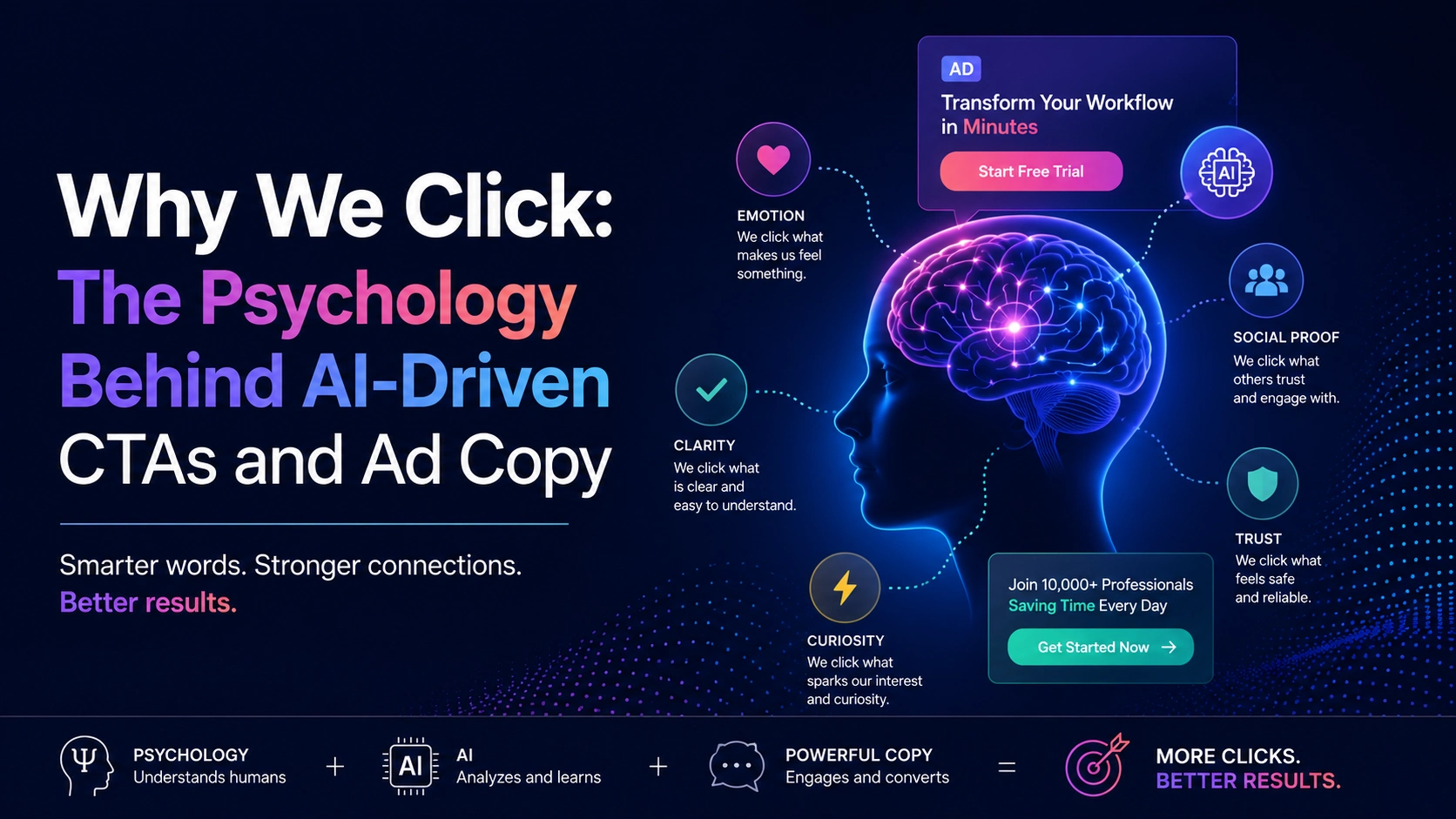
Click psychology is the study of why people take action online: what makes someone tap a button, follow a link, or respond to an ad rather than scrolling past it.
The mechanism is primarily emotional and fast. Marketing scientist Gerald Zaltman at Harvard established through decades of consumer research that the vast majority of purchasing decisions originate in the brain’s emotional centers, below the threshold of conscious deliberation. Emotion decides. Logic justifies afterwards.
For ad copy and CTAs, this means emotional resonance precedes rational arguments. An ad that makes someone feel something urgency, curiosity, belonging, excitement outperforms an ad that explains something consistently.
The IPA data BANK’s analysis of over 1,400 marketing case studies confirms this: emotionally led ad copy outperforms rational equivalents by roughly two to one. Emotional response creates memory. Memory creates recognition. Recognition creates the impulse to act.
The six psychological triggers behind every click:
| Trigger | How it works in CTA advertising | Example CTA |
| Fear of missing out | Scarcity or time limits create perceived irreversibility | “Only 3 seats left claim yours” |
| Curiosity | Opens an information gap; low commitment to explore | “See exactly how we do it” |
| Social proof | Reduces risk through third-party validation | “Trusted by 12,000+ businesses” |
| Reciprocity | Gives value first, prompting a return action | “Get your free strategy guide” |
| Loss aversion | People fear loss more than they value equivalent gain | “Don’t lose your early-bird rate” |
| Authority | Trust through credentials or visible expertise | “Used by India’s top 100 brands” |
The brands that build long-term click performance understand which triggers which audience at which stage of the buying journey. AI helps identify those combinations at scale. Human judgement decides which combinations the brand should actually use.
What Makes a CTA Work
Call-to-action is the bridge between attention and action. Weak CTA copywriting wastes strong creativity. A CTA that is unclear, passive, or generic will underperform regardless of how well-targeted the surrounding ad is.
The data on what changes CTA performance is granular.
High-agency verbs outperform passive alternatives by 27% (Optimizely, across 14,000 A/B tests). “Claim your spot” generates 31% higher CTR than “Learn more.” The difference between an active and a passive verb is not stylistic. It is a commercial.
Singularity matters significantly. A single CTA per page boosts conversion by up to 266%. A single CTA per email increases click rates by 371%. Most pages underperform not because of bad copy but because they ask for too many things at once, diffusing the psychological momentum that took the rest of the ad to build.
Specificity converts. “Get your free 30-minute marketing audit” outperforms “Contact us” because it answers three questions the user is asking simultaneously: what will I receive, how long will it take, and what commitment does this require of me? Every word of ambiguity is a reason to defer the click.
Effective CTA copywriting has three components working together:
- A clear action verb that tells the user what to do
- A specific benefit that tells the user what they get
- An emotional or urgency signal that tells the user why now
The best CTAs feel like a natural next step in a conversation. The worst feels like a demand made by someone who needs the click more than the user needs to give it.
How AI is Changing Ad Copy Performance
AI copywriting applies trained models to generate, test, and optimize digital marketing copy based on behavioral data and performance history. It is pattern-recognition operating at a scale no human team can replicate.
The practical applications in ad copy optimization are specific.
AI generates multiple headline, CTA, and body copy variations simultaneously, runs them against live audiences, identifies which combinations of language, emotional register, and structure produce the best results, and shifts spend toward the winners in real time. For Google Ad copy, this is now embedded in Responsive Search Ads and Performance Max. Google’s AI tests permutations of headline and description combinations against specific query intent signals, device types, and user behaviour patterns.
For paid social media advertising, AI matches copy to intent signals across individual browsing histories. Different users in different stages of the purchase journey receive different versions of the same message, calibrated for where they are rather than where the brand assumes they are.
One case study document this at an unusual scale. JPMorgan Chase, working with AI copywriting platform Persado, tested AI-generated copy against human-written equivalents across millions of ad impressions. According to published case study data, AI-optimized copy achieved up to 450% higher CTR in specific contexts not uniformly across all campaigns, but in ad sets where the AI had sufficient behavioural data to identify the emotional language that resonated with audience segments.
The pattern in that result is instructive. AI performed best where it had the most data. In lower-data contexts, human copywriting held its own. The implication is not that AI always wins. It is that AI wins when the data supply is large enough to distinguish signal from noise.
AI-powered ads in 2026 are also capable of generating visual variants, not just copy, testing creative combinations across image, video, and text simultaneously. The best results come from treating AI as a hypothesis engine generating many options quickly and human judgement as the selection layer that ensures what reaches the audience is on-brand, on-tone, and genuinely differentiated.
Insight 1: The Saturation Paradox
AI CTA optimization has been running at scale across millions of brands for years. The same platforms, the same datasets, the same optimization signals. And the result, across many categories, is that winning CTAs have converged toward the same small set of familiar phrases.
“Get started.” “Claim your free X.” “Join X users.” “Book a demo.” “Try for free.”
These phrases tested well in 2019 and 2020. They spread across the industry because AI tools learned they worked. And then, because they were everywhere, they stopped working as well. The brain learns to recognise optimized patterns and begins treating them as ambient noise.
This is the saturation paradox of AI CTA advertising. The process that identifies high-performing copy distributes it across competitors until the performance advantage is competed away. Because all competitors are using similar tools on similar data, CTAs converge toward the same optimized average.
The CTA that breaks through in 2026 is often the one that breaks the optimized template.
The practical implication: AI is most valuable for optimising performance within established creative territory. It is poor at discovering new territory. Brands that use AI for execution while keeping humans responsible for creative strategy will consistently outperform brands that have delegated both.
Insight 2: When CTR Becomes the Target, It Stops Being a Useful Measure
Here is a version of Goodhart’s Law that the digital advertising industry has not fully reckoned with.
When AI is optimized for click-through rate, it maximizes click-through rate. It writes headlines that generate curiosity without earning trust. It creates urgency that attracts the most impulsive users, not the most qualified ones. It manufactures pressure without ensuring the experience on the other side of the click delivers what the pressure implied.
Clicks go up. Conversion quality drops. Customer lifetime value declines.
This is not hypothetical. Indian EdTech ran this experiment publicly across several years. Multiple major platforms ran aggressively optimized “free demo / free trial / free everything” conversion ads that generated enormous click volumes. The conversion rate from those clicks to paid enrolment, and the retention quality of those enrolments, did not match the optimism of the CTR metrics. The category eventually suffered a structural trust problem that optimized ad copy had partly created.
Conversion ads that perform well over time are optimized not for who will click, but for who will convert and stay.
The practical fix is not to stop using AI for CTA optimization. It is to give AI better goals. Optimize post-click engagement depth, scroll completion after the click, form completion rates, second-page visits, and repeat interactions. These are harder to set up but they tell the AI what the business actually needs, not what is easiest to measure.
Insight 3: India Has Its Own CTA Psychology
This is the section most global ad copy frameworks miss entirely.
In India, “Free” can trigger suspicion rather than action.
Years of spam SMS messages, fraudulent promotional emails, and too-good-to-be-true offers have conditioned significant portions of the Indian internet audience to treat “Free” as a warning signal rather than a value signal. This is the opposite of the psychological mechanism the word exploits in Western markets. Brands running Western-optimized CTA templates in India without adapting for this trust context risk the exact opposite of the intended effect.
WhatsApp CTAs perform differently here than almost anywhere else in the world.
India has the world’s largest WhatsApp user base, with over 487 million users as of 2024 (Meta-disclosed data). For B2B brands, local service businesses, and D2C companies, a “Chat on WhatsApp” CTA consistently outperforms traditional form-based lead capture. The friction removal is significant: the user stays in an environment they already trust, on a channel they engage with dozens of times daily, rather than navigating to a landing page and filling fields. AI-powered ads tools trained predominantly on Western performance data often fail to surface this optimization. The training data simply does not reflect Indian channel preference strongly enough to produce this recommendation reliably.
India’s digital advertising market estimated to have crossed ₹50,000 crore in total digital ad spend by 2024, according to FICCI-EY industry projections has produced a performance marketing culture where speed of trust-building is critical. Cash on delivery as a trust signal is one of the most India-specific conversion mechanisms in existence. For a significant portion of Indian e-commerce buyers, particularly outside the top metros, “COD available” embedded in an ad or landing page CTA produces measurable conversion uplift. It signals that the brand bears the risk, not the buyer. No Western AI CTA training set is going to surface this recommendation.
Language specificity is an almost entirely untested opportunity. India’s next 400 million internet users are vernacular-first. Effective digital marketing copy in Hindi, Tamil, Telugu, Marathi, Bengali, and Gujarati for Indian audiences is largely unclaimed territory. The brands that build this knowledge base now will have a compounding advantage that cannot be bought later.
A digital advertising company operating in India without this cultural intelligence is running a fundamentally incomplete strategy, regardless of how sophisticated its AI tooling is.
Insight 4: The Brand Voice Vs. Performance Tension
A/B testing reliably finds winners. What it optimizes toward is not always what the brand needs.
The CTAs that score highest in head-to-head tests are often the most generic precisely because they are the most familiar. “Get started” wins A/B tests because it removes friction through instant legibility. It also removes the brand from the equation, because any brand could say it.
The CTAs that build brand equity are often more distinctive, more specific to a brand’s voice, and occasionally less immediately legible to a cold audience. They might convert slightly lower in an A/B test and significantly higher with a warm audience that recognises and trusts the brand voice.
Optimising for clicks in isolation produces brand voice erosion over time.
The brands that have built lasting Indian advertising presence Asian Paints, Surf Excel, Tata, Fevicol have maintained strong, specific brand voices in their copy that did not change based on what tested best in any single month. The consistency was the compounding asset.
For AI-powered ads, the practical implication is to run separate optimization streams: a performance-first stream for acquisition campaigns where familiarity is appropriate, and a brand-voice-protected stream for retention, consideration, and loyalty campaigns where distinctiveness matters more. Treating all CTA copywriting as interchangeable is the fastest way to make a brand sound like every other brand running the same AI tools.
The AI-human Workflow for Ad Copies that Convert
Understanding both the power and the limits of AI optimization points toward a specific collaborative approach.
The five stages of an effective AI-assisted ad copy workflow:
- Humans set the strategy. Audience, objective, emotional territory the brand should occupy, guardrails, and what makes this offer genuinely differentiated. AI cannot supply this. It must be given it.
- AI generates variations. Multiple headlines, CTAs, body copy angles. Generating 10-20 variants before selection is standard for serious conversion ads.
- Humans filter for brand voice and cultural fit. Every AI output passes through a human layer before it reaches an audience. This is where market knowledge, cultural awareness, and brand consistency enter.
- AI runs structured experiments. A/B and multivariate testing with properly calibrated goals — not just CTR, but post-click quality signals that reflect real conversion intent.
- Humans derive strategy from AI findings. What does the test data reveal about the audience? What creative hypothesis does this open? AI surfaces patterns. Humans turn them into strategy.
Briefing AI well is where this workflow wins or loses. A strong AI prompt for CTA copywriting includes the audience segment and funnel stage, the desired action and primary benefit, the brand tone with both positive examples and explicit negative examples, the platform (Google Ad copy behaves differently from a social CTA), and a request for multiple emotional registers urgency-led, benefit-led, and curiosity-led variants. Classic frameworks like AIDA (Attention, Interest, Desire, Action) and PAS (Problem, Agitate, Solve) are worth naming explicitly in prompts, as AI tools trained on high-performing copy tend to default to these structures. Specifying them gives the human more control over output structure.
The Conversational Future of CTA Advertising
The shift in search from ranked links to AI-generated answers is beginning to reshape what calls-to-action look like at the point of discovery.
When a user asks an AI engine “What’s the best payment gateway for an Indian startup?”, the response does not give them a list of links. It gives them a synthesised recommendation. The CTA embedded in that experience is not a button. It is a conversational prompt: “Ask a consultant,” “Start your free assessment,” “Compare pricing for your team size.”
CTA copywriting for these surfaces is structurally different from banner or search ad CTAs. It has to feel like a natural continuation of a conversation the user has already started, not an interruption. It requires a different kind of brevity one that assumes the user has received value and is being invited further, not grabbed from cold awareness.
The brands whose digital marketing copy is built for conversational surfaces, not just buttons, will have better AI-era visibility. This is where CTA strategy, GEO, and AEO optimization begin to converge.
How Savit Builds Ad Copy and CTAs That Earn the Click
At Savit, we start with the psychology before we start with the platform.
Before we write a line of Google Ad copy, paid social media advertising creative, or any CTA, we ask: what does the audience who will click it feel about this category? What do they doubt? What would make clicking feel low-risk and high-reward? The answers shape every word. That is advertising psychology applied professionally.
We use AI extensively for what it does best. Ad copy optimization through continuous A/B and multivariate testing. Generating multiple CTA and headline variants before human selection. Matching digital marketing copy to intent signals at the individual level. Running AI-powered ads across Google and paid social media advertising channels with real-time performance data guiding budget allocation.
And yet, every single output is checked by a human before it is released to a live audience. Our copywriters are there to check against brand voice, cultural sensitivity, and that element of contextual judgement an AI can simply never consistently do well enough. For the Indian markets, that’s verifying CTA patterns that have proven effective in India, such as WhatsApp integration, COD trust signals, or vernacular copies where relevant, versus patterns that don’t, such as artificially created “free” offers that lose consumer trust instead.
Our process for conversion ads is deliberate: deep discovery first (audience, intent, regional nuance), then strategy (where AI-powered ads can add maximum leverage), then creation (AI variants refined by senior copywriters), then systematic testing (against goals that reflect real business outcomes, not just click counts), then optimization (AI insights interpreted by human strategists who know what to scale and what to retire).
As your top digital advertising company in Mumbai serving brands across India and the globe, we understand that effective CTA advertising requires Indian cultural intelligence alongside global AI capability. The copy that converts in Chennai is not always the copy that tests best in Chandigarh. The urgency signal that works in a Hindi-language Reels ad is not always the one that works in an English-language LinkedIn ad.
Our work spans CTA copywriting, Google Ad copy management, paid social media advertising, landing page optimization, and full-funnel campaign strategy all combining AI-driven insight with human psychological judgement. Every campaign is built to earn clicks that convert, not just clicks that count.
Talk to Savit about ad copy and CTAs that make the right people click.